By Erin Free
FilmInk salutes the work of creatives who have never truly received the credit that they deserve. In this installment: director Rod Amateau, who helmed Pussycat, Pussycat, I Love You, Where Does It Hurt?, The Statue, The Garbage Pail Kids and more.
The issue of quality has raised its head frequently in the Unsung Auteurs column. While many believe that an auteur is one who creates deeply personal, high-quality work, we see the term differently. To us, an auteur is merely a filmmaker whose work bears an identifiable throughline via either theme, style, tropes, performers or any combination of the latter. In short, you can turn out shit and still be an auteur. That’s not to say that this week’s entrant, the late Rod Amateau, turned out shit, but his feature films are not likely to appear on any critic’s “best of” lists. These film are, however, recognisably his.
Rodney Amateau was born in New York City in 1923 to Rabbi Albert Jean Amateau and Rebecca Amateau, with no family filmmaking connections. Amateau’s entrance into the entertainment industry began while he was in the military service. At the age of just seventeen, Amateau married actress Colleen Gray, who helped him get work as a stuntman. “She got me some work falling out of windows, doubling girls because I’m little,” Amateau told journalist Darrell Y. Hamamoto in the 1970s. “I doubled little men, like Humphrey Bogart and Alan Ladd.”

From stunt work, Amateau moved into various crew roles, including stunt coordinating and second unit directing. His directorial debut came in 1951. “I directed the first movie for television, [the western] The Bushwhackers,” Amateau told journalist Darrell Y. Hamamoto in the 1970s. “I was the second unit director, but the original director got sick or something. It was a sixty-minute movie for CBS. I hadn’t directed anything before this except wagons turning over and stagecoaches going wild.”
Amateau directed the 1952 B-grade programmer Monsoon, and his effective work was duly noticed by some major figures in the burgeoning television industry. Amateau then began what would become a long and successful career on the small screen. His third wife was Sandra Burns, the daughter of comic legends George Burns and Gracie Allen, and Amateau worked extensively on The George Burns And Gracie Allen Show as a producer and director, and then continued in those roles on classic (and some not-so-classic) small screen shows of the 1960s like The Many Loves Of Dobie Gillis, The New Phil Silvers Show, Mr. Ed, Gilligan’s Island, Lassie, My Mother The Car, O.K Crackerby! and many more.
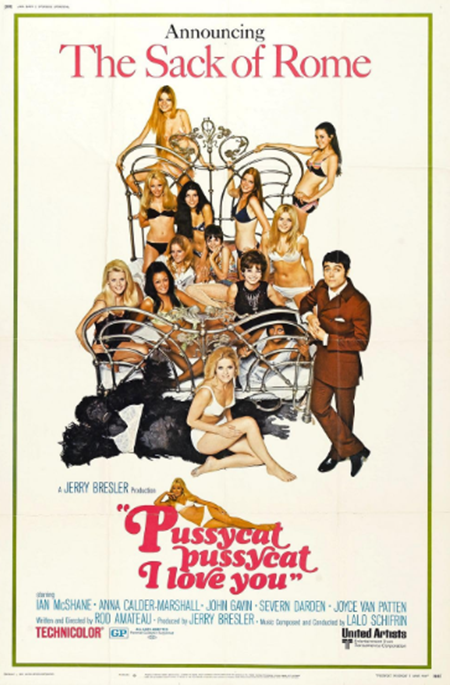
By the late 1960s, Amateau was an old hand at comedy held in high regard by the TV industry, and after co-writing the darkly comic 1969 Jerry Lewis-Peter Lawford feature Hook, Line And Sinker (in which Jerry goes on a mad spending spree when incorrectly told that he’s dying), the TV vet made his major big screen writing and directing debut with 1970’s Pussycat, Pussycat, I Love You, which was shot at Italy’s famed Cinecittà Studios and was intended as a sequel to the 1965 film What’s New Pussycat? A saucy comedy starring Ian McShane as an American abroad addled by neuroses, Pussycat, Pussycat, I Love You would form something of a template for Amateau’s eventual cinematic oeuvre. An auteur of low comedy, many of his films deal explicitly with the subject of male insecurity in highly farcical terms.
Amateau returned to this theme (and to Cinecittà Studios) with 1971’s now forgotten comedy The Statue, in which David Niven expertly plays an insecure Nobel Prize-winning professor who suspects that his beautiful sculptor wife (Virna Lisi), has been cheating on him when she unveils an enormous nude statue of him…complete with a set of night tools that are most definitely not his. A goofy, silly comedy about male anxiety and sexual hang-ups (which features early turns from future comic godheads like John Cleese, Graham Chapman and Tim Brooke-Taylor), The Statue was poorly received, and would certainly raise eyebrows today, but it remains a fascinating curio.

Continuing his run with major comic players (while also continuing to work consistently in television), Amateau next headlined the great Peter Sellers in 1972’s feature Where Does It Hurt?, a nutty, whacked out satire set in an American hospital featuring the writer-director’s now characteristic mix of sex and bad behaviour. “The language is profane, the proceedings inane, and the story insane,” howled TV Guide. “If you hate doctors, Mexicans, homosexuals, blacks, females, Catholics, Jews, Italians, Japanese, insurance companies, hospitals, Poles, and humanity, you’ll love this movie.”
Amateau detoured from comedy briefly, working on the screenplay for the 1975 South Africa-set political thriller The Wilby Conspiracy (starring Michael Caine and Sidney Poitier and directed by Unsung Auteur Ralph Nelson), but returned in earnest with two raunchy teen sex comedies – 1976’s rambunctious multi-character effort Drive-In and 1978’s The Seniors, a T&A fest most notable for an early appearance by Dennis Quaid – that would later feature prominently on 1980s video store shelves.
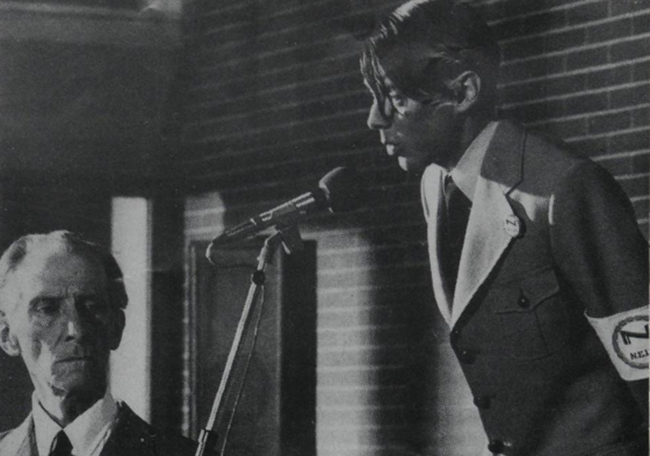
If he’d flirted with causing mass offence with Where Does It Hurt?, no-holds-barred provocateur Amateau upped the ante with 1979’s Son Of Hitler, in which Willi, a gentle, not-so-bright woodcarver from the Bavarian mountains (played by Bud Cort from Harold & Maude and Brewster McCloud) learns that he is, in fact, yes, the offspring of a certain German fascist figurehead. With the secret out, Willi then becomes a pawn in the Fourth Reich fantasies of a former Nazi played by Peter Cushing! Made in Germany, Son Of Hitler was barely released, and would likely stand as the most bizarre entry on Amateau’s resume…if he hadn’t directed 1987’s The Garbage Pail Kids!
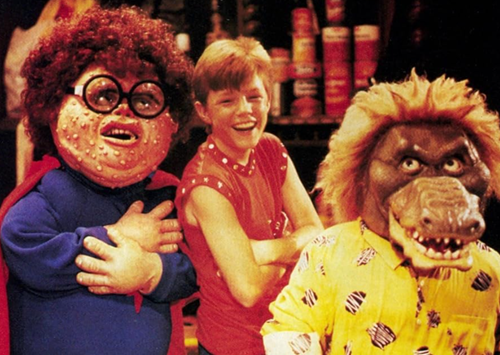
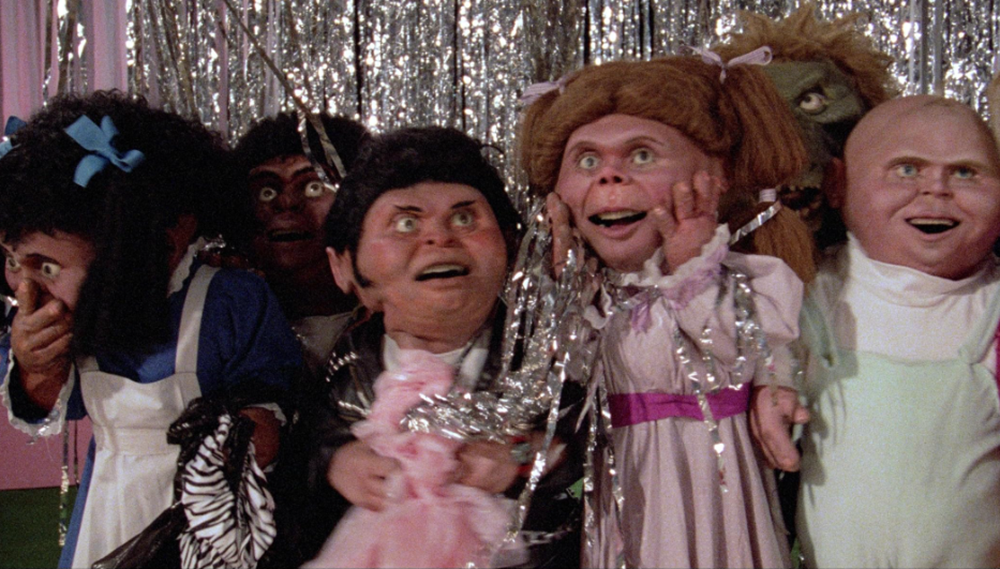
Coming after his fairly standard 1984 battle-of-the-bands teen comedy Lovelines, this now notorious big screen take on the famous gross-out, scatological trading card series (with characters like Greaser Greg, Windy Winston and Valerie Vomit) is so weird as to practically defy description. The eponymous characters are played by little people wearing bizarre, enormous mechanical heads that are beyond freaky, while the film’s black humour matches its delirious visuals. In one example of where The Garbage Pail Kids actually chooses to go, the titular child-like grotesques nearly end up at The State Home For The Ugly, a prison where people too ugly for society are incarcerated and executed!
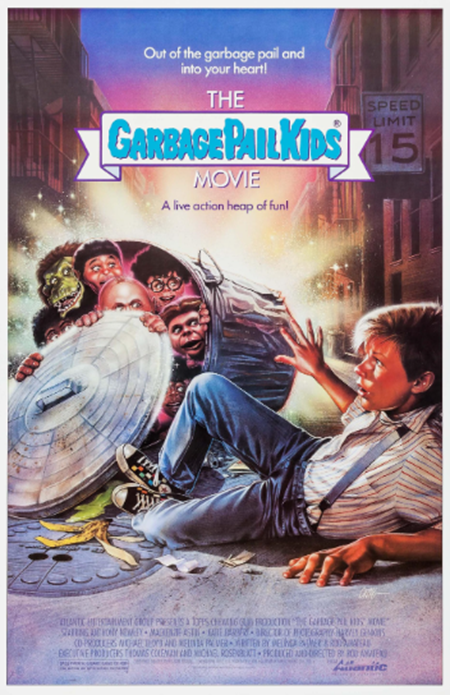
Originally pitched as a horror movie by the film’s make-up supervisor and Unsung Auteur John Carl Buechler, The Garbage Pail Kids was flipped by Amateau into a family film, and exists bizarrely in some kind of freaked-out liminal universe located between the two disparate genres. Starring Brit cult figure Anthony Newley and child actor Mackenzie Astin (whose father, Addams Family star John Astin, tried to talk him out of doing it), and filled with weird, highly inappropriate humour, The Garbage Pail Kids was excoriated by film critics (The New York Times called it “too repulsive for children or adults of any age”), but now has a small but dedicated cult of fans turned on by its singular weirdness.
Though an Amateau unpublished novel would form the basis for Blake Edwards’ underrated 1988 comedy Sunset starring Bruce Willis and James Garner, The Garbage Pail Kids stands as the writer-director’s final film credit. Amateau retired from directing in 1989, and passed away from a cerebral haemorrhage in 2003 at the age of 79. Always eager to offend and amuse audiences in equal measure, Rod Amateau directed many telemovies (including 1983’s High School USA, which mixed his raunchy teen flick proclivities with many of the stars he’d worked with during the 1960s and 1970s on the small screen), but deserves far greater appreciation for his highly unusual and very provocative approach to big screen comedy.
If you liked this story, check out our features on other unsung auteurs Sam Wanamaker, Paul Aaron, Savage Steve Holland, Rudy Wurlitzer, Keith Gordon, Alan Metter, Lynne Littman, Chuck Russell, John Derek, Don Chaffey, Harley Cokeliss, Jeannot Szwarc, Craig Gillespie, David Greene, Ernest Pintoff, Paul Williams, Jo Heims, Lee H. Katzin, Christoper Cain, Ken Wiederhorn, Barbara Loden, David Mackenzie, Alan Rudolph, James Lee Barrett, Edwin “Bud” Shrake, Joan Tewkesbury, Jamaa Fanaka, Jack Starrett, Joseph Sargent, Jeffrey Schwarz, George Sidney, Philip Dunne, Zak Hilditch, Luke Sparke, Cyrus Nowrasteh, Morgan Matthews, Tom Laughlin, Diane Keaton, Ed Hunt, Nancy Savoca, Robert Vincent O’Neil, Marvin J. Chomsky, Sam Firstenberg, Jack Sholder, Richard Gray, Giuseppe Andrews, Gus Trikonis, Greydon Clark, Frances Doel, Gordon Douglas, Billy Fine, Craig R. Baxley, Harvey Bernhard, Bert I. Gordon, James Fargo, Jeremy Kagan, Robby Benson, Robert Hiltzik, John Carl Buechler, Rick Carter, Paul Dehn, Bob Kelljan, Kevin Connor, Ralph Nelson, William A. Graham, Judith Rascoe, Michael Pressman, Peter Carter, Leo V. Gordon, Dalene Young, Gary Nelson, Fred Walton, James Frawley, Pete Docter, Max Baer Jr., James Clavell, Ronald F. Maxwell, Frank D. Gilroy, John Hough, Dick Richards, William Girdler, Rayland Jensen, Richard T. Heffron, Christopher Jones, Earl Owensby, James Bridges, Jeff Kanew, Robert Butler, Leigh Chapman, Joe Camp, John Patrick Shanley, William Peter Blatty, Peter Clifton, Peter R. Hunt, Shaun Grant, James B. Harris, Gerald Wilson, Patricia Birch, Buzz Kulik, Kris Kristofferson, Rick Rosenthal, Kirsten Smith & Karen McCullah, Jerrold Freeman, William Dear, Anthony Harvey, Douglas Hickox, Karen Arthur, Larry Peerce, Tony Goldwyn, Brian G. Hutton, Shelley Duvall, Robert Towne, David Giler, William D. Wittliff, Tom DeSimone, Ulu Grosbard, Denis Sanders, Daryl Duke, Jack McCoy, James William Guercio, James Goldstone, Daniel Nettheim, Goran Stolevski, Jared & Jerusha Hess, William Richert, Michael Jenkins, Robert M. Young, Robert Thom, Graeme Clifford, Frank Howson, Oliver Hermanus, Jennings Lang, Matthew Saville, Sophie Hyde, John Curran, Jesse Peretz, Anthony Hayes, Stuart Blumberg, Stewart Copeland, Harriet Frank Jr & Irving Ravetch, Angelo Pizzo, John & Joyce Corrington, Robert Dillon, Irene Kamp, Albert Maltz, Nancy Dowd, Barry Michael Cooper, Gladys Hill, Walon Green, Eleanor Bergstein, William W. Norton, Helen Childress, Bill Lancaster, Lucinda Coxon, Ernest Tidyman, Shauna Cross, Troy Kennedy Martin, Kelly Marcel, Alan Sharp, Leslie Dixon, Jeremy Podeswa, Ferd & Beverly Sebastian, Anthony Page, Julie Gavras, Ted Post, Sarah Jacobson, Anton Corbijn, Gillian Robespierre, Brandon Cronenberg, Laszlo Nemes, Ayelat Menahemi, Ivan Tors, Amanda King & Fabio Cavadini, Cathy Henkel, Colin Higgins, Paul McGuigan, Rose Bosch, Dan Gilroy, Tanya Wexler, Clio Barnard, Robert Aldrich, Maya Forbes, Steven Kastrissios, Talya Lavie, Michael Rowe, Rebecca Cremona, Stephen Hopkins, Tony Bill, Sarah Gavron, Martin Davidson, Fran Rubel Kuzui, Elliot Silverstein, Liz Garbus, Victor Fleming, Barbara Peeters, Robert Benton, Lynn Shelton, Tom Gries, Randa Haines, Leslie H. Martinson, Nancy Kelly, Paul Newman, Brett Haley, Lynne Ramsay, Vernon Zimmerman, Lisa Cholodenko, Robert Greenwald, Phyllida Lloyd, Milton Katselas, Karyn Kusama, Seijun Suzuki, Albert Pyun, Cherie Nowlan, Steve Binder, Jack Cardiff, Anne Fletcher ,Bobcat Goldthwait, Donna Deitch, Frank Pierson, Ann Turner, Jerry Schatzberg, Antonia Bird, Jack Smight, Marielle Heller, James Glickenhaus, Euzhan Palcy, Bill L. Norton, Larysa Kondracki, Mel Stuart, Nanette Burstein, George Armitage, Mary Lambert, James Foley, Lewis John Carlino, Debra Granik, Taylor Sheridan, Laurie Collyer, Jay Roach, Barbara Kopple, John D. Hancock, Sara Colangelo, Michael Lindsay-Hogg, Joyce Chopra, Mike Newell, Gina Prince-Bythewood, John Lee Hancock, Allison Anders, Daniel Petrie Sr., Katt Shea, Frank Perry, Amy Holden Jones, Stuart Rosenberg, Penelope Spheeris, Charles B. Pierce, Tamra Davis, Norman Taurog, Jennifer Lee, Paul Wendkos, Marisa Silver, John Mackenzie, Ida Lupino, John V. Soto, Martha Coolidge, Peter Hyams, Tim Hunter, Stephanie Rothman, Betty Thomas, John Flynn, Lizzie Borden, Lionel Jeffries, Lexi Alexander, Alkinos Tsilimidos, Stewart Raffill, Lamont Johnson, Maggie Greenwald and Tamara Jenkins.