


By Erin Free
FilmInk salutes the work of creatives who have never truly received the credit that they deserve. In this installment: actor, writer, producer and director Tom Laughlin, the creator and star of the Billy Jack film series.
For those familiar with the films of the 1970s, the hailing of the late Tom Laughlin as an Unsung Auteur might seem to be a case of major over-reach. With 1971’s Billy Jack, Laughlin wrote, produced, directed and starred in one of the decade’s biggest independent hits, and in the process instantly set himself up as an anti-establishment figurehead. But unlike, say, those of Easy Rider creators Peter Fonda and Dennis Hopper, Laughlin’s rebel reputation has gradually, quietly dissipated and ebbed away in the ensuing years.
With a number of increasingly unusual and self-indulgent film projects that have failed to get off the ground, and bizarre tilts at the world of politics (he has run for US President on a number of occasions, as both a Democrat and Republican, and also worked as an advisor to independent candidate Ross Perot), Laughlin has slowly, surely and disappointingly stoked up an image as a borderline crackpot, squawking from the sidelines with wild criticisms like a true outsider with no chance of ever really getting inside.

What has gotten lost in the decades since Tom Laughlin first broke out, however, is what a truly cutting-edge figure he was. While the likes of Clint Eastwood, Woody Allen and Robert Redford have been credited and highly feted for paving the way for actors turned director in Hollywood, Tom Laughlin was right there at ground zero too. But unlike the aforementioned major players, Laughlin was also literally doing everything on his projects: writing, directing, starring and producing, often under various pseudonyms, as well as raising finance and distributing his films himself. Tom Laughlin was the whole show, a true auteur in rigid control of his cinematic output from conception to distribution, and for that, he doesn’t get nearly the credit he deserves.
Thomas Robert Laughlin was born in 1931 in Milwaukee, and after focusing on sports in high school, he eventually shifted into drama while studying at Marquette University. Laughlin formed his own stock company on campus before transferring to the University Of South Dakota, where he majored in radio acting, directing, and producing. After graduating, Laughlin found work as an actor on television in the mid-1950s, and then appeared in supporting roles in a variety of feature films, including These Wilder Years (1956), Tea And Sympathy (1956), Lafayette Escadrille (1958), South Pacific (1958) and Gidget (1959).

Laughlin scored his first starring role in 1957’s The Delinquents, an early work from future master filmmaker Robert Altman. Well regarded and popular, the punchy, daring teen drama gave Laughlin enough cache to scrape together a tiny budget for his writing and directing debut The Proper Time, a romance set on-campus at UCLA which eventually saw release in 1962. Though the film failed to make much of an impact, and is largely forgotten today, there is an undeniable sense of historical importance to The Proper Time.
In the early 1960s, Tom Laughlin was one of only a very few actors to try their hand at directing, with John Cassavetes a notable other. But while Cassavetes remains feted as a godfather figure for actor-directors and independent filmmakers alike, Laughlin is never mentioned in the same breath as this undeniable master. Not merely dabbling in directing, Laughlin again raised the funds for another low budget movie with 1965’s The Young Sinner, in which he also starred as a young football player caught up in a moral and emotional quandary.

Like its predecessor, The Young Sinner failed to make much of an impact, and Laughlin summarily walked out on the film industry to found a Montessori preschool in Santa Monica, California alongside his wife Delores Taylor, who he had married in 1954. Though the school was the largest of its kind in the US (and was even profiled in Time Magazine), Laughlin still yearned to create and make movies. He had written the script for what would eventually become Billy Jack back in 1954, but had been drawn into a number of other possible projects that kept him from getting it made.
The concept of Billy Jack was broad in scope and required something of an epic canvas, so Laughlin cannily opted to lay the groundwork for the ambitious film by introducing the central character of Billy Jack in a considerably less big-thinking work. Working with concepts like franchises, continuing characters and origin stories before the terms had even been coined, Laughlin wrote, directed and starred in 1967’s The Born Losers, one of the best examples of the lurid, violent, and much maligned biker film genre.

A tough, gritty, and often bizarre flick featuring an idiosyncratic biker gang that must have had an influence on Mad Max mastermind George Miller, The Born Losers is an absolute belter of a film, but remains most notable for its central character. An obvious precursor to Sylvester Stallone’s Rambo, Tom Laughlin’s Billy Jack is a half-Native American Green Beret Vietnam veteran who longs for peace but has a bad habit of getting drawn into violence. When the aforementioned biker gang rapes a number of young women, perennial outsider Billy Jack finds himself sweating in the hothouse atmosphere that soon stokes up in the small town near where he lives quietly in the wilderness.
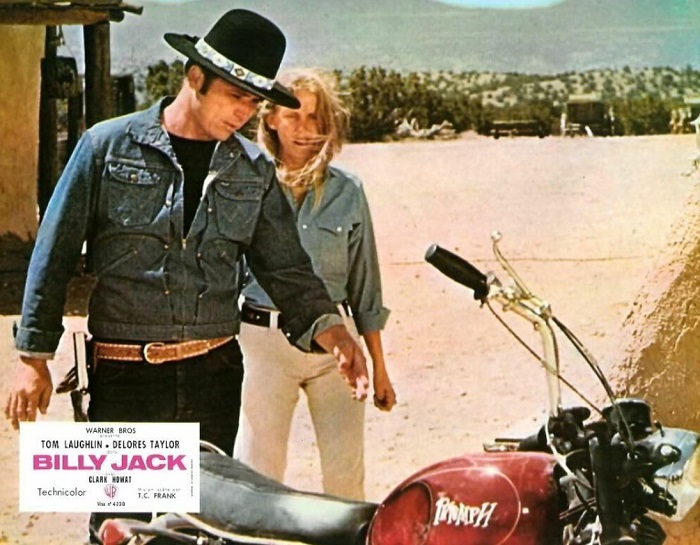
A cool, laconic, instantly iconic figure in double denim and cowboy hat as deft with the martial art of hapkido as he is with a withering, curiously comic put-down, Tom Laughlin is superb as Billy Jack, and the character’s anti-establishment strut helped The Born Losers become a considerable hit for exploitation factory and biker film specialists American International Pictures, who picked up the low budget indie flick for distribution while it was in post-production. The financial success of The Born Losers provided Laughlin with the platform he needed to raise the funds for his Billy Jack dream project.

The film’s path to the big screen wasn’t an easy one, but Laughlin refused to say die. When American International Pictures pulled out of the project, Laughlin brought 20th Century Fox on board, and when they dropped out, Warner Bros. got involved. Concerned with its difficult and incendiary subject matter, none of the aforementioned studios, however, would distribute the film, and Laughlin took on the job himself. The actor, writer, producer, director and now distributor booked the film into theatres himself, and laughed all the way to the bank when Billy Jack racked up $10 million on its initial release, and a further $50 million after various re-releases and performances in ancillary markets.
One of the biggest countercultural hits of the 1970s, Billy Jack saw its eponymous anti-hero spring to the defence of the staff (the principal of the school is played by Laughlin’s wife, Delores Taylor) and students of a hippie Freedom School when they are bullied, harassed and eventually attacked by the cruel, bigoted denizens of the small town nearby. A tough guy for the ages, Billy Jack fights for the underdog and delivers brilliantly choreographed beat-downs to those who thoroughly deserve them, usually accompanied by a choice cut of dialogue. “I’m gonna take this right foot, and I’m gonna whop you on that side of your face,” Billy Jack taunts a redneck adversary in one of the film’s best fight scenes, “and you wanna know something? There’s not a damn thing you’re gonna be able to do about it.”
With its unlikely mix of countercultural, hippie thinking and fists-and-feet-flying violence, Billy Jack was much loved by the peace-touting youth of the era (who obviously and ironically longed for their own tough-guy hero to take on The Man on their behalf), but the critics were far less enamoured of its confusing philosophical stance. “I’m somewhat disturbed by the central theme of the movie,” said esteemed film commentator Roger Ebert. “Billy Jack seems to be saying the same thing as The Born Losers: that a gun is better than a constitution in the enforcement of justice. Is democracy totally obsolete, then? Is our only hope that the good fascists defeat the bad fascists?”
It’s certainly fair comment, but the very of-its-era Billy Jack stands as a truly rousing piece of 1970s entertainment, and it’s near impossible not to get behind its eponymous good-guy anti-hero as he tries to make the world a better and safer place for a school community that just wants to exist on its own peaceful terms. Despite the obstacles against it, Billy Jack was indeed a big hit, and Tom Laughlin quickly capitalised on the film’s surprise success, releasing a sequel, The Trial Of Billy Jack, in 1974.

Running at nearly three hours, and far looser and more free-thinking than its relatively tight-and-taut predecessor, The Trial Of Billy Jack sees its eponymous anti-hero on trial for his law-breaking efforts in the first film, and also goes far deeper into the philosophies of The Freedom School, which Billy Jack still protects from outside threat. A true auteur, Laughlin once again did just about everything on the film, and made it in his own indomitable way. The critics once again condemned him, but Laughlin’s sequel was a big hit, and he donned double-denim again for 1977’s Billy Jack Goes To Washington, a loose remake of the great Frank Capra’s classic film Mr. Smith Goes To Washington kick-started on the wishes of the legendary director’s own son.
With far less action than the previous Billy Jack movies, and beset by various distribution woes, Billy Jack Goes To Washington (which sees its hero appointed a US State Senator and battling corruption and graft in the capitol) was Laughlin’s first box office failure. The film would also be Laughlin’s last as an actor and director. He attempted another sequel in 1986 with The Return Of Billy Jack (in which the hard-kicking Vietnam vet battles child pornographers and the mob in New York), but the film collapsed, with only a handful of scenes completed. Laughlin (who also directed and starred in the peculiar 1975 western The Master Gunfighter) attempted to revive Billy Jack several times over the years, as both a TV series and via a number of increasingly strange proposed films, but to no avail.

Before his sad passing in 2013 after dealing with cancer and a variety of other health issues, Tom Laughlin (often alongside his longtime wife and creative partner Delores Taylor, and along with their three children) became involved with a diverse array of interests, including politics, martial arts, psychology and sports, often in a highly unconventional manner. His reputation as a perennial outsider, combined with his poor standing in Hollywood due to his battles with various studios, have sadly diminished Laughlin’s reputation, but he is not only a truly essential icon of the 1970s counterculture, but also a pioneering figure when it comes to actors moving into the director’s chair. And in terms of creatives who take control of their material and craft it on their own very singular terms, Unsung Auteur Tom Laughlin is almost without peer…
If you liked this story, check out our features on other unsung auteurs Diane Keaton, Ed Hunt, Nancy Savoca, Robert Vincent O’Neil, Marvin J. Chomsky, Sam Firstenberg, Jack Sholder, Richard Gray, Giuseppe Andrews, Gus Trikonis, Greydon Clark, Frances Doel, Gordon Douglas, Billy Fine, Craig R. Baxley, Harvey Bernhard, Bert I. Gordon, James Fargo, Jeremy Kagan, Robby Benson, Robert Hiltzik, John Carl Buechler, Rick Carter, Paul Dehn, Bob Kelljan, Kevin Connor, Ralph Nelson, William A. Graham, Judith Rascoe, Michael Pressman, Peter Carter, Leo V. Gordon, Dalene Young, Gary Nelson, Fred Walton, James Frawley, Pete Docter, Max Baer Jr., James Clavell, Ronald F. Maxwell, Frank D. Gilroy, John Hough, Dick Richards, William Girdler, Rayland Jensen, Richard T. Heffron, Christopher Jones, Earl Owensby, James Bridges, Jeff Kanew, Robert Butler, Leigh Chapman, Joe Camp, John Patrick Shanley, William Peter Blatty, Peter Clifton, Peter R. Hunt, Shaun Grant, James B. Harris, Gerald Wilson, Patricia Birch, Buzz Kulik, Kris Kristofferson, Rick Rosenthal, Kirsten Smith & Karen McCullah, Jerrold Freeman, William Dear, Anthony Harvey, Douglas Hickox, Karen Arthur, Larry Peerce, Tony Goldwyn, Brian G. Hutton, Shelley Duvall, Robert Towne, David Giler, William D. Wittliff, Tom DeSimone, Ulu Grosbard, Denis Sanders, Daryl Duke, Jack McCoy, James William Guercio, James Goldstone, Daniel Nettheim, Goran Stolevski, Jared & Jerusha Hess, William Richert, Michael Jenkins, Robert M. Young, Robert Thom, Graeme Clifford, Frank Howson, Oliver Hermanus, Jennings Lang, Matthew Saville, Sophie Hyde, John Curran, Jesse Peretz, Anthony Hayes, Stuart Blumberg, Stewart Copeland, Harriet Frank Jr & Irving Ravetch, Angelo Pizzo, John & Joyce Corrington, Robert Dillon, Irene Kamp, Albert Maltz, Nancy Dowd, Barry Michael Cooper, Gladys Hill, Walon Green, Eleanor Bergstein, William W. Norton, Helen Childress, Bill Lancaster, Lucinda Coxon, Ernest Tidyman, Shauna Cross, Troy Kennedy Martin, Kelly Marcel, Alan Sharp, Leslie Dixon, Jeremy Podeswa, Ferd & Beverly Sebastian, Anthony Page, Julie Gavras, Ted Post, Sarah Jacobson, Anton Corbijn, Gillian Robespierre, Brandon Cronenberg, Laszlo Nemes, Ayelat Menahemi, Ivan Tors, Amanda King & Fabio Cavadini, Cathy Henkel, Colin Higgins, Paul McGuigan, Rose Bosch, Dan Gilroy, Tanya Wexler, Clio Barnard, Robert Aldrich, Maya Forbes, Steven Kastrissios, Talya Lavie, Michael Rowe, Rebecca Cremona, Stephen Hopkins, Tony Bill, Sarah Gavron, Martin Davidson, Fran Rubel Kuzui, Elliot Silverstein, Liz Garbus, Victor Fleming, Barbara Peeters, Robert Benton, Lynn Shelton, Tom Gries, Randa Haines, Leslie H. Martinson, Nancy Kelly, Paul Newman, Brett Haley, Lynne Ramsay, Vernon Zimmerman, Lisa Cholodenko, Robert Greenwald, Phyllida Lloyd, Milton Katselas, Karyn Kusama, Seijun Suzuki, Albert Pyun, Cherie Nowlan, Steve Binder, Jack Cardiff, Anne Fletcher ,Bobcat Goldthwait, Donna Deitch, Frank Pierson, Ann Turner, Jerry Schatzberg, Antonia Bird, Jack Smight, Marielle Heller, James Glickenhaus, Euzhan Palcy, Bill L. Norton, Larysa Kondracki, Mel Stuart, Nanette Burstein, George Armitage, Mary Lambert, James Foley, Lewis John Carlino, Debra Granik, Taylor Sheridan, Laurie Collyer, Jay Roach, Barbara Kopple, John D. Hancock, Sara Colangelo, Michael Lindsay-Hogg, Joyce Chopra, Mike Newell, Gina Prince-Bythewood, John Lee Hancock, Allison Anders, Daniel Petrie Sr., Katt Shea, Frank Perry, Amy Holden Jones, Stuart Rosenberg, Penelope Spheeris, Charles B. Pierce, Tamra Davis, Norman Taurog, Jennifer Lee, Paul Wendkos, Marisa Silver, John Mackenzie, Ida Lupino, John V. Soto, Martha Coolidge, Peter Hyams, Tim Hunter, Stephanie Rothman, Betty Thomas, John Flynn, Lizzie Borden, Lionel Jeffries, Lexi Alexander, Alkinos Tsilimidos, Stewart Raffill, Lamont Johnson, Maggie Greenwald and Tamara Jenkins.

