




By Erin Free
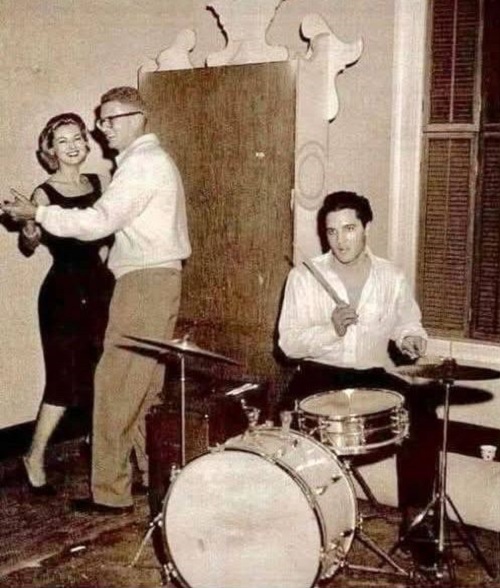
FilmInk salutes the work of creatives who have never truly received the credit they deserve. In this installment: director and writer Philip Dunne (above, far right), who helmed Wild In The Country, Blindfold, Ten North Frederick, and Three Brave Men.
Many creatives featured in the Unsung Auteurs column have enjoyed success in other fields before shifting into directing (novelist William Peter Blatty, cinematographer Jack Cardiff, playwright John Patrick Shanley, stunt coordinator Craig R. Baxley and others), while several others have been helmers of Elvis Presley movies (Norman Taurog, William A. Graham, Denis Sanders). This week, we feature an under-celebrated creative who can comfortably take a seat in both camps: noted, award-winning screenwriter Philip Dunne, who directed one of Presley’s best movies in the underrated Wild In The Country, along with a handful of other strong dramas.
Philip Dunne was born in 1908 in New York City, the son of acclaimed columnist and humourist Finley Peter Dunne and Margaret Ives Abbott, the first American woman to win an Olympic medal, and the daughter of noted book reviewer and novelist, Mary Ives Abbott. Though a career as a writer would have seemed a forgone conclusion, Dunne initially had other aspirations, but after graduating from Harvard, he headed to Hollywood, and eventually obtained work as a script reader at major studio 20th Century Fox.

“We got nothing but the worst stuff; all the good books and plays went through the New York readers’ department,” Dunne said of his work as a reader. “We got the pathetic originals written by out-of-work screenwriters. I kept seeing ways that I thought I could improve them. I’d write a synopsis, and I’d make it better. I couldn’t help it. It would be an obvious thing that the guy had missed. And when you learn to synopsise a story, you learn to construct it. At the same time, I was moonlighting writing short stories, so all these things came together.”
After being fired from Fox amidst a cost-cutting frenzy, Dunne scored a contract with MGM, and penned the 1934 Jimmy Durante musical comedy Student Tour for the studio, but was largely unhappy with his work on the picture. Dunne’s first major published screenplay came with director Rowland V. Lee’s adaptation of the classic novel The Count Of Monte Christo, which Dunne helped structure into its final shooting shape. After finding further success with his adaptation of another classic novel in 1936’s The Last Of The Mohicans, Dunne returned to 20th Century Fox as a contracted screenwriter, where he would remain for 25 years.

As well as serving during WW2 as Chief of Production for the Motion Picture Bureau, U.S. Office of War Information, Dunne further sharpened his skills as a savvy, intelligent adaptor of previously published material, writing, co-writing or reshaping the screenplays for films like Swanee River (1939), Johnny Apollo (1940), How Green Was My Valley (1941), Son Of Fury: The Story Of Benjamin Blake (1942), The Late George Apley (1947), The Ghost & Mrs. Muir (1947), Forever Amber (1947), Escape (1948), The Luck Of The Irish (1948), Pinky (1949), David And Bethsheba (1952), and The Robe (1953). Dunne also wrote four original screenplays and produced a couple of movies too.
A studio stalwart at 20th Century Fox, Dunne made a somewhat ignominious move into directing in 1955 when studio boss Daryl F. Zanuck needed someone to helm his property Prince Of Players. Dunne was experienced, trusted, and, well, around, so he was offered the job. “I started directing too late and, no question, at the wrong time,” Dunne has said. 20th Century Fox, the studio system, were falling apart. The boat had sailed.” That said, Dunne acquitted himself very well in the director’s chair, working from Moss Hart’s screenplay about Civil War-era actor Edwin Booth (the brother of Abraham Lincoln’s assassin John Wilkes Booth), played by Richard Burton. Dunne instantly established himself as a strong director of historical drama who really knew how to make a story move.

With Prince Of Players a mild success, Dunne was now seen as a reliable director at 20th Century Fox, and he helmed a number of interesting films for the studio, focusing largely on solid dramas, often with big-name stars and adapted from existing source material. In quick succession, there was 1955’s The View From Pompey’s Head (a suspenser with Richard Egan and Dana Wynter), 1956’s Hilda Crane (a fine vehicle for Jean Simmons), 1957’s Three Brave Men (a true-life drama with Ray Milland and Ernest Borgnine), 1958’s In Love And War (a WW2 mini-epic with Jeffrey Hunter and Robert Wagner), 1958’s Ten North Frederick (a political drama with Gary Cooper and Stuart Whitman) and 1959’s Blue Denim (a coming of age flick with Carol Lynley and Brandon De Wilde).
In 1961, Dunne worked with the biggest star of them all: Elvis Presley. Along with the likes of 1958’s King Creole and 1960’s Flaming Star, 1961’s Wild In The Country was a more serious, prestige film for The King. A longtime fan of James Dean, this appeared to be Presley’s attempt to enter the same kind of acting and narrative stratosphere as his on-screen role model. Adapted from J.R Salamanca’s novel by acclaimed playwright Clifford Odets, this brooding drama features Presley as an angst-ridden young man from a dysfunctional family who dreams of becoming a writer. As well as a strong, dramatic story, Presley also got his best female co-stars ever (outside of Ann-Margret) in Tuesday Weld, Millie Perkins and Hope Lange. It’s unquestionably one of Presley’s best films, and one of Dunne’s too.
Dunne directed two more films (1962’s thriller Lisa with Stephen Boyd and Dolores Hart and 1963’s espionage romantic comedy Blindfold with Rock Hudson and Claudia Cardinale), and also worked in a variety of other fields. He was a successful magazine journalist, political speech writer, playwright and short story author. Politically, Dunne was strongly anti-communist, but he was also a vocal and very public critic of the communist-hunting House Un-American Activities Committee (HUAC) of the 1950s, fighting with other Hollywood players against the blacklisting of fellow writers and performers. Philip Dunne passed away in 1992, a gifted studio-era writer and director with an impressive body of work.
If you liked this story, check out our features on other unsung auteurs Zak Hilditch, Luke Sparke, Cyrus Nowrasteh, Morgan Matthews, Tom Laughlin, Diane Keaton, Ed Hunt, Nancy Savoca, Robert Vincent O’Neil, Marvin J. Chomsky, Sam Firstenberg, Jack Sholder, Richard Gray, Giuseppe Andrews, Gus Trikonis, Greydon Clark, Frances Doel, Gordon Douglas, Billy Fine, Craig R. Baxley, Harvey Bernhard, Bert I. Gordon, James Fargo, Jeremy Kagan, Robby Benson, Robert Hiltzik, John Carl Buechler, Rick Carter, Paul Dehn, Bob Kelljan, Kevin Connor, Ralph Nelson, William A. Graham, Judith Rascoe, Michael Pressman, Peter Carter, Leo V. Gordon, Dalene Young, Gary Nelson, Fred Walton, James Frawley, Pete Docter, Max Baer Jr., James Clavell, Ronald F. Maxwell, Frank D. Gilroy, John Hough, Dick Richards, William Girdler, Rayland Jensen, Richard T. Heffron, Christopher Jones, Earl Owensby, James Bridges, Jeff Kanew, Robert Butler, Leigh Chapman, Joe Camp, John Patrick Shanley, William Peter Blatty, Peter Clifton, Peter R. Hunt, Shaun Grant, James B. Harris, Gerald Wilson, Patricia Birch, Buzz Kulik, Kris Kristofferson, Rick Rosenthal, Kirsten Smith & Karen McCullah, Jerrold Freeman, William Dear, Anthony Harvey, Douglas Hickox, Karen Arthur, Larry Peerce, Tony Goldwyn, Brian G. Hutton, Shelley Duvall, Robert Towne, David Giler, William D. Wittliff, Tom DeSimone, Ulu Grosbard, Denis Sanders, Daryl Duke, Jack McCoy, James William Guercio, James Goldstone, Daniel Nettheim, Goran Stolevski, Jared & Jerusha Hess, William Richert, Michael Jenkins, Robert M. Young, Robert Thom, Graeme Clifford, Frank Howson, Oliver Hermanus, Jennings Lang, Matthew Saville, Sophie Hyde, John Curran, Jesse Peretz, Anthony Hayes, Stuart Blumberg, Stewart Copeland, Harriet Frank Jr & Irving Ravetch, Angelo Pizzo, John & Joyce Corrington, Robert Dillon, Irene Kamp, Albert Maltz, Nancy Dowd, Barry Michael Cooper, Gladys Hill, Walon Green, Eleanor Bergstein, William W. Norton, Helen Childress, Bill Lancaster, Lucinda Coxon, Ernest Tidyman, Shauna Cross, Troy Kennedy Martin, Kelly Marcel, Alan Sharp, Leslie Dixon, Jeremy Podeswa, Ferd & Beverly Sebastian, Anthony Page, Julie Gavras, Ted Post, Sarah Jacobson, Anton Corbijn, Gillian Robespierre, Brandon Cronenberg, Laszlo Nemes, Ayelat Menahemi, Ivan Tors, Amanda King & Fabio Cavadini, Cathy Henkel, Colin Higgins, Paul McGuigan, Rose Bosch, Dan Gilroy, Tanya Wexler, Clio Barnard, Robert Aldrich, Maya Forbes, Steven Kastrissios, Talya Lavie, Michael Rowe, Rebecca Cremona, Stephen Hopkins, Tony Bill, Sarah Gavron, Martin Davidson, Fran Rubel Kuzui, Elliot Silverstein, Liz Garbus, Victor Fleming, Barbara Peeters, Robert Benton, Lynn Shelton, Tom Gries, Randa Haines, Leslie H. Martinson, Nancy Kelly, Paul Newman, Brett Haley, Lynne Ramsay, Vernon Zimmerman, Lisa Cholodenko, Robert Greenwald, Phyllida Lloyd, Milton Katselas, Karyn Kusama, Seijun Suzuki, Albert Pyun, Cherie Nowlan, Steve Binder, Jack Cardiff, Anne Fletcher ,Bobcat Goldthwait, Donna Deitch, Frank Pierson, Ann Turner, Jerry Schatzberg, Antonia Bird, Jack Smight, Marielle Heller, James Glickenhaus, Euzhan Palcy, Bill L. Norton, Larysa Kondracki, Mel Stuart, Nanette Burstein, George Armitage, Mary Lambert, James Foley, Lewis John Carlino, Debra Granik, Taylor Sheridan, Laurie Collyer, Jay Roach, Barbara Kopple, John D. Hancock, Sara Colangelo, Michael Lindsay-Hogg, Joyce Chopra, Mike Newell, Gina Prince-Bythewood, John Lee Hancock, Allison Anders, Daniel Petrie Sr., Katt Shea, Frank Perry, Amy Holden Jones, Stuart Rosenberg, Penelope Spheeris, Charles B. Pierce, Tamra Davis, Norman Taurog, Jennifer Lee, Paul Wendkos, Marisa Silver, John Mackenzie, Ida Lupino, John V. Soto, Martha Coolidge, Peter Hyams, Tim Hunter, Stephanie Rothman, Betty Thomas, John Flynn, Lizzie Borden, Lionel Jeffries, Lexi Alexander, Alkinos Tsilimidos, Stewart Raffill, Lamont Johnson, Maggie Greenwald and Tamara Jenkins.

