

by Stephen Vagg
The year 1966 is an interesting one in small screen Australian drama. Television had been broadcasting here for a decade and had established itself as the leading entertainment medium in the country, supplanting radio and cinema. It hadn’t been a great decade for local shows – in fact, sometimes it had been downright poor – but the success of programs like Homicide and Mavis Bramston proved that not only did Australians enjoy something homegrown, they could like it in large numbers. Quotas for local drama were introduced in 1967, but prior to that, the ABC increased its already decent output. This essay looks at three television plays from 1966.
Marleen
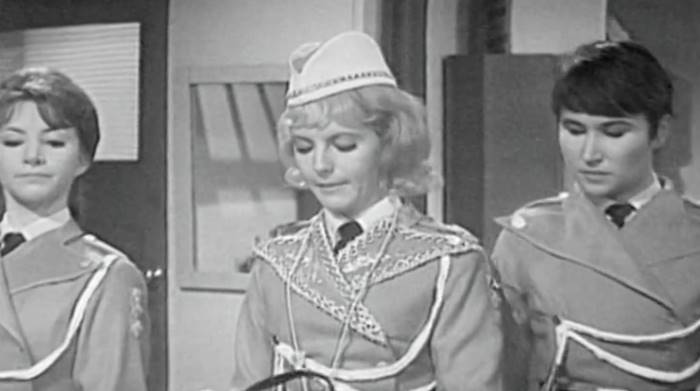
Marleen was a half-hour episode of the anthology series ‘Australian Playhouse’. It was a black comedy by Pat Flower, best known for her thrillers (eg. The Tape Recorder), although she did a lot of comedy as well (eg, Done Away With, Tilley Landed On Our Shores). Marleen is named for its central character, a marching band captain (Joy Mitchell). She has two offsiders (Fay Kelton and Elizabeth Harris) plus bewildered parents (Syd Conabere, Dorothy Bradley), who are worried about their daughter’s dictatorial tendencies, which come to the fore when Marleen is up for a competition to elect the World Miss Marching Girl. Marleen goes a bit fascistic and [SPOILERS] war veteran dad puts on his medals and shoots his daughter dead.
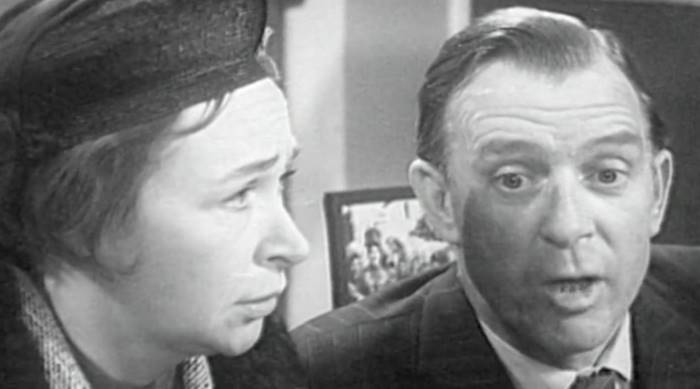
Oscar Whitbread directed. This was quite fun if you can get into the broad theatrical mode of it. Reviews were unnecessarily harsh – I think that they couldn’t handle the tonal shift, because the comedy is clear, as is the satirical point.

What About Next Year?
This was another from the first season of ‘Australian Playhouse’. The script was written by Richard Lane, a rare Australian TV writer from this period who I actually met; I interviewed him in 2000 about my biography on Rod Taylor. Lane had worked with Rod during the radio days and wrote a superb book on the history of radio drama that was very useful. His wife was actor Lynne Murphy, who recently passed away, and who appeared in the third play discussed in this article. I remember they were very kind, very funny and had a dog who was very prone to humping the legs of visitors.
Lane mostly worked for commercial stations during his radio and TV career. I’ve read a few of his radio scripts, particularly impressed with The Remittance Man, about a broken down English actor in Australia… this was a terrific script that would have made a good radio play, and might have if the ABC had given the job of running TV drama to Leslie Rees, someone who cared about Australian writing, rather than Oxford blow-in Neil Hutchison, who actively campaigned against local writing throughout his career, despite more than thirty years of working on the dime of the Australian tax player to promote Australian culture.
Lane’s TV credits include soaps like Autumn Affair, Young Doctors and Motel, as well as mini-series like the notorious hit You Can’t See Round Corners and the notorious flop The Purple Jacaranda, and TV plays like Johnny Belinda (for Shell Presents), Cross of Gold and What About Next Year.
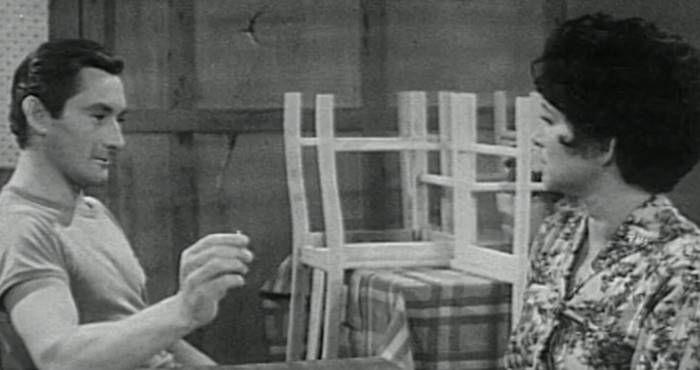
This is a decent little suspense tale about a man (Dennis Miller) who turns up at a house looking for a missing friend. He encounters a woman (Terry Aldred), her daughter (Veronica Casey) and an old man (Edward Howell). Miller and Aldred are particularly effective; I liked seeing Miller as a cocky smug guy who find himself in over his head. The direction by Englishman Pat Barton isn’t particularly effective – Lane deserved better. A contemporary review is here.

The Runaway
The Runaway was, I believe, the first TV play from John Croyston, a former teacher who had been writing and producing for ABC radio. He would go on to become one of the ABC’s most significant writers and directors in the late 1960s and 1970s; he was a particular favourite of David Goddard, who became head of TV drama at the ABC in 1965 for several colourful years.
Goddard changed the way the ABC made television plays. They used to be just put on sporadically, but Goddard tried to ensure that they were broadcast in a thematically linked series eg. ‘Australian Playhouse’ (1966-67), ‘Love and War’ (1967), a series on greed (1968), Australian Plays (1969) – a practice that continued into the 1970s and 1980s. However, the ABC still did the occasional one-off stand alone play such as The Runaway. It aired on Wednesday Theatre, a weekly show that ran from 1965 to 1969, which broadcast various dramas, operas and specials, some of them Australian-made.

The Runaway is a 60-minute drama about two brothers, Gary (Graham Dixon) and Fred (Ken James, later famous as the middle, sensitive brother on Skippy and the egotistical star on The Box). They have a pastry chef dad, who I think is meant to be a New Australian (John Gray), a mum (Lynne Murphy aka Mrs Richard Lane) and her father (Edward Hepple). The main character is Gary, who wants to go to university and read books and is sort of dating Jenny, played by Helen Morse. Jenny, looking gorgeous, throws herself at Gary and he isn’t into it, so maybe Gary’s got a few things to figure out apart from what career he wants to do, but that really isn’t unpacked.
It’s a slower moving sort of drama with some effective moments, slightly reminiscent of British TV dramas that were in vogue at the time. The director was Storry Walton, who’d just made a mini series about two brothers, My Brother Jack, and would go on to collaborate a number of times with Croyston (one of which I’ve reviewed, Casualty). As a cricket fan, I appreciate how brother Fred was a cricket player and there’s a scene where Greg and grandma go to watch Fred play. I think this might have made it the first Australian TV drama to touch on cricket – though one never knows, there may have been an episode of Consider Your Verdict or Homicide on it.

I asked Storry Walton for his thoughts on the play and he was kind enough to provide the following:
“John Croyston’s screenplay for The Runaway came out of a continuing debate in the ‘60s about the nature and style of the new medium of television compared with the cinema. Producers had already worked out that television – a small screen in a small living room with a small family audience – was a medium of intimacy, compared with the experience of the wide vistas of the big cinema screens in their big theatres with big audiences. And the little television screen gave greater opportunity to use the close-up to ‘see thinking’, to explore the human condition in the closest possible way – the shrug, the momentary wince, the close interplay of people in small spaces.
“The Runaway was conceived by John as a close-up exploration of family life, closer than the cinema view, and dwelling on mood and character as much as plot. In a way, it was an exercise in claustrophobia, where people’s anger and love and frustration are all mixed up and throttled by their physical closeness.
“I directed the screenplay accordingly, with the cast mainly confined in small spaces and the screen filled with the physicality of the characters and their interactions closely observed.
“It was one of the earliest roles for Helen Morse, fresh out of NIDA and for Ken James, who had also won a precious place at NIDA, but left after a couple of months for a major role in the long-running series Skippy. Both went on to long and distinguished careers.
“The exterior scenes were shot by the legendary cinematographer and DOP Bill Grimmond, who also went on to shoot over 60 episodes of Skippy. Against the ABC’s rules to shoot on 16mm, we shot on higher quality 35mm because I wished to ease the visual transition between film sequences and the electronic cameras of the television studio, which largely succeeded.
“Looking at it after all these years, I reckon it’s pretty slow and repetitive and I think I could have better served John’s script with more dynamic direction. I think we would have both agreed that a bit of editing would have helped too. A newspaper critic said it was not a work of genius, but showed promise. Promise of what I wonder? Promise perhaps that the ABC would continue its experiments in screen drama with Australian writers, themes and styles. Actually, that was a promise kept – for all the next few years.”

As mentioned, by 1966, Australian drama was beginning to get some momentum – the quotas that started in 1967 would finally give it a secure foothold. The ABC had not yet entirely shifted to an all-Australian line up – in 1966 alone, they did versions of two pays by Canadian Arthur Hailey (Collision Course, Flight into Danger) but by 1969 all Australian drama would be locally written. It took us thirteen years to grow up, but we got there in the end.
The author would like to thank Storry Walton for his contributions to this article.
For more articles like this, read:
60 Australian TV Plays of the 1950s & ‘60s
Annette Andre: My Brilliant Early Australian Career
Forgotten Australian TV Plays – The Slaughter of St Teresa’s Day
Forgotten Australian TV Plays: A Tongue of Silver
The Flawed Landmark: Burst of Summer
Forgotten Australian TV Plays: The Grey Nurse Said Nothing
Forgotten Australian TV Plays: You Can’t Win ‘Em All
Forgotten Australian TV plays: Marriage Lines
Forgotten Australian TV Plays: The Merchant of Venice
Forgotten Australian TV Plays: Seagulls Over Sorrento
Forgotten Australian TV Plays: Noeline Brown
Ten Female Drama Writers from the First Decade of Australian TV | FilmInk
Forgotten Australian TV plays: Romeo and Juliet | FilmInk
Sean Scully: From Disney to Australian TV Plays | FilmInk
Forgotten Australian TV Plays: The Long Sunset | FilmInk
Forgotten Australian TV Plays: Reflections in Dark Glasses
Forgotten Australian TV Plays: The Case of Private Hamp | FilmInk
Forgotten Australian TV Plays: The Hot Potato Boys | FilmInk
Forgotten Australian TV Plays: The Life and Death of Richard II
Forgotten Australian TV Plays: Harlequinade | FilmInk
Forgotten Australian TV Plays: Outpost | FilmInk
Forgotten Australian TV Plays: The Rape of the Belt | FilmInk
Forgotten Australian TV Plays: Murder Story | FilmInk
Forgotten Australian TV Plays: The Big Killing | FilmInk
Forgotten Australian TV Plays: Antarctic Four
Forgotten Australian TV Plays: The Tape Recorder | FilmInk
Forgotten Australian TV Plays: The Man Who Saw It | FilmInk
Forgotten Australian TV Plays: The Scent of Fear
Forgotten Australian TV Plays: The Big Client | FilmInk
Forgotten Australian TV Plays: The Recruiting Officer | FilmInk
Forgotten Australian TV Plays: Done Away With | FilmInk
Forgotten Australian TV Plays: Split Level | FilmInk
Forgotten Australian TV Plays: She’ll Be Right | FilmInk
Forgotten Australian TV plays: Reunion Day | FilmInk
Forgotten Australian TV Plays: The Cell
Forgotten Australian TV Plays: The Swagman | FilmInk
Forgotten Australian TV Plays: Cobwebs in Concrete | FilmInk
Forgotten Australian TV Plays: A Stay at Home and Across the Bridge | FilmInk
Forgotten Australian TV Plays: The Shifting Heart | FilmInk
Forgotten Australian TV plays: Kain | FilmInk
Forgotten Australian TV Plays: Rusty Bugles | FilmInk
Forgotten Australian TV Plays: A Season in Hell | FilmInk
Forgotten Australian TV Plays: Corinth House | FilmInk
Forgotten Australian TV Plays: The Tower | FilmInk
Forgotten Australian TV Plays: The Sweet Sad Story of Elmo and Me | FilmInk
Forgotten Australian TV Plays: The Drover’s Wife | FilmInk
Forgotten Australian TV Plays: Five episodes of Australian Playhouse | FilmInk
Forgotten Australian TV Plays: In the Absence of Mr Sugden | FilmInk
Forgotten Australian TV plays: The Astronauts | FilmInk
Forgotten Australian TV Plays: The Monkey Cage | FilmInk
Forgotten Australian TV Plays: The Quiet Season and Enough to Make a Pair of Sailor’s Trousers
Forgotten Australian TV Plays: Shadow on the Wall | FilmInk
Forgotten Australian TV plays: Salome | FilmInk
Forgotten Australian TV Plays: Prelude to Harvest | FilmInk
Forgotten Australian TV Plays: Casualty | FilmInk
Forgotten Australian TV Plays: Martine | FilmInk
Forgotten Australian TV Plays: Ashes to Ashes and Caught Napping | FilmInk
Forgotten Australian TV plays: Tartuffe and The Taming of the Shrew | FilmInk
Forgotten Australian TV Plays: Seven Comedies from the 1960s
Forgotten Australian Television Plays: The Blind Balance | FilmInk
Forgotten Australian Television Plays: A Tale of Two Hamlets | FilmInk
Forgotten Australian TV Plays: Two Slices of Shakespeare | FilmInk
Forgotten Australian TV Plays: Two from Michael Boddy | FilmInk
Australia’s Forgotten Television Plays: Four from the Goddard Years | FilmInk
Forgotten Australian TV Plays: Point of Departure and Man of Destiny | FilmInk
Forgotten Australian TV plays: Everyman
Forgotten Australian TV Plays: Stormy Petrel | FilmInk
Forgotten Australian TV Plays: The Outcasts | FilmInk
Forgotten Australian TV Plays: The Patriots | FilmInk
Forgotten Australian TV Plays: The Hungry Ones | FilmInk
Forgotten Australian TV Series: Jonah | FilmInk
Remembered Australian TV Plays: Pastures of the Blue Crane | FilmInk
The Films of John Farrow | FilmInk
Forgotten Australian TV Screenwriters: Michael Plant | FilmInk
Forgotten Australian TV Plays: The Small Victory | FilmInk
Forgotten Australian TV Writers: Ron McLean | FilmInk
Forgotten Australian TV Series: Whiplash | FilmInk
Forgotten Australian TV Plays: Treason | FilmInk
Forgotten Australian TV Plays: Don’t Listen Ladies | FilmInk

I worked as a production assistant on Runaway and remember it as a highlight of the four years that I spent at the ABC. i have always wanted to see it again but had given up hope of that possibility. If it is available I would very much appreciate the opportunity to re -view it.
My contribution to the production included accompanying Bill Grimmond to (nominally) direct 2nd unit shots of trains going over bridges, suburban shopfronts and the like. One of these shots was a closeup of Helen Morse – everything else was inanimate.
The John Gray character is intended as a new Australian. The script describes him as “Of German descent, he still has a trace of accent inherited from his father.”
The running time of 60 minutes surprises me because the script runs to 95 pages but there is a lot of white space.
I am very happy that Runaway survives in some form. It was a happy shoot and Storry was a wonderfu land encouraging mentor to me.