by Gill Pringle
Based on a new screenplay by Pulitzer Prize and Tony Award winner Tony Kushner (Angels in America, Lincoln), Spielberg’s reimagining of the beloved musical stars Ansel Elgort (Tony); Ariana DeBose (Anita); David Alvarez (Bernardo); Mike Faist (Riff); Brian d’Arcy James (Officer Krupke); Corey Stoll (Lieutenant Schrank); Josh Andrés Rivera (Chino); Rita Moreno (Valentina, who owns the corner store in which Tony works); and introducing Rachel Zegler as Maria. Moreno also serves as one of the film’s executive producers.
As an Oscar-winning producer and director, Spielberg’s artistic decisions continue to keep audiences guessing, helming such diverse films as Schindler’s List, Jaws, E.T., Indiana Jones, Saving Private Ryan and Jurassic Park.
FilmInk meets with Spielberg, aged 74 [he turned 75 on Saturday], just days after the passing of Stephen Sondheim, 91, who wrote West Side Story’s enduring lyrics when he was just 24 years old.
How daunted were you by the enormous legacy attached to West Side Story?
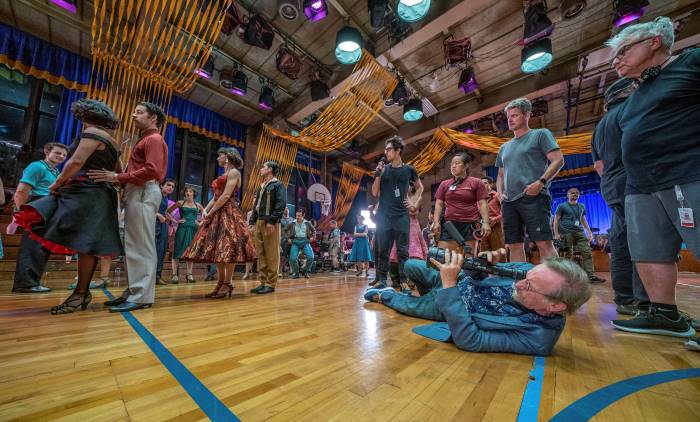
“This film is probably the most daunting of my career. West Side Story is arguably the greatest score ever written in the theatre, and that’s not lost on any of us. It’s very intimidating to take a masterpiece and make it through different eyes and different sensibilities without compromising its integrity.
“But I believe that great stories should be told over and over again, in part to reflect different perspectives and moments in time into the work. You have to demand of yourself, over and over again, justification for treading on what feels like sacred ground. We all did that. The riskiness of this enterprise was not lost on any of us. But everyone involved entered this project with tremendous love and respect, bordering on reverence, for the show and obviously for its legendary creators. But we also knew we had to make a movie for our times and make it with a contemporary understanding and with contemporary values that we subscribe to.”
Why do you think West Side Story transcends time?
“What is so wonderful about this story is that, no matter how much the world around us changes, the lessons and insights it offers us do not. It’s a story that has captivated audiences for decades because it is not just a love story, but also a culturally significant work with a central premise – that love transcends prejudice and intolerance – that hasn’t lost its relevance over time.
“West Side Story means so much to so many, and I’m thrilled to have this chance to give it new life and share it with a new audience.”
How much was Stephen Sondheim involved in your big screen adaptation of West Side Story?
“He was involved. Steve was the first person I met when I sought the rights to make our version of West Side Story. We sat down together at his place in New York City, in person with his dogs. And we had met before because my company made Sweeney Todd, adapting it with Johnny Depp. And I met Steve at the premiere of that for the first time. And then we had both been honoured, and wound up bumping into each other at the White House when we received the Presidential Medal of Freedom with Steve, myself, and Barbra Streisand. We were all kind of paired together.”
How did the conversation about re-making West Side Story first come about?
“Well, each time I met with Steve, I wanted to say to him: ‘I have this desperate desire to do my version of West Side Story’, but I just couldn’t get the words out of my mouth. We talked about everything but that. And then finally, I just sort of bit the bullet, and I was able to meet with him and the other estates. So, Steve was very involved. He was very involved in commenting about Tony Kushner’s script and Tony had an open dialogue with Steve during the process of going from one draft to the next. But, where Steve got really, really involved, which was the best place for his involvement, was when we did all the pre-records with the vocal artists. Steve was there for three weeks, five days a week, every day sitting right next to me at the recording studio. It was such an honour to share that.”
It’s interesting to see how you don’t translate or subtitle the Spanish in this new version? What was your rationale?
“That language had to exist in equal proportions alongside the English with no help because both these languages are spoken in the US. I also want the Spanish-speaking audiences and English-speaking audiences, to sit in the theatre together so the English-speaking audiences will suddenly hear laughter coming from pockets of the theatre from the Spanish-speaking audience. Because we live in a bilingual country, and this feels like a movie for a country that is bilingual.”
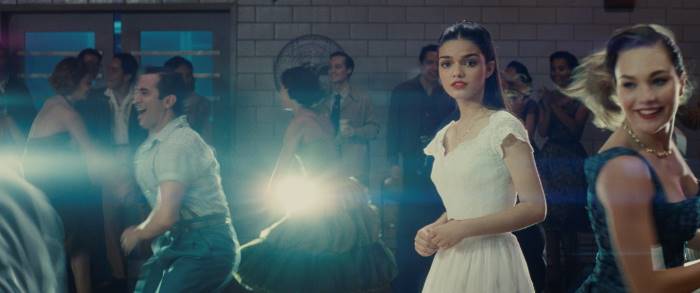
In the casting, New Jersey high school senior Rachel Zegler in the lead role of Maria, you introduce a budding new star. A Latina of Colombian descent, Zegler was among the first group of potential Marias you saw. How did you finally decide she was your Maria?
“Rachel is extraordinary. She walked onto this huge set, never having made a movie before, surrounded by a bunch of fairly formidable people and superbly talented actors with much more experience than her. She watched, she listened, she learned at a jaw-dropping rate, but she also brought with her that mysterious quality of having been born to do what she’s doing. Her María is a revelation.”
We hear that the “America” dance scene was filmed outside on one of the hottest days in New York. Can you elaborate?
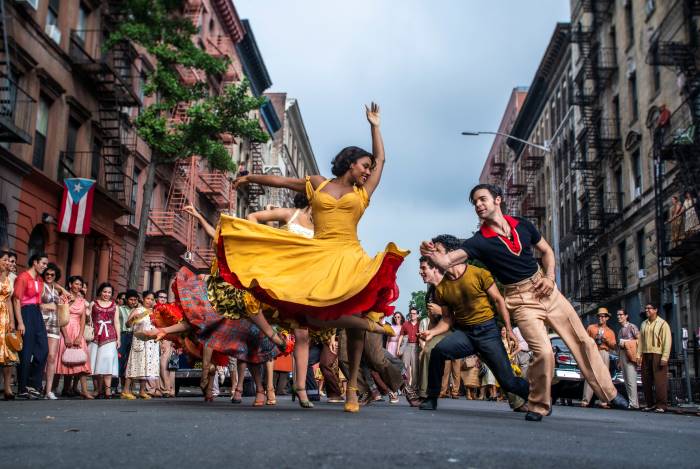
“Yes. We had three days of intolerable heat. We could only close down the streets in Harlem on a Saturday and Sunday. So, we took off Thursday and Friday, and worked Saturday and Sunday. On Saturday, the heat index was 102. The actual temperature was about 96. And they were doing the non-vocal portion of just the dance for “America”, which took a long time to shoot. There were a lot of takes, and the kids were working so hard, they were sweating through their costumes. But, thanks to the magic of digital technology, we were able to take out a lot of sweat in post-production. But, when we got to the end of the day, the kids were out of breath. And what I used to do is when there was a good take, I’d invite the entire cast into the tent. They loved coming into the tent, because it was shady in there. But they also wanted to see what we had just filmed. So, they all came into the tent, and there would be a huge ‘geschrei’; Yiddish for a celebration; an outcry of joy when they’d see themselves dancing, but they wanted to go out and do it again, and yet they were pouring sweat.”
And you shut down production over concern for your dancers working in the heat?
“Yes. When we finished our first day, and I checked with our producer what the temperature would be the next day, and she said, ‘It was 95 today; it’s supposed to be 96 with 103 in the heat index’. And so, I basically said, ‘We’re taking off Sunday, and I will cover the cost. We’re not gonna charge the Disney Fox Company for this because I’m actually gonna cancel a shooting day, because I’m not gonna let my dancers go through this again’. And luckily the heat broke, and by the time we got back to America, we were in a very comfortable 88. So, it was much better.”
Which scenes did you and screenwriter Tony Kushner feel the most pressure to get absolutely perfect?
“I don’t think there was a scene in this film that Tony and I didn’t feel we had to get absolutely perfect, because a scene is simply a progression toward making a point, or reaching the end of the story. If we both felt a scene did not contribute to the overall story or it didn’t contribute to the growth or the arc of these characters, that scene would find no place in West Side Story. So, every scene has an essential role to play in basically unspooling the story in celebration of being alive, and in tragedy, because conversation wasn’t able to be had before tragedy occurred. And the message or conversation must always be attempted before anything else is attempted. And these are all little building blocks. It’s like a string of pearls, you know? And so, I don’t think there was any scene that we didn’t pay surgical attention to. And especially Tony, who is obsessed with research… which is why I think we got it right in very many different ways. And Tony was also very much open to new ideas from the cast but, at the same time, very open to, ‘Is there another way to tell the scene?’”
And there were many re-writes?
“There was one scene in particular – and I’m not gonna say what the scene was – where there were 32 rewrites, and the last rewrite happened 24 hours before we actually shot the scene.”
Really, you’re not going to tell us?!
“There’s no reason to because I don’t want people watching for it. In the four movies I’ve made with Tony, in every one, there’s one scene that we rewrite and rewrite and rewrite and rewrite and rewrite and rewrite. And I don’t know why that is. I think it’s just about exploring it. What are we leaving on the table? What crumbs are we leaving on the table that could be very nourishing for an audience? Let’s not leave anything on the table. Sometimes that just means rethinking the entire scene.”
West Side Story is in cinemas on December 26, 2021