


by Stephen Vagg
In the early days of television, the brief of the ABC was outlined in the Broadcasting and Television Act 1942-1962, which said that the public broadcaster was to “ensure that adequate and comprehensive programmes are provided… to serve the best interests of the general public.”
This was kind of vague to put it mildly: what is adequate/comprehensive/in the best interest of the public? Well, the ABC tried a few things – mostly ideas borrowed from the BBC. They had Shakespeare and Shaw, a bit of Chekov, and the occasional Australian play. They also had a fair amount of marital comedies among the upper classes.
Yep, in the late 1950s and 1960s, the ABC’s definition of “adequate and comprehensive programs” in the “best interests of the general public” included local adaptations of stage plays about rich men and their mistresses/wives/ex-wives. Just what Betty Blacktown ordered.
The first Australian TV play ever made was along those lines – an adaptation of JM Barrie’s The Twelve Pound Look. There was also Holiday in Biarritz, Fair Passenger, Three Cornered Moon, Don’t Listen Ladies, Tartuffe and The Four Poster, not to mention Australian-written comedies in this vein, including The Little Woman and The Five Sided Triangle. I’m not sure why they were so popular – I guess they were on stage a lot (upper crust theatre goers always seem to enjoy a bit of dramatised infidelity).
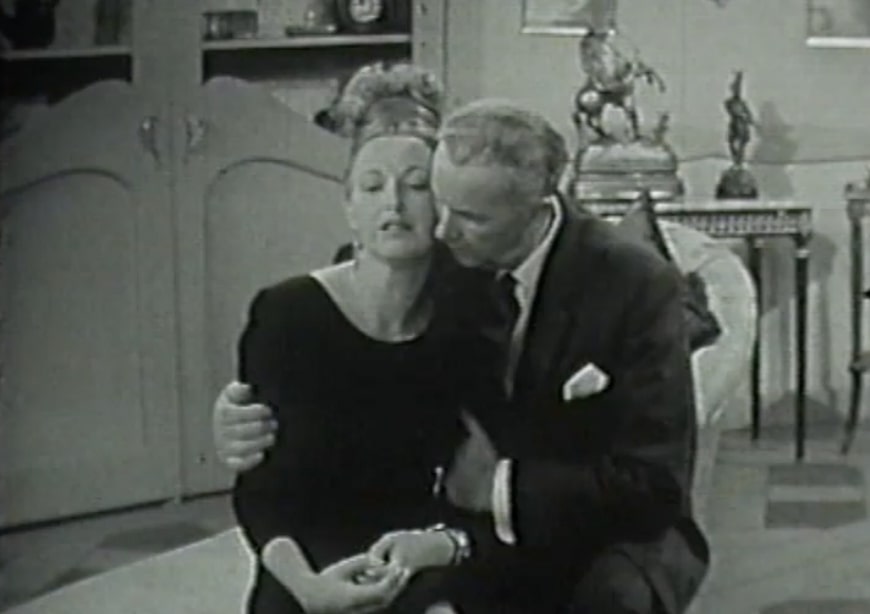
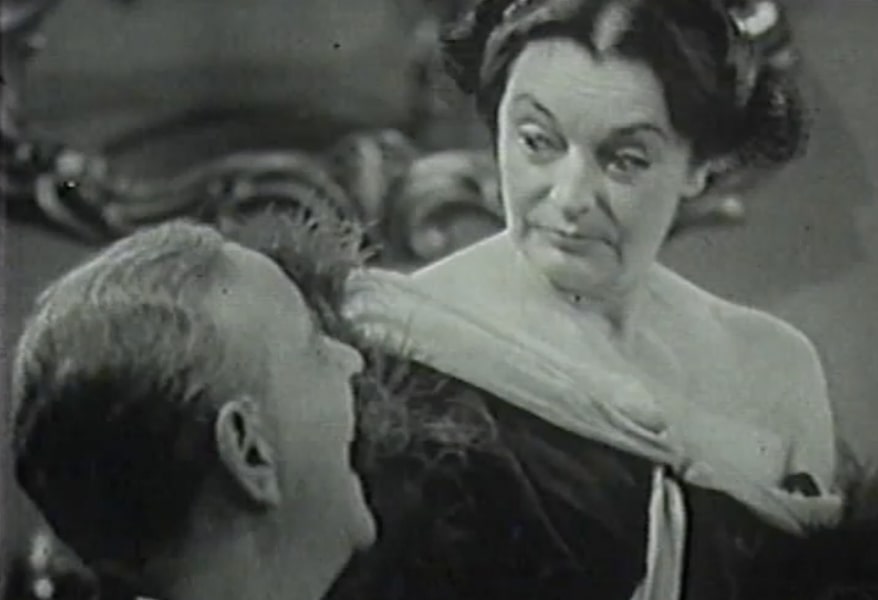
This article is focused on Don’t Listen Ladies, a farce based on a play from French writer Sacha Guitry. It’s set in an antique shop run by Daniel (Alexander Archdale in the TV version) and his second wife Madeleine (Margo Lee). She finds a letter that makes her think that he is having an affair, so encourages the love of Daniel’s assistant, Blandinet (Neil Fitzpatrick), who is infatuated with her. Also involved are Daniel’s first wife Valentine (Brigid Lenihan), a former girlfriend called Julie (Neva Carr Glynn), a young man called Michel (Owen Weingott), who Madeleine thinks of marrying, and customer Baron de Charancy (Noel Brophy). Oh, and a maid (Audrey Teasdale).
The play was first performed in Paris in 1942 (yep, with Germans in the audience and everything) as “N’ecoutez pas, Madames!” with Guitry himself starring as Daniel. It was adapted into English with the title “Don’t Listen Ladies” by Guy Bolton and “Stephen Powys”. Powys was actually PG Wodehouse (the guy who wrote all those Jeeves stories) using a pseudonym because Wodehouse had a bad reputation after World War Two due to him spending time in France under the occupation. Guitray’s reputation also suffered from this (he even spent time in prison after the liberation under charges of collaboration). The play had a run on the West End and Broadway; in New York, influential columnist Walter Winchell attacked Guitry for his relationship with the Germans and this was thought to have hurt the commercial possibilities of the play.
I have read a copy of the play (accessible here). It’s a lot of fun – you can imagine with the right cast, especially the leads, it would be entertaining to watch on stage. It’s cute how the antique dealer talks to the audience, to the men in the audience (“don’t listen ladies” is what he asks the ladies in the audience to do), as he discusses marriage, fidelity, etc. That’s a very theatrical device – it doesn’t always work well on screen, and I’m not sure it does in the ABC production, though I have to admit that I’ve only seen the last 40 minutes of that (never ideal, but particularly not for a farce which depends so much on set up and pay off).
Don’t Listen Ladies appears to have been popular with Australian drama societies in the 1950s and 1960s, and was adapted for ABC radio. This presumably contributed to the ABC’s decision to make it (a 75-minute version). It’s still weird that in 1963, they decided to film a French farce about a married antique dealer. I think this may have been the only PG Wodehouse filmed for Australian TV.
The play was shot in Sydney under the direction of James Upshaw, who mostly specialised in variety shows, but did a bit of comedy: his other credits include adaptations of Noel Coward’s Red Peppers, and a version of The Four Poster Bed. (I have done pieces on non-comic plays directed by Upshaw such as The Big Killing, The Big Client, and Scent of Fear).
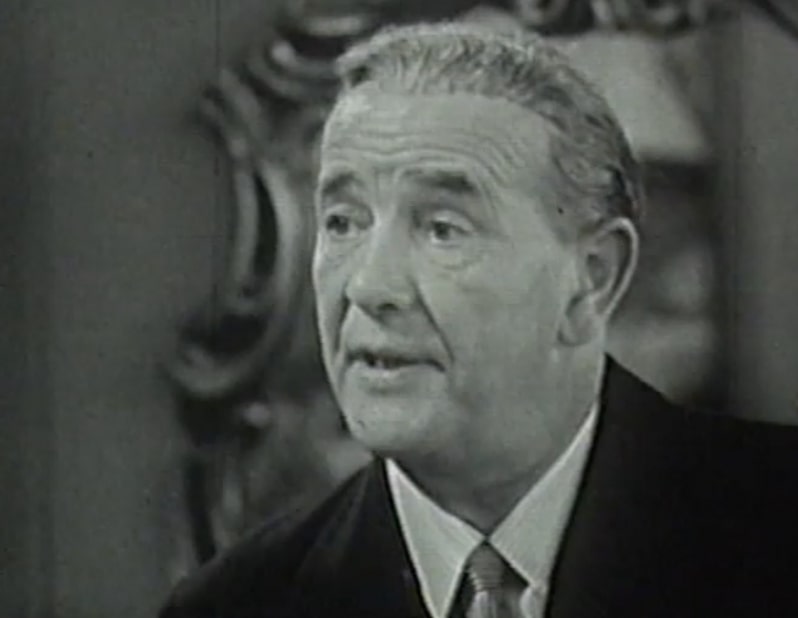
In the play, Daniel is meant to be a good looking fifty; Alexander Archdale was over sixty and looked it, and to be frank, he simply isn’t hot enough for Margo Lee, who plays his wife – this, for me, is the main flaw of the production. Lee, who is always fun, is far more comfortably cast; she’s bright and funny, and her scenes with Neil Fitzpatrick at the end are quite touching. Neva Carr Glynn is ideal as the former nude model. Incidentally, Archdale and Lee appeared in the first Australian TV drama ever broadcast – an adaptation of JM Barrie’s play The Twelve Pound Look.
Don’t Listen Ladies was part of the great counter reformation of Australian drama at the ABC, the period from 1962-64 when the proportions of locally written shows went into decline in favour of European works. I admit the whole time when watching it I was going “why are they doing this?” But the actors seem to be having fun.
The author would like to thank Chris Keating for his assistance with this piece.
For more articles like this, read:
60 Australian TV Plays of the 1950s & ‘60s
Annette Andre: My Brilliant Early Australian Career
Forgotten Australian TV Plays – The Slaughter of St Teresa’s Day
Forgotten Australian TV Plays: A Tongue of Silver
The Flawed Landmark: Burst of Summer
Forgotten Australian TV Plays: The Grey Nurse Said Nothing
Forgotten Australian TV Plays: You Can’t Win ‘Em All
Forgotten Australian TV plays: Marriage Lines
Forgotten Australian TV Plays: The Merchant of Venice
Forgotten Australian TV Plays: Seagulls Over Sorrento
Forgotten Australian TV Plays: Noeline Brown
Ten Female Drama Writers from the First Decade of Australian TV | FilmInk
Forgotten Australian TV plays: Romeo and Juliet | FilmInk
Sean Scully: From Disney to Australian TV Plays | FilmInk
Forgotten Australian TV Plays: The Long Sunset | FilmInk
Forgotten Australian TV Plays: Reflections in Dark Glasses
Forgotten Australian TV Plays: The Case of Private Hamp | FilmInk
Forgotten Australian TV Plays: The Hot Potato Boys | FilmInk
Forgotten Australian TV Plays: The Life and Death of Richard II
Forgotten Australian TV Plays: Harlequinade | FilmInk
Forgotten Australian TV Plays: Outpost | FilmInk
Forgotten Australian TV Plays: The Rape of the Belt | FilmInk
Forgotten Australian TV Plays: Murder Story | FilmInk
Forgotten Australian TV Plays: The Big Killing | FilmInk
Forgotten Australian TV Plays: Antarctic Four
Forgotten Australian TV Plays: The Tape Recorder | FilmInk
Forgotten Australian TV Plays: The Man Who Saw It | FilmInk
Forgotten Australian TV Plays: The Scent of Fear
Forgotten Australian TV Plays: The Big Client | FilmInk
Forgotten Australian TV Plays: The Recruiting Officer | FilmInk
Forgotten Australian TV Plays: Done Away With | FilmInk
Forgotten Australian TV Plays: Split Level | FilmInk
Forgotten Australian TV Plays: She’ll Be Right | FilmInk
Forgotten Australian TV plays: Reunion Day | FilmInk
Forgotten Australian TV Plays: The Cell
Forgotten Australian TV Plays: The Swagman | FilmInk
Forgotten Australian TV Plays: Cobwebs in Concrete | FilmInk
Forgotten Australian TV Plays: A Stay at Home and Across the Bridge | FilmInk
Forgotten Australian TV Plays: The Shifting Heart | FilmInk
Forgotten Australian TV plays: Kain | FilmInk
Forgotten Australian TV Plays: Rusty Bugles | FilmInk
Forgotten Australian TV Plays: A Season in Hell | FilmInk
Forgotten Australian TV Plays: Corinth House | FilmInk
Forgotten Australian TV Plays: The Tower | FilmInk
Forgotten Australian TV Plays: The Sweet Sad Story of Elmo and Me | FilmInk
Forgotten Australian TV Plays: The Drover’s Wife | FilmInk
Forgotten Australian TV Plays: Five episodes of Australian Playhouse | FilmInk
Forgotten Australian TV Plays: In the Absence of Mr Sugden | FilmInk
Forgotten Australian TV plays: The Astronauts | FilmInk
Forgotten Australian TV Plays: The Monkey Cage | FilmInk
Forgotten Australian TV Plays: The Quiet Season and Enough to Make a Pair of Sailor’s Trousers
Forgotten Australian TV Plays: Shadow on the Wall | FilmInk
Forgotten Australian TV plays: Salome | FilmInk
Forgotten Australian TV Plays: Prelude to Harvest | FilmInk
Forgotten Australian TV Plays: Casualty | FilmInk
Forgotten Australian TV Plays: Martine | FilmInk
Forgotten Australian TV Plays: Ashes to Ashes and Caught Napping | FilmInk
Forgotten Australian TV plays: Tartuffe and The Taming of the Shrew | FilmInk
Forgotten Australian TV Plays: Seven Comedies from the 1960s
Forgotten Australian Television Plays: The Blind Balance | FilmInk
Forgotten Australian Television Plays: A Tale of Two Hamlets | FilmInk
Forgotten Australian TV Plays: Two Slices of Shakespeare | FilmInk
Forgotten Australian TV Plays: Two from Michael Boddy | FilmInk
Australia’s Forgotten Television Plays: Four from the Goddard Years | FilmInk
Forgotten Australian TV Plays: Point of Departure and Man of Destiny | FilmInk
Forgotten Australian TV plays: Everyman
Forgotten Australian TV Plays: Stormy Petrel | FilmInk
Forgotten Australian TV Plays: The Outcasts | FilmInk
Forgotten Australian TV Plays: The Patriots | FilmInk
Forgotten Australian TV Plays: The Hungry Ones | FilmInk
Forgotten Australian TV Series: Jonah | FilmInk
Remembered Australian TV Plays: Pastures of the Blue Crane | FilmInk
The Films of John Farrow | FilmInk
Forgotten Australian TV Screenwriters: Michael Plant | FilmInk
Forgotten Australian TV Plays: The Small Victory | FilmInk
Forgotten Australian TV Writers: Ron McLean | FilmInk
