



by Nataliia Serebriakova
Worth: $16.00
FilmInk rates movies out of $20 — the score indicates the amount we believe a ticket to the movie to be worth
Cast:
Sandra Hüller, Hanns Zischler, August Diehl
Intro:
Fatherland is not only about the past. It is a warning about the cyclical nature of history and the dangers of forgetting.
Paweł Pawlikowski’s Fatherland revisits the thematic territory that has long defined his cinema (Ida, Cold War, — memory, identity, historical guilt, and the silence that follows catastrophe. Yet here, his approach feels even more restrained and austere. The film refuses emotional guidance, creating a distance that forces the viewer to confront its meanings without mediation.
Set in postwar Germany, the story unfolds in a country attempting to reconstruct itself while suppressing its recent past. At its center is a journey undertaken by Thomas Mann and his daughter Erika. What begins as a physical movement between East and West gradually becomes an inward descent into unresolved trauma, moral compromise, and generational tension.
Pawlikowski avoids conventional dramaturgy, instead structuring the film through fragments — encounters, pauses, glances — where what remains unspoken carries the most weight.
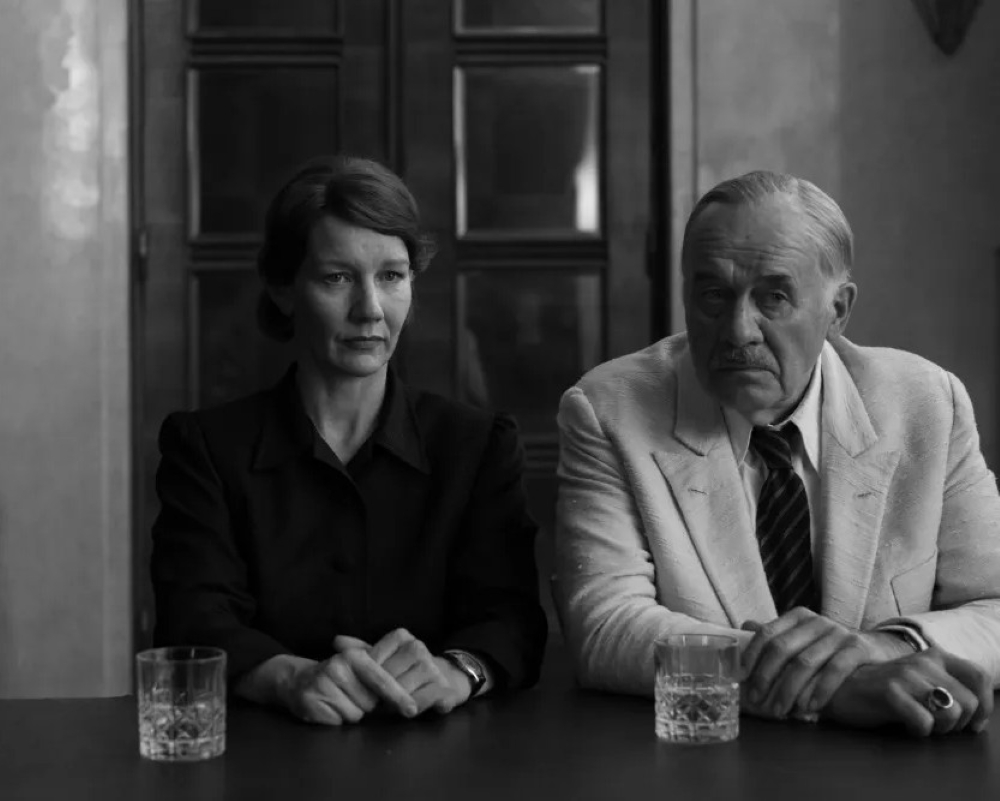
Visually, Fatherland continues the director’s signature style: stark black-and-white cinematography, precise composition, and controlled framing. But here, form serves a sharper purpose. The images feel preserved, almost museum, as if reality itself has been frozen for examination. Characters appear ghostlike, suspended within spaces that function as sites of memory rather than lived environments. The camera observes without intrusion, maintaining a cold distance that heightens discomfort.
Cinematographer Łukasz Żal uses light and shadow as a narrative force. Interiors often feel too large, too empty, emphasising the characters’ isolation. Even when figures share the same frame, they remain emotionally estranged. This tension — achieved without raised voices or overt conflict — becomes one of the film’s defining qualities.
At the center stands Erika, played by Sandra Hüller with controlled intensity. Her performance resists openness; emotion is contained, but never absent. Every gesture suggests suppressed anger and disillusionment. She rejects the possibility of reconciliation — both with history and with her father. Her silence is more forceful than speech, and when it fractures, the film reaches its most powerful moments.
Opposite her, Hans Zischler as Thomas Mann embodies an older intellectual order — cultured, articulate, yet increasingly disconnected from reality. His belief in culture as a moral force appears fragile in the face of historical catastrophe. As his certainty erodes, he becomes a figure of quiet confusion, unable to fully grasp the ethical demands of the present.
Pawlikowski offers no resolution. Instead, he emphasises incompatibility: two generations confronting the same trauma through irreconcilable frameworks. For Mann, Germany remains an idea shaped by culture and tradition. For Erika, it is a crime scene that cannot be redeemed. This tension remains unresolved, and that refusal is central to the film’s power.
Sound and music are used sparingly but precisely, reinforcing a sense of loss and irreversibility. Rather than guiding emotion, they open a subtle, almost subconscious layer beneath the film’s surface austerity.
Crucially, the film engages with German guilt not as a closed historical chapter, but as an ongoing condition. In the context of Russia’s war against Ukraine, Fatherland acquires renewed urgency. Questions of guilt, complicity, and silence are no longer abstract — they define present reality. The film’s exploration of denial and moral evasion echoes current attempts to normalise violence or obscure responsibility.
Pawlikowski draws no direct parallels, yet the associations are unavoidable. A society striving for “normality” while ignoring its crimes, the failure of culture to prevent violence, the retreat into intellectual distance — all of this speaks directly to the present moment.
Ultimately, Fatherland is not only about the past. It is a warning about the cyclical nature of history and the dangers of forgetting.
