


By Erin Free
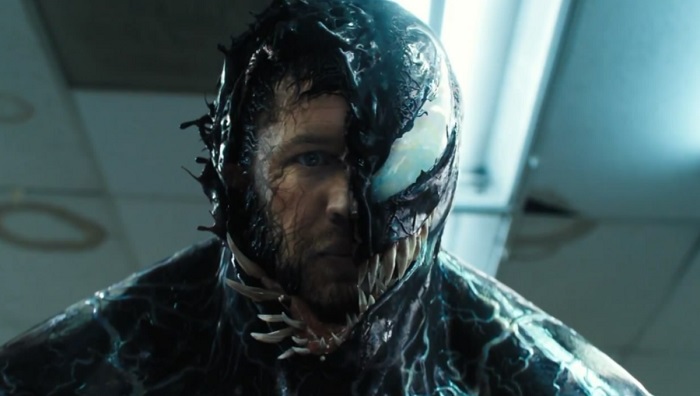
VENOM (TOM HARDY) IN VENOM “As far as Marvel characters, I have to say for me, Venom looks the coolest,” British actor, Tom Hardy, told Entertainment Weekly of what appealed to him about playing the cinema’s most unconventional superhero. “That sounds a bit shallow! But I appreciate that he has a kind of brazen swagger and a zero foxtrot attitude. There’s also a tragic clown element, which I find funny and is harmonious with some of the work that I like to do,” Hardy said about the role. “There’s something funny about the circumstances of having a gift but it’s a tragic gift. It’s a superpower you don’t really want, but at the same time, you love it. It makes you feel special. He’s a reluctant hero and an anti-hero.” In Venom, Hardy plays investigative journalist, Eddie Brock, who ends up physically and emotionally merging with the alien symbiote creature, Venom, which “gifts” him with incredible new superpowers, and a new sense of abandon. Eddie wrestles to control his dangerous new abilities, but also gets a massive high from them. Soon, these two separate entities become more and more intertwined, and Eddie’s behaviour gets more wild, violent, and anarchic. Free of moral restraint, Eddie/Venom starts doing dangerous, vicious but undeniably heroic things in a very anti-heroic manner. “Eddie Brock now has a beast who lives rent-free in him,” Hardy told Esquire of his latest wild and wonderful creation.
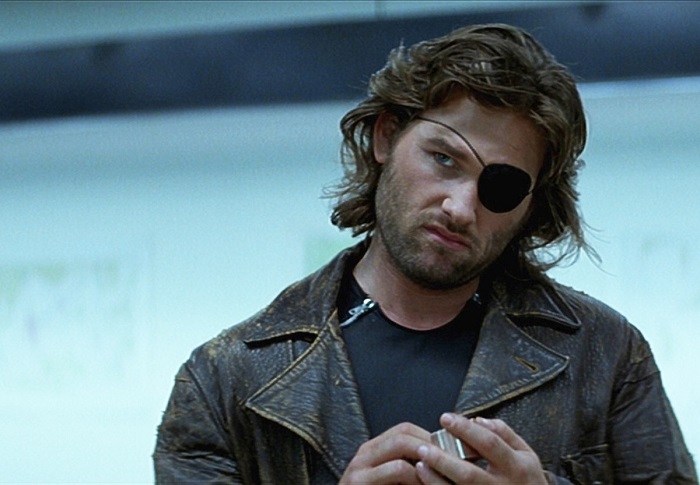
SNAKE PLISSKEN (KURT RUSSELL) IN ESCAPE FROM NEW YORK When it comes to badass anti-heroes, few can hold a candle to Snake Plissken. Played with gruff, imaginative authority by Kurt Russell in John Carpenter’s 1981 cult classic Escape From New York, Plissken is a bad man in an even worse world. Ravaged by war and an out-of-control crime rate, America has become such a cesspool that New York has been refitted into a maximum security prison. When a plane carrying The US President crashes into the prison after being hijacked by terrorists, war hero turned bank robber Plissken is sent in to get him. “We’re still at war,” says Lee Van Cleef’s Police Commissioner Bob Hauk, the man sending him in. “We need him alive.” The recalcitrant Plissken’s sneering reply – “I don’t give a fuck about your war…or your president” – instantly sets him up as a classic anti-authoritarian hero. “Snake is an archetypal Western character; a hired gun,” John Carpenter has said of the character’s genesis. “He’s also a part of me that’s distrustful and dislikes authority. Snake is a sociopath and doesn’t give a shit about anyone. All he cares about is living for the next sixty seconds. He doesn’t want to hurt you, but don’t screw with him. He’ll get you back.” And though seemingly a simple action sci-fi flick, the final scene of Escape From New York – Plissken cruelly unspooling a tape containing a message of possible world peace – showcases one of the most unforgettably nihilistic and rebellious characters in the history of cinema.
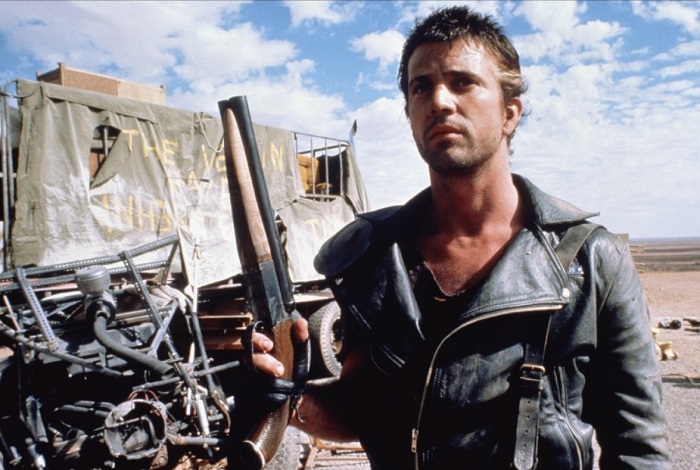
MAX ROCKATANSKY (MEL GIBSON) IN THE MAD MAX TRILOGY George Miller’s bone-rattling 1979 biker flick, Mad Max, is undoubtedly one of the finest and most original action films ever made. Set in a violent near-future where vicious biker gangs strike terror into anyone on the road, Mad Max follows the downward spiral of young cop, Max Rockatansky (Mel Gibson in his star making performance), who goes from disillusionment to burnt out frenzy when his wife and baby are mowed down by a gang, setting off a shattering chain of events that spark murder, rape, and sadistic savagery. George Miller equalled his brutalist masterpiece with 1981’s Mad Max 2, which pushed its titular anti-hero into an even more dystopic future. Distant, non-committal and mercenary, the Max of this second entry is no white knight. A third, less successful entry – 1985’s Mad Max: Beyond Thunderdome – didn’t dent the magnetic aura that had risen around Max Rockatansky. Despite having only minimal dialogue, Max is a man of action, and those actions – often performed under taciturn duress – are what define him. “I still get letters from people wanting to write a thesis on Mad Max as classic post-modern cinema,” director, George Miller, has said of Mad Max. “And then in every place, it seemed to have a resonance. Someone from Iceland said that Max is a lone Viking guy. In Japan, they told me that he was a samurai. I suddenly had the wit to see that I was a storyteller, and a servant of the collective unconscious.”
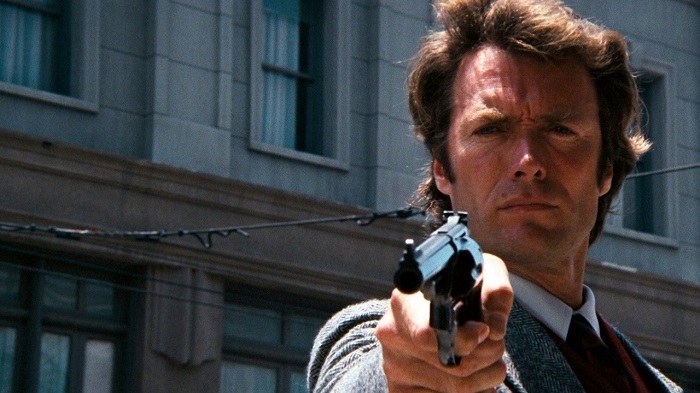
HARRY CALLAHAN (CLINT EASTWOOD) IN DIRTY HARRY In 1971, Inspector Harry Callahan – played with towering authority and sly humour by Clint Eastwood – instantly blasted his way into Hollywood’s pantheon of classic anti-heroes. Though he would reappear in three fine if slightly inferior sequels (1973’s Magnum Force, 1976’s The Enforcer, 1983’s Sudden Impact) and one true abomination (1988’s dire The Dead Pool), Harry Callahan is at his lean, lithe, brutal best in Don Siegel’s 1971 masterpiece Dirty Harry. This drum-tight thriller marked Eastwood’s first major urban, modern role (he still sported a cowboy hat and boots in Siegel’s prior classic, 1968’s Coogan’s Bluff), and it would ultimately form the cornerstone of his highly impressive career. Armed with his massive .44 Magnum handgun, and a spectacular disregard for petty things like by-the-book police procedures and respect for authority, Callahan has a distinctly Old West approach to enforcing the law. The film was a massive success, and Clint Eastwood made Harry Callahan a truly indelible character. Many leftist critics and social commentators, however, saw Callahan as a right wing, neo-fascist dinosaur. His against-the-grain singularity, to-the-bone terseness, and willingness to bend the rules, however, make him a classic anti-hero. “I felt the character was a man of purpose,” Eastwood told MTV in 2008. “Once he decided on something, there were no side-movements away from it, no extraneous movements. He was a very determined soul.”
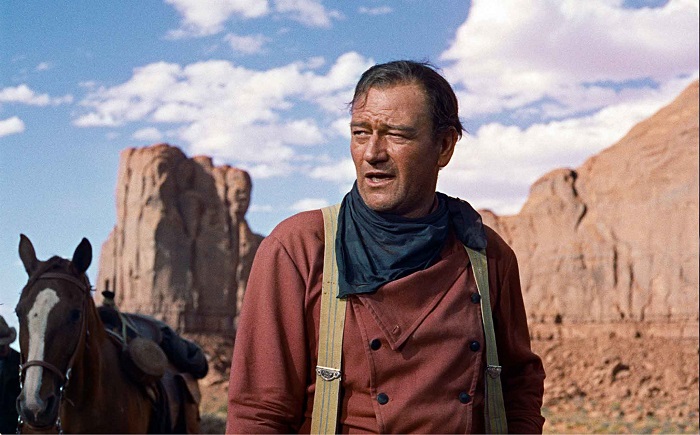
ETHAN EDWARDS (JOHN WAYNE) IN THE SEARCHERS One of the great ironies of the western genre is that its greatest on-screen figurehead – the towering John Wayne – gave his finest performance in a role that rebukes just about everything deemed essential to a “white hat” western hero. A borderline psychotic Confederate veteran who spends years in the relentless pursuit of renegade Indians who have captured his niece, Debbie (Natalie Wood), Wayne’s Ethan Edwards is a bigoted, violent bully of a man whose mission is far from a holy one: he doesn’t plan to bring Debbie home to her family, but rather to kill her, since she’s now the “leavin’s of an Indian buck”, and a figure of shame and embarrassment. John Wayne is truly astounding in the role, making Edwards a picture of both extreme heroism and building madness. “It’s his greatest role,” said Glenn Frankel, the author of The Searchers: The Making Of An American Legend. “A lot of us have this vision of John Wayne as this guy in the sixties and seventies who was very right wing. But before he was that guy, he was this very supple and interesting character. On the one hand, he’s John Wayne – he’s very charismatic and we’re rooting for him to succeed on his quest and yet, what is the quest? Our white knight is planning to kill the young damsel. He’s very burdened by this mission, but he’s driven by vengeance and his brand of justice.”
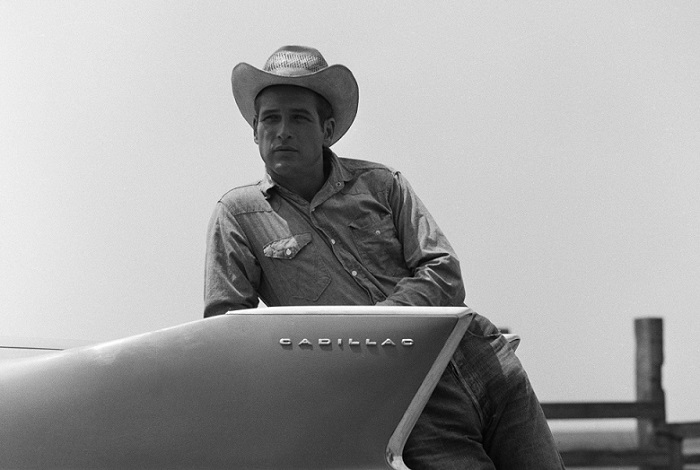
HUD BANNON (PAUL NEWMAN) IN HUD Paul Newman has a career resume boasting a fistful of iconic characters, but without doubt, one of his most unforgettable and unsettling is the icy, amoral Hud Bannon in Martin Ritt’s 1963 classic Hud, an austere, bruising character study about the dying days of the west. Set amongst the stagnant landscape of a Texas ranch, the film sets the callous, unfeeling young Hud against his decent father, Homer (the majestic Melvyn Douglas). Hud, meanwhile, is only concerned about money, booze, women and his own bad self. Though vicious (he rapes the family’s gorgeous, life-force-like housekeeper, played with ebullient but sly brilliance by Oscar winner Patricia Neal) and unforgivably mercenary (he cruelly takes control of his father’s property when it starts to falter financially), Hud is also impossible to look away from. Newman plays the character with such unforced nuance that you can detect fleeting evidence of Hud’s inner hurt and damage, without ever edging toward sentimentality. The character is now an icon of macho badness, and has a longevity even more pronounced than Newman’s more recognisable good guys. “He had all the external graces,” Newman has said of Hud’s appeal. “He was thin and muscular and drank well and was great with the ladies and had a sense of humour. He had a sense of boldness. He was simply rotten at the core.”
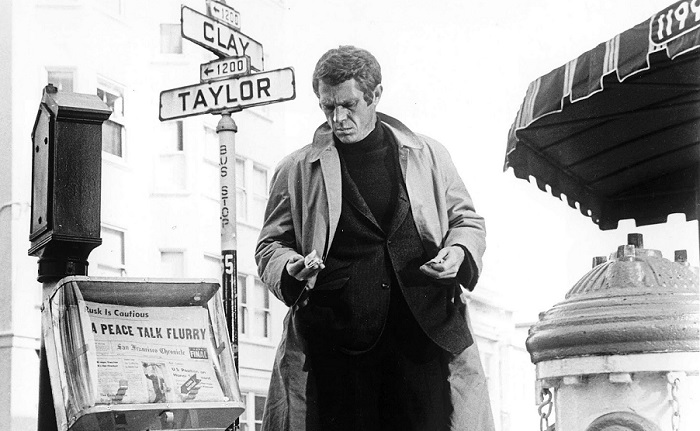
FRANK BULLITT (STEVE MCQUEEN) IN BULLITT Steve McQueen gives one of his finest performances as taciturn San Francisco cop, Frank Bullitt, in the 1968 thriller, Bullitt, which the late actor often referred to as his favourite on-screen character. Dressed in of-the-era flannels and turtlenecks, McQueen moves through the film with authority and elegance, relentlessly tracking down the mobsters who killed a witness in his protection. Much more minimalist than most crime thrillers, Bullitt is engineered around McQueen’s less-is-more approach (“You only say what’s important, and you own the scene,” the actor once said), taking on an air of existentialism merely by dint of its extraordinary restraint; McQueen’s famous stare at Jacqueline Bisset across a crowded restaurant table subtly but powerfully conjures up more intimacy than any torrid love scene could. Though most famous for its legendary climactic ten-minute car chase which ingeniously exploits the undulating streets and sinewy freeways of San Francisco to perfection, the coolest thing about Bullitt remains its title character – like a literal eye of the storm, Frank Bullitt is still and unmoveable while everything furiously swirls and tilts around him. His mere sense of self and silence instantly makes him an anti-hero of the first order. “I’m a limited actor,” McQueen once said. “I have to find characters and situations that feel right. Even then, when I’ve got something that fits, it’s a hell of a lot of work.”
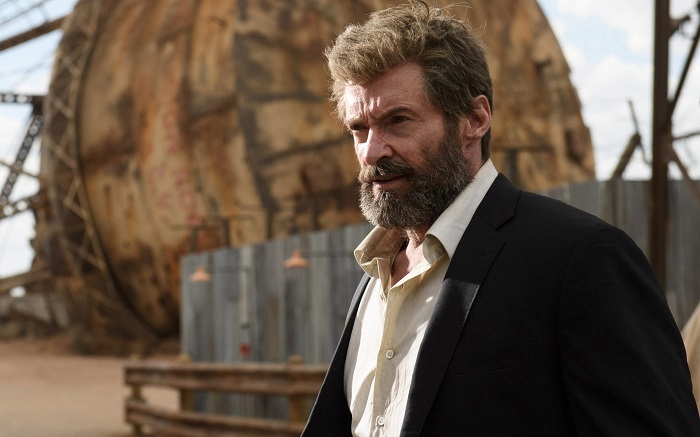
WOLVERINE (HUGH JACKMAN) IN THE X-MEN AND WOLVERINE MOVIES “Wolverine is one of the hardest challenges that I’ve had as an actor,” Hugh Jackman has said of his Marvel Comics anti-hero. “It’s the backbone of my career.” Wolverine is justifiably one of the most popular and enduring characters in the Marvel Comics stable. A member of the mutant superhero team, The X-Men, Wolverine (aka Logan) is blessed – or perhaps cursed – with a rapid healing factor, which allows him to not only recover from injury with extraordinary speed, but also to age at an abnormally slow rate. Also possessed of retractable bone claws and animal-keen sensory powers, Wolverine was absorbed into the shady Weapon X programme, where his skeleton was covered with the metal adamantium, making him near indestructible, and his claws even more deadly. He is also a character who has no problem with killing people, and literally immersing himself in violence…in short, he’s about as far from fellow superheroes like Superman and Captain America as you could get. “Wolverine is a dangerous character,” says veteran producer, Ralph Winter, who worked on the first three X-Men films. “You’re not sure what he’s going to do. There’s a rage just beneath the surface. He’s been manipulated and deceived, and yet he has a charming side. He fights for the right thing. There’s a lot going on behind his eyes, and that’s always attractive.” Shakespearean in scope, Wolverine still stands as Marvel’s greatest anti-hero, both in print and on screen.
Venom is in cinemas now.
