



by Mitchell Jordan
Worth: $18.00
FilmInk rates movies out of $20 — the score indicates the amount we believe a ticket to the movie to be worth
Cast:
Sarah Spale, Martin Vischer, Rabea Egg, Morgane Ferru, Ueli Jäggi, Viviana Zappa, Cyril Metzger
Intro:
… inspiring and touching …
Everyone knows 1920s fictional cooking icon Betty Crocker, but few outside of Switzerland would be aware of the country’s own kitchen guru, Betty Bossi, and – more importantly – the woman who created her.
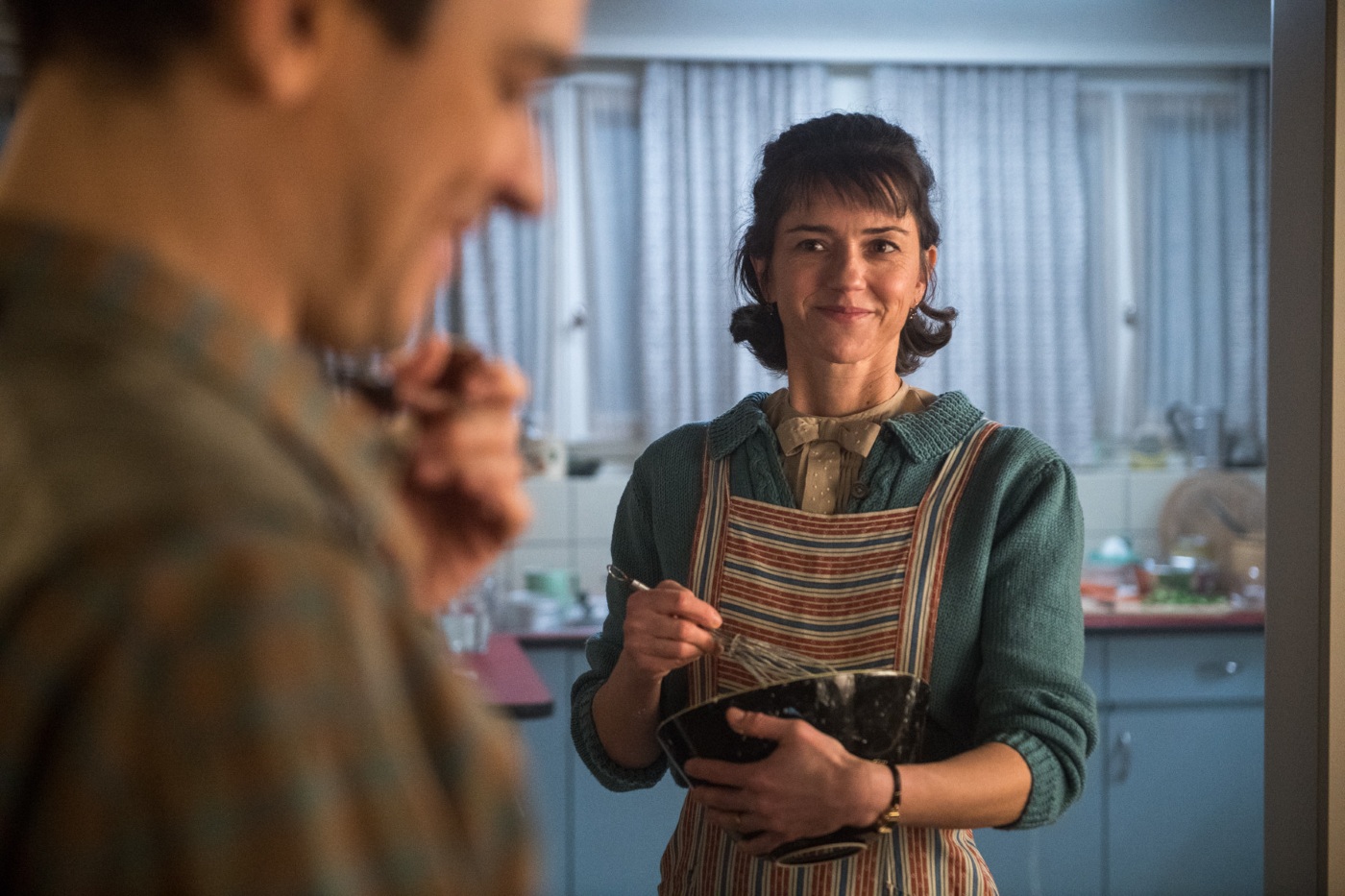
Director Pierre Monnard chronicles the life of Emmi Creola (Sarah Spale) a wife, mother of three and copywriter for a Zurich advertising agency who invented a cultural icon. The film opens in the present day when a young female journalist is sent to interview an elderly Emmi at a restaurant, where she demands fresh basil for her bowl of pasta. Clearly, this is a woman in control, who knows what she wants. But it was not always that way.
Stepping back to 1956 in the aftermath of World War 2, the film takes audiences to a country where tension between the Swiss and immigrants is palpable. Less static are the gender relations of the time. We see Emmi punching out copy at her typewriter in a room of mostly men, walking home after work to rouse her children and prepare dinner with barely functional utensils while her husband, the seemingly inept Ernst (Martin Vischer) tries to connect an aerial to the family’s first ever television.
At work, a male colleague’s pitch for a typical housewife cooking character to sell kitchen products riles Emmi, who knows that other women are too time-poor and overworked to spend their days pouring over pages of the cookbook. She suggests Betty Bossi, a newspaper agony aunt for women in the kitchen, who soon becomes a hit, and sees Emmi making in-store appearances as Betty, a smart lady whom other mothers and wives look to as a saviour and idol.
In lesser hands, this story could have easily become sentimental or a glossy hero’s journey from tinned beans to banquet, but Monnard never shies away from the complexities of Emmi’s story. What, for example, does it mean to pretend to be someone else? Is it wrong of Emmi to use her own family’s dilemmas and experiences as fodder for Betty’s newspaper column? There’s also a brief look at domestic violence and women’s safety through Emmi’s newfound sidekick, the feisty Maxi (Rabea Egg), a cook at an Italian restaurant who often steals the show with her wit and knowledge of how to de-Swiss food into something truly mouth-watering.
It’s true that many of the male characters can appear like stereotypes, but it’s also worth considering that this is no doubt because those were the attitudes of the time. While Ernst initially suffers somewhat as a shadow to his wife, he too comes into his own by the film’s neat conclusion where the pair become a team. Indeed, a real highlight is seeing the photos of the real Emmi and Ernst during the credits.
“I don’t want the whole song and dance,” elderly Emmi sells the journalist. But after watching Monnard’s inspiring and touching tribute, one can’t help feeling she deserves all that and more.
