

by Stephen Vagg
Our recent piece on Dolores Hart prompted us to revisit the oeuvre of director Henry Levin (1909-80), who made Hart’s best-remembered film Where the Boys Are (1960) along with many others over a career of thirty plus years. Despite long stints at Columbia, 20th Century Fox and MGM, Levin’s not very well regarded critically, so we decided to do a deep dive on him via this A to Z.
Do we think he was an underrated genius? Or his is relative obscurity deserved? Read on and find out.
A is for animal movies
Levin’s first movie as director was Cry of the Werewolf (1944), a cheerful Columbia B-picture knock-off of Cat People (1943), about a woman (Nina Foch) who thinks she’s a wolf. Levin found himself returning to animals from time to time throughout his career: Sergeant Mike (1944), the story of a soldier (Larry Parks) and his war dog; April Love (1957), about a teen (Pat Boone) forced to ride horse buggies instead of cars when he loses his drivers’ licence; Run for the Roses (1977), a boy and his horse and the Kentucky Derby. There was also a memorable goose in Journey to the Centre of the Earth (1959). We don’t think there was a predilection for this on Levin’s part – it seems that throughout his career, he simply shot the scripts he was given rather than developing his own material, and some of those scripts happened to have animals in them.
B is for black movies
Levin directed a surprisingly large amount of black-related movies – well, two of them, which is two more than most of his contemporaries. The first was the war propaganda documentary The Negro Sailor (1945), a fascinating slice of cultural history inspired by the success of The Negro Soldier. The second was the Fred Williamson vehicle That Man Bolt (1973), an endearingly dumb combination of James Bond, karate, and blaxploitation, where Williamson travels from America to Hong Kong and kicks a lot of ass. Against this are several films that Levin made set in the old slave-owning south with barely any black characters in them: The President’s Lady (1953), and The Gambler from Natchez (1954); ditto the Jamaican set Treasure Seekers (1977) has an almost entirely white cast. Still, it is cute that Levin made a Fred Williamson movie.
C is for Clifton Webb
Levin directed three Clifton Webb films at 20th Century Fox – Mister Scoutmaster (1953), The Remarkable Mr Pennypacker (1958), and Holiday for Lovers (1959) – none of which really captured Webb’s special quality as a star. Levin also directed a sequel to the 1950 Webb hit, Cheaper by the Dozen, called Belles on Their Toes (1952). However, Levin’s best film, Journey to the Centre of the Earth, was originally envisioned as a vehicle for Webb – who was too ill, so James Mason stepped in instead.
D is for dialogue director
Levin broke into the film industry in the early 1940s at Columbia Studios as a dialogue director – someone whose job it was to help the director with the actors (William Castle, later a legendary producer famed for his gimmicks, started at Columbia at the same time doing a similar job). Levin did that for sixteen months, working on B pictures like Appointment in Berlin (1943) before being promoted to director with Cry of the Werewolf.
E is for education
Levin’s training as a film director came in the 1930s, where he spent over a decade working in theatre: amateur stuff in his hometown, then summer stock, and a bit of Broadway – which led to the aforementioned job offer from Columbia in Hollywood. Remember, kids – it’s all about doing your 10,000 hours, and Levin definitely put that in before he ever set foot on a sound stage.
F is for film noir
Levin directed a decent amount of these at Columbia, and they are very good: Night Editor (1946) (a real gem), Convicted (1950) (a solid remake of The Criminal Code), Two of a Kind (1951), and The Family Secret (1951). Levin’s The Guilt of Janet Ames (1947) should have been a film noir but turns into a load of dreadful psychological codswallop, which helped damage Rosalind Russell’s career. Levin’s attempts at mixing noir/crime with comedy generally did not work as well eg Mister Soft Touch (1949) (dull), A Little Bank That Should Be Robbed (1958) (doggedly unfunny). However, he did make a gloriously fun comedy mystery in The Corpse Came COD (1948) with George Brent and Joan Blondell. That’s the thing with Levin’s career – he could be hot and cold in the same genre, it depended on the stars, script and producer he was given. Henry could not transcend bad material, but he could on occasion enhance strong material.
G is for the Great Depression
Levin originally planned to be a stockbroker in New York – he studied economics at college, like a good boy – but he started working on Wall Street in 1929 just before the stock market crashed, unleashing the Great Depression. Levin was forced to change careers, and moved home to Trenton, New Jersey, where he sold real estate and worked in theatre in his spare time, developing skills that would launch his film career. Moral of the story: sometimes you might be better off financially following your passion.
H is for horror movie
Columbia Pictures weren’t famous for their horror films in the 1940s, certainly not compared with Universal and RKO, but they made a few, some of which Levin directed. As mentioned, he started off his directorial career with a Val Lewton-esque horror film, Cry of the Werewolf, then made three hugely entertaining “B” pictures based on the I Love a Mystery radio series, all with horror aspects: I Love a Mystery (decapitations and George Macready), The Unknown (insanity and crypts), The Devil’s Mask (headhunters). It’s a shame that he didn’t work more in the space, he had a flair for it.
I is for Irving Allen
A producer best remembered for two things (a) being confused with master of disaster Irwin Allen, and (b) turning down the opportunity to make a film series of the James Bond novels (his partner Albert Broccoli decided to do it instead and reaped a fortune). Levin directed several of Allen’s post-Broccoli movies in the 1960s: the surprisingly smart epic Genghis Khan (1965), the jokey Dean Martin/Matt Helm movies Murderer’s Row (1966) and The Ambushers (1967), and the nihilistic, spaghetti Western-ish The Desperadoes (1968). Allen clearly regarded Levin as a safe pair of hands – someone he could trust to deliver on time and on budget. Indeed, Levin was that.
J is for James Bond
Levin directed several James Bond knock-offs in the 1960s. The most high-profile of these are the aforementioned two Matt Helm films, but the most fun is Kiss the Girls and Make them Die (1965), which ostensibly stars dull Mike Connors but is stolen by the marvellously entertaining Dorthy Provine and Terry Thomas having the time of their lives playing a riff on Lady Penelope and her chauffeur Parker from the Thunderbirds.
K is for kids’ films
Levin movies with kid protagonists were typically bad. Mr Scoutmaster was schmaltz Clifton Webb; Scout’s Honor (1980) (his last movie) was a dreadful Gary Coleman television film, which manages to waste the talents of both Coleman and Katherine Helmond; Run for the Roses is a plodding, conflict-free horse flick; Sgt Mike had a painfully boring kid. However, his movies for kids (families, rather) were great – Journey to the Centre of the Earth, The Wonderful World of the Brothers Grimm (1963), etc.
L is for Life Stories
Levin found himself allocated to the occasional biopic throughout his career, starting with Jolson Sings Again (1949), about how the career of Al Jolson (Larry Parks) was revived by the mammoth success of The Jolson Story (1946) – featuring a scene where Larry Parks as Jolson plays against Larry Parks as Larry Parks. Levin also directed The Petty Girl (1950), a hugely entertaining musical based on a real artist, George Petty (played by Robert Cummings); Belles on Their Toes, a sequel to Cheaper by the Dozen, which was based on a true story; The President’s Lady, a biopic of bigamist president Andrew Jackson (Charlton Heston); Genghis Khan, with Omar Sharif surprisingly good in the title role amongst some of the worst yellowface in Hollywood history (Robert Morley and James Mason!). Levins’s oddest true story movie was The Flying Missile (1951) with Glenn Ford, the story of the history of submarined-launched cruise missiles… which actually is quite watchable.
M is for musicals
Levin cranked out a few musicals – along with the aforementioned Jolson Sings Again and The Petty Girl, he did a string of musical remakes of non musical films: The Farmer Takes a Wife (1953), a not-very-good Betty Grable take on the 1935 Janet Gaynor-Henry Fonda film; Let’s Be Happy (1957), a not-very-good Vera Ellen/Tony Martin take on the 1941 British comedy Jeannie; April Love, a sweet Pat Boone version of Home in Indiana (1944). Boone also sung in Levin’s Bernadine (1957) and Journey to the Centre of the Earth (though his songs were cut out of the latter). In the early 1960s, Levin made a string of comedies starring singers: Where the Boys Are with Connie Francis, If a Man Answers (1962) with Bobby Darin, Honeymoon Hotel (1964) with Robert Goulet, the Matt Helm films with Dean Martin. All these films might’ve been better off had they been turned into musicals.
N is for nun
That’s what Dolores Hart became. Levin had a crush on Hart, as evidenced by the close-ups given on Where the Boys Are, a terrific film which ranks just below Journey to the Centre of the Earth as Levin’s best. His reunion with Hart in Come Fly with Me (1963) was less successful. It should be said that Levin got Hart to deliver her best performance in Where the Boys Are – indeed, he regularly got strong performances out of his female leads throughout his career.
O is for overseas locations
From the 1950s onwards, Levin worked predominantly on Hollywood films shot overseas, including England (The Warriors (1955) with Aussies Errol Flynn and Peter Finch), Scotland (Let’s Be Happy), Tunisia (The World of Aladdin (1960) with Donald O’Connor), Italy (Kiss the Girls and Make Them Die), Yugoslavia (Genghis Khan), Jamaica (The Treasure Seekers with Aussie Rod Taylor), Brazil (Kiss the Girls), Spain (The Desperados), Hong Kong (That Man Bolt). Levin made so many films in Europe that he even lived in Italy for a few years. The most troublesome shoot of these was The World of Aladdin, where filming in a mosque offended the locals so much that it prompted a riot in which people actually died.
P is for Pat Boone
Levin was probably the most significant director in Pat Boone’s career. He handled Boone’s film debut in Bernadine (though Dick Sergeant plays the lead), Boone’s coming of age as a film star in April Love and Boone’s best movie, Journey to the Centre of the Earth. Boone should have worked with Levin in the 1960s – it would’ve helped both men.
Q is for quiet critical reputation
Levin had a super quiet critical reputation. His career and life inspired very few interviews, profiles and analysis, he is among the most anonymous directors of his generation. We would often get him mixed up with Henry Koster.
R is for romantic comedies
Levin churned out a lot of these over the years: The Mating of Millie (1948) with Evelyn Keyes and Glenn Ford (both frequent Levin stars), And Baby Makes Three (1949) with Barbara Hale and Robert Young (weirdly made for Humphrey Bogart’s company, Sanatana, which also used Levin on The Family Secret), plus the ensemble rom coms Where the Boys Are, Come Fly With Me, and Honeymoon Hotel. Mr Soft Touch with Keyes and Ford is kind of a romantic comedy only without laughs.
S is for Swashbuckler
Levin turned his hand to a number of swashbucklers over the years – The Bandit of Sherwood Forest (1946) (with Cornel Wilde as Robin Hood’s son), The Fighting Guardsman (1945) (with Willard Parker as a Scarlet Pimpernel type in France), The Return of Monte Carlo (1946) (the third in Edward Small’s Monte Cristo franchise, with Louis Hayward as the Count’s grandson), The Gallant Blade (1948) (Larry Parks in 17th century France), The Warriors (Errol Flynn as Edward the Black Prince). None of these are classics in the genre, but all have things to offer to fans; Bandit of Sherwood Forest was a particularly big hit.
T is Taking Over Movies
Levin was the king of taking over movies that started under other directors – at Columbia anyway. He took over The Bandit of Sherwood Forest from George Sherman, The Guilt of Janet Ames from Charles Vidor, The Man from Colorado (1948) from Vidor, Mr Soft Touch from Gordon Douglas, The Petty Girl from Vidor. He co-directed The Wonders of Aladdin with Mario Bava and Brothers Grimm with George Pal. Levin himself was replaced on That Man Bolt by David Lowell Rich after falling ill.
U is for underrated
Was Henry Levin an underrated artist? Um… no. Make some good films, a few excellent ones, but too much dreck. Sorry, Levin fans. Just because this is a deep dive on his movies doesn’t mean we’ve lost our sense of taste.
V is for Vidor, Charles
As mentioned in “taking over movies”, Levin stepped in several times to take over films originally helmed by Charles Vidor. Vidor was probably Columbia’s leading director of the 1940s (Gilda, A Song to Remember, Cover Girl), but was always fighting with the studio’s head of production Harry Cohn. On The Guilt of Janet Ames, Vidor couldn’t handle working under women producers (Virginia Vann Upp and Helen Deutsch), so Cohn replaced him with Levin during filming; on The Man from Colorado, Vidor fell behind schedule so Cohn replaced him with Levin again during filming; Vidor was assigned The Petty Girl and whined, so Cohn sacked him and replaced him with… you guessed it, Levin. The fights between Vidor and Harry Cohn went for years and ranged from yelling matches to law suits and physical violence; indeed, the dispute grew so vicious and was so well publicised that MGM’s Louis B Mayer had to negotiate a truce between them – Vidor bought himself out of his contract with Columbia, and went on to make a number of bunch of movies for other studios (including The Swan and Love Me or Leave Me) before dying during the shooting of Song Without End (1960). Levin didn’t replace him on that one though – George Cukor did.
W is for Westerns
Like all journeymen directors of his generation, Levin made a few Westerns, all quite watchable but often ruined by miscasting: for instance Three Young Texans (1954) has Mitzi Gaynor and Keefe Brasselle out west; the otherwise-entertaining Gambler from Natchez (which is technically a “southern”) really needed a stronger star than Dale Robertson; The Lonely Man (1957) expects us to believe Jack Palance and Tony Perkins are father and son, and that Perkins is a cowboy; The Desperados has Vince Edwards looking like he’s about to fall asleep, with Jack Palance (playing his father) over acting to compensate. For whatever reason, some of these Westerns are moody psychological melodramas: The Man from Colorado, The Lonely Man, The Desperados. The Man from Colorado is probably the best of Levin’s Westerns, with Glenn Ford and William Holden in excellent form.
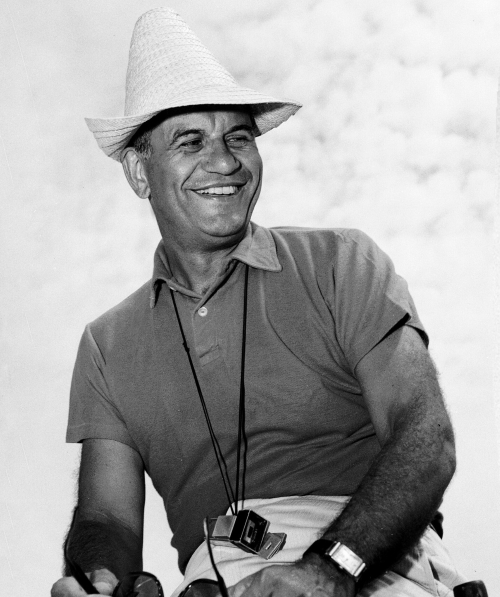 X is for exit, with your boots on
Levin died of a heart attack on 1 May 1980, the day after filming wrapped on Scout’s Honor, his final film. That’s the way to go – not during shooting, like Charles Vidor, but right after. What a pro!
Y is for young stars
Levin launched a series of young stars throughout his career – in addition to the aforementioned early Pat Boone pictures, he helmed the first starring vehicle (or one of the first starring vehicles) for people like Connie Francis, Jim Hutton, Yvette Mimieux, Willard Parker, Stephen Crane (Mr Lana Turner), Larry Parks, Nina Foch, Anthony Perkins, Paula Prentiss, Ann Savage, Robert Morse, Robert Goulet, and Jill St John. Levin wasn’t a miracle worker – for instance, he made several films starring Evelyn Keyes but couldn’t really make her a star, and no one could do anything with Stephen Crane or Willard Parker – but he was clearly skilled with emerging talent.
Z is for Zanuck, Daryl F.
In 1951, Zanuck hired Levin to work at Fox after the director had spent eight years at Columbia. Levin was at Fox for most of the 1950s, then had long stints at MGM and for Irwin Allen. At heart, he was a studio journeyman. He made two classics (Journey to the Centre of the Earth, Where the Boys Are), plus a lot of fun films – you throw in Night Editor, I Love a Mystery, The Corpse Came COD, The Petty Girl, Convicted, The Gambler from Natchez, Kiss the Girls and Make Them Die, The Wonderful World of the Brothers Grimm, and you’ve got a decent top ten. Good for you, Levin!
