


by Anthony O'Connor
Worth: Discs: 7, The Film: 4/5, The Extras: 4/5, Overall: 8/10
FilmInk rates movies out of $20 — the score indicates the amount we believe a ticket to the movie to be worth
Cast:
Chow Yun-fat, Ti Lung, Leslie Cheung, Dean Shek, Anita Mui, Tony Leung
Intro:
… a must own for fans of Woo, Hong Kong action or just lovers of watching blokes leap through the air in slow motion, shooting other blokes with dual wielded handguns.
The Films:
The name “John Woo” is guaranteed to send a frisson of excitement through cinephiles of a certain age. The Hong Kong director is responsible for some of the greatest action films of all time, including The Killer (1989), Hard Boiled (1992) and Face/Off (1997). Hell, he even formalised the “gun-fu” style of onscreen fights that persists to this day in blockbuster franchises like John Wick. Despite Woo’s impressive pedigree, and legions of loyal fans, it’s been relatively difficult to get a hold of some of his earlier work, usually having to rely on third generation DVDs ripped from fourth generation VHS copies. That changes now. Thanks to the charismatic assassins at Imprint Asia, Woo’s formative works have been given the 4K treatment. Which brings us rather neatly to today’s offering: the A Better Tomorrow Trilogy.
A Better Tomorrow (1986) is the story of Triad member Ho (Ti Lung), who runs a counterfeiting scam with his best mate, Mark (Chow Yun-fat), a fact that he tries desperately to keep from his younger brother, cop-in-training Kit (Leslie Cheung). After a deal goes pear-shaped, Ho ends up in jail, Mark ends up permanently injured in a shootout and Kit becomes a driven cop, with a hate-boner for the Triad.
After Ho gets released from the clink, he attempts a redemptive path but soon realises that leaving a life of crime is harder than it looks.
At its core, A Better Tomorrow is a slightly goofy family melodrama interspersed with astonishing action scenes. Woo really swung for the fences with this one, and it changed the face of action movies locally and internationally. Some of the writing is a bit naff, mind you, and Kit is never quite as convincing as Ho and Mark, but ultimately, this is a big-hearted, emotional, violent, tragic and explosive action flick that more than earns its iconic status. That said, the next in the series blew the bloody doors off!
A Better Tomorrow 2 (1987) is a wild, messy bitch of a film. Due to the popularity of Chow Yun-fat, the actor was brought back… this time playing Mark’s long-lost identical twin, Ken! Yes, seriously. Ho and Kit also return, and the plot revolves around the three of them trying to bring down one of the biggest, baddest gangsters of all, Ko (Kwan Shan). Words fail to adequately explain how off the rails ABT2 is, there are just so many bizarre moments and baffling choices. This is a film where Ken, truly an unhinged goblin of a character, attempts to cure the very real PTSD of Lung (Dean Shek) by… emptying the contents of the fridge on the floor, smashing up the house and ranting until he’s literally drooling. And he’s one of the good guys! Jaw-dropping moments like these are followed up with even more astonishing action, with Woo’s rapid, tight editing honing his style to sleek, kinetic perfection. The climactic shootout in a fancy mansion literally needs to be seen to be believed and although the previous entry is probably a better movie, ABT2 is truly unforgettable.
The same, sadly, cannot be said about the third flick.
Okay, here’s the skinny: during the shooting of ABT2, John Woo and producer Tsui Hark had a major falling out over the direction of the series. Now, this wasn’t your typical “the producer is an enemy of art” type bizzo, as Hark is an accomplished director in his own right and would go on to direct the Once Upon a Time in China series (amongst others). However, he and Woo’s differences were irreconcilable and they split, leaving Hark to direct A Better Tomorrow 3: Love & Death in Saigon which probably should have been called A Not Very Good Yesterday because it was a prequel and a bit shit.
The film takes us to 1974 Vietnam and reintroduces us to Mark as a younger man getting embroiled in yet another extremely unlikely crime story. The Vietnamese setting is pretty cool, and seeing the origin of Mark’s sunnies is amusing, but the whole thing feels pedestrian. It’s not helped by the fact that the action scenes are surprisingly limp.
John Woo is a hard act to follow but Hark really drops the ball, losing any of the exciting, kinetic shootouts that defined the previous films and replacing them with flat, mostly bloodless sequences that honestly feel quite amateurish by comparison.
Not without its charms, mind you, but a big step down for the series. As a mildly interesting side note, Woo would go on to make his far superior version of the material with A Bullet in the Head in 1990. Oh, and thankfully, Woo and Hark eventually buried the hatchet and overcame their differences. Which, you know, good for them.
All three films look beautiful in 4K, particularly the first two, and this is undeniably the best way to see any of these tomorrows better.
The Extras:
There’s a lot going on with the extras across these three films, which will delight longtime fans and newbies alike. There are three audio commentaries with various film critics. There are two lengthy interviews with John Woo, talking about the first two films and being generally lovely and crediting Tsui Hark with the fact that he even has a career.
There are interviews with producers, screenwriters, academics and Vietnam researchers. There are archival featurettes for each film, deleted scenes, image galleries and trailers.
However, best in show is the three part series from author of My Best Friend’s Exorcism, Grady Hendrix. Called Hong Kong Confidential, Grady delivers short but utterly fascinating and clearly passionate chats about the background of these films. One of the most fascinating revelations is that Tsui Hark and John Woo basically took turns saving one another’s career, and there was a time when Woo couldn’t get an action film made to save his life. Also, Hark wanted the film to be a female led story starring Michelle Yeoh. Hendrix is an ardent devotee of this genre and his genuine admiration for everyone involved really shines through. Hell, he even has nice things to say about part 3!
Also included in the package is the A Better Tomorrow 2 workprint, which is a much longer and more faithful representation of Woo and Hark’s original vision and the hard to find Taiwanese Cut of A Better Tomorrow 3.
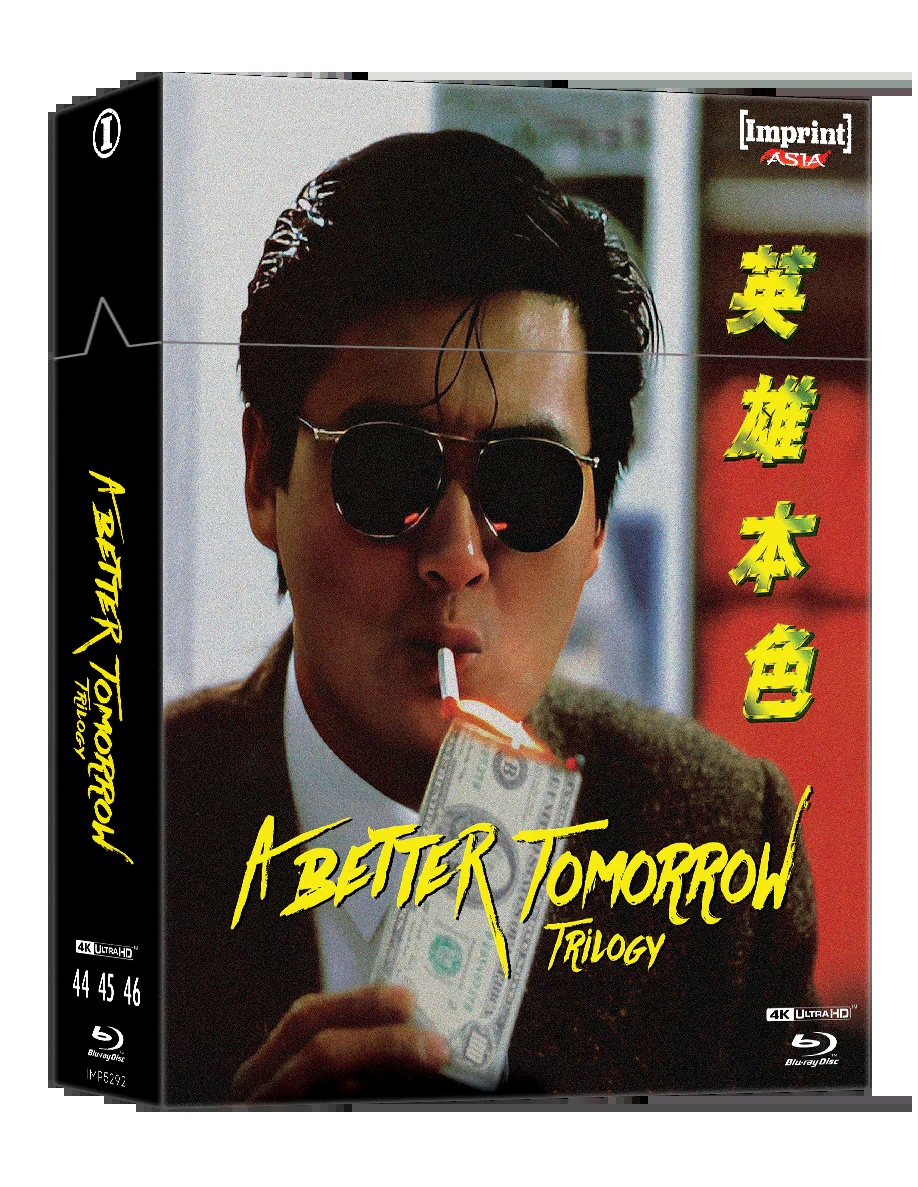
Along with the great digital extras, there’s also a steelbook for the 4K versions of the trilogy, a nice big hardbox for the rest and an 80-page hardback booklet with essays and piccies. It’s a pretty outrageous collection, and definitely not cheap, but for fans who’ve wanted to see these formative works as pretty as possible, this is as good as it gets.
Verdict:
The A Better Tomorrow Trilogy is a stylish, violent and emotional, if occasionally uneven, set of films that quite literally changed the face of action cinema. These are the movies that gave the world John Woo the action auteur and Chow Yun-fat the action star, and formalised an entire genre of bullet ballet that persists on all media to this very day.
Housed in a handsome hardbox with oodles of extras and plenty to dig into, this is a must own for fans of Woo, Hong Kong action or just lovers of watching blokes leap through the air in slow motion, shooting other blokes with dual wielded handguns. If that sounds like you, A Better Tomorrow Trilogy will make your heart explode with joy like a 1980s blood squib under a starched white shirt.
