




by Stephen Vagg
We’ve done pieces in this series on various stars of the 1960 movie Where the Boys Are, including Paula Prentiss, Connie Francis, Yvette Mimieux, and Jim Hutton. So, it makes sense to turn attention to Dolores Hart, the actual female lead of that film (we’ll have to get around to doing George Hamilton one day too).
Hart became famous for giving up her career to become a nun. Quite a few writers did spells in seminaries before the start of their careers (Tom Kenneally, Morris West, Bruce Stewart, Tony Abbott) but actresses going the other way is rarer. June Haver, a back-up Betty Grable in the 1940s, did a stint in an abbey during the early 1950s but quit after eight months and married Fred MacMurray. Dolores Hart joined up in 1963 and as of writing is still a nun. That is hard core. Especially considering that for six years prior, she was a not-quite movie star.
Hart was born in Chicago in 1938, moving to Los Angeles as a girl – her father, Bert Hicks, was an aspiring actor who was under contract to a few Hollywood studios over the years but never made the grade. He was also a violent drunk, who eventually left Dolores’ mother, who was also an alcoholic (both mum and dad would die relatively young). Nonetheless, young Dolores wanted to be an actor; both her parents were good looking, and she grew up very beautiful, which helped (it always helps).
Dolores Hart’s career rise to leads in movies was almost absurdly rapid. She was appearing in a college production of Joan of Lorraine, playing the title role, when spotted by an employee of producer Hal Wallis, who was looking for someone to cast as the love interest of rock sensation Elvis Presley in Loving You (1957). Elvis had been shoehorned into his first film, Love Me Tender (1956) but Loving You, his second picture, was specifically devised for the star. Like a surprisingly large amount of early Elvis movies, Loving You had a subplot about Elvis dallying with an older woman (played here by Lizabeth Scott) before going off with someone age-appropriate – and Dolores Hart was selected to play said age-appropriate girl. We don’t think Loving You is anyone’s favourite Elvis movie – it is poorly directed and glorifies controlling managers – but it had a lot of good stuff in it, notably the music, a Footloose-style finale, Elvis at his youthful sexy best, and Dolores Hart, who is very winning and sweet. The movie was a big hit.
Wallis then put Hart in another “good girl” part in Wild is the Wind (1957), a melodrama starring Anna Magnani involved in a love quadrangle with Tony Quinn, Anthony Franciosa and Hart, who played Franciosa’s girlfriend. Hart had the chance to mix it up a little in “Silent Witness”, an episode of Alfred Hitchcock Presents – she played a college student sleeping with her middle-aged lecturer (Don Taylor) who is married (to Pat Hitchcock!). Hart wouldn’t often get the chance to play a character with both agency and sexual desire, and she’s very effective; it makes one wish she’d depicted a few more temptresses in her career, as she gives the part sympathy and dimension.
Wallis used Hart opposite Elvis again in King Creole (1958), a far better movie than Loving You (indeed, it’s one of Elvis’ best-ever efforts). Again, she played a good girl that Elvis returns to after dallying with an older girl (Carolyn Jones) who (SPOILERS) conveniently dies enabling Elvis to be with Hart. Elvis is at his most early period Tony Curtis here – all snarls, swivelling hips and chip on the shoulder – and Hart is a beautifully effective counterpoint; she was one of his best leading ladies. (We understand why she didn’t want to work with him again – for instance, she refused to be cast in Girls Girls Girls) – but it’s a shame. Hart then played against a man old enough to be her father – as most starlets of her generation were required to do – when cast as Montgomery Clift’s girlfriend in Lonelyhearts (1958), a patchy drama with Clift constantly looking like he’s on the verge of a nervous breakdown.
Hart went over to Broadway and appeared in a hit comedy, The Pleasure of His Company – you might remember the 1960 film version with Fred Astaire and Debbie Reynolds. Australian Cyril Ritchard took the Astaire part (no one much remembers Ritchard these days, but he was a huge Broadway star). Hart played the Reynolds role (Hart wrote in her memoirs that when she found out Reynolds would be in the film “it was the only time in my life I wanted to kill”). Incidentally, Hart’s love interest on stage was played by a young George Peppard (a role taken in the film by Tab Hunter).
Hart also continued to chalk up interesting television credits, appearing in one television play with Tony Curtis and another with Frances Farmer. In “The Crossing” for The June Allyson Show, she played a naïve young woman leched after by middle aged Barry Sullivan.
After Pleasure of His Company, Hart returned to Hollywood. According to her 2013 memoir The Ear of the Heart: An Actress’ Journey from Hollywood to Holy Vows (which is the main source of information for most of this piece), Hal Wallis was going to loan her to Hammer to make Never Take Candy from a Stranger (great movie) but turned that down in the hope she might be cast in the lead of The Story of Ruth – but she lost that role to Elana Eden. She also lost out on parts in From the Terrace (to Ina Balin), Ben Hur (Haya Harareet), A Majority of One (Madlyn Rhue) and most disappointingly, Wallis’ version of Tennessee Williams’ Summer and Smoke – Wallis wanted Hart but Peter Glenville chose Pamela Tiffin. We like Tiffin, but Hart would’ve been much better as the young girl who flings herself at Laurence Harvey.
Wallis loaned her to Allied Artists to play the love interest for Jeff Chandler, twenty years her senior, in The Plunderers (1960), a mash up between a Western and juvenile delinquent film. Once more, Hart was the young option chosen over an older woman (Marsha Hunt); she’s actually really sweet in the film, which is occasionally effective but is poorly paced and staged.
MGM then gave Hart her best role to date in Where the Boys Are (1960) – a “four girls” movie where Hart played the lead, the college student who speaks up in favour of premarital sex though doesn’t necessarily mean it for herself (this was radical for a studio movie at the time) – the solid centre while Connie Francis sings, Paula Prentiss goes madcap and Yvette Mimieux is sexually assaulted – who still finds time to romance George Hamilton. Director Henry Levin developed a crush on Hart, annoying his wife; Hart admits “I got a lot of close ups”. It’s probably her best movie performance and the film was a big hit, her first without Elvis.
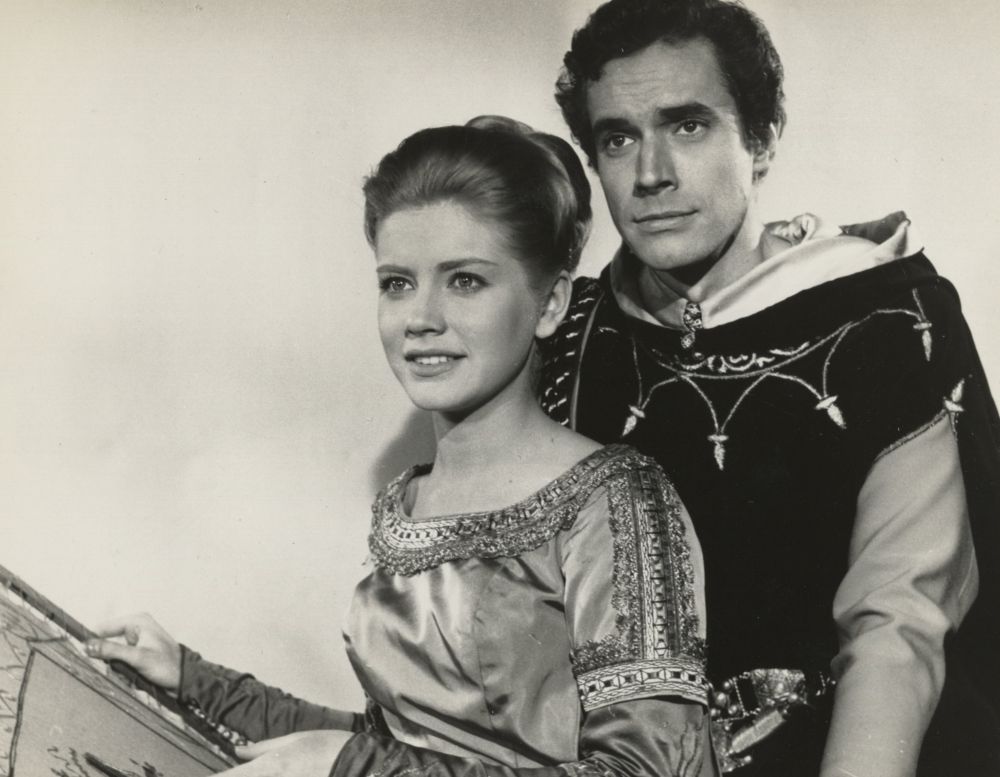
Hart did an episode of Playhouse 90, “To the Sound of Trumpets”, with Stephen Boyd and Boris Karloff, then was given a great chance, or so it seemed, in 20th Century-Fox’s religious drama Francis of Assisi (1961), playing St Clare, a friend of Francis (played by Bradford Dillman). She’s lovely and believable, but the film is dull and made by people who don’t understand drama, or had forgotten (it was produced by Spyros Skouras’ son Plato, and was directed by Michael Curtiz in career decline). St Francis was a box office flop: the one interesting thing about it is Hart, who later became a nun, playing someone who becomes nun.
Hart was getting choosy. Fox wanted her to star with Fabian in A Summer World, but she turned the film down and it was never made. She also refused a part in a film that was made, the terrible adaptation of F. Scott Fitzgerald’s Tender is the Night (1962); Jill St John was cast instead. Hart was uncomfortable as Robert Wagner’s girlfriend in the so-so farce Sail a Crooked Ship (1961), for Columbia; Hart had many fine qualities as a performer but was low energy on screen – she was no Paula Prentiss. Still, who knows what she could have done with the material and filmmakers that, say, Natalie Wood enjoyed with Splendour in the Grass or Love with a Proper Stranger.
We mention Natalie Wood because Hart then played a role originally earmarked for Wood: the female lead in The Inspector (1962) (also known as Lisa), playing a survivor of a Nazi concentration camp, trying to get into Israel with the help of Stephen Boyd. Hart’s excellent and the film should have been a breakthrough for her but it simply isn’t very good – it’s a dull slog, as many movies directed by Philip Dunne tended to be; as Variety pointed out in its review, the film tries to be several things (a romance, thriller, drama, serious comment on human condition), but does none of them well. Even with A-list stars, this movie wouldn’t have worked.
Hart’s last film was Come Fly with Me (1963), a sort of Where the Boys Are for air hostesses, though not as good; Hart seems disinterested. Her final acting role was a guest stint on an episode of The Virginian where she was sweet and winning. After this, she signed up as a nun and that was that.
Prior to Hart’s change of life, she was still in demand, though the roles weren’t fantastic: according to her memoirs, MGM offered her Honeymoon Hotel (1964) with Robert Morse (we think that Nancy Kwan played this role), and sent her scripts for A Ticklish Affair (the part Shirley Jones played), The Courtship of Eddie’s Father (ditto) and Twilight of Honour (Joan Blackman’s part); Hal Wallis pencilled her in for A Girl Named Tamiko but then changed his mind and loaned her out for Bedtime Story, the Marlon Brando-David Niven comedy later remade as Dirty Rotten Scoundrels (another role taken by Shirley Jones). Hart said that she was keen to do the film of Barefoot in the Park (which Wallis had the rights to – Jane Fonda played it in the end). Robert Rossen wanted her to test for Lilith (the Jean Seberg part).
So, you can get some impression of how Hart’s career might have continued had she not become a nun. We doubt that she would ever become a big star – Hollywood was too geared against women stars in the late 1960s unless you could sing, and all Hart’s contemporaries found things harder as the decade went along. However, she was beautiful, warm and could act – she would have had a life-long career. We can see Dolores Hart in a hit sitcom, a string of interesting TV movies and some theatre work, as well as the inevitable guest shots on The Love Boat and Fantasy Island.
Hart’s memoir goes into depth about the nun phase of her career, which included her clashes with authority and spiritual struggles. She remained good friends with some of her Hollywood peers, such as Paula Prentiss, Connie Francis, Lois Nettleton, Karl Malden, and Patricia Neal (there’s a funny account where she helped Neal recover from her stoke by helping the former Mrs Roald Dahl run lines for a scene from the play Anastasia). She fell out with Stephen Boyd – who she dated while making The Inspector – over his interest in Scientology.
Interesting career. Amazing life. She found what she was meant to do. Made some good movies.
