



by Nataliia Serebriakova
Worth: $16.40
FilmInk rates movies out of $20 — the score indicates the amount we believe a ticket to the movie to be worth
Cast:
Léa Seydoux, Laurence Rupp, Catherine Deneuve, Jella Haase, Sylvester Groth
Intro:
… deliberately controlled, almost austere.
Marie Kreutzer’s Gentle Monster begins with a premise that feels almost deceptively simple: a successful artist relocates her family in search of calm, only to see that fragile order collapse overnight. But the film is not interested in the mechanics of scandal or investigation. Instead, it locks onto something far more uncomfortable — the slow, internal disintegration of a person forced to reconsider everything that she thought she knew.
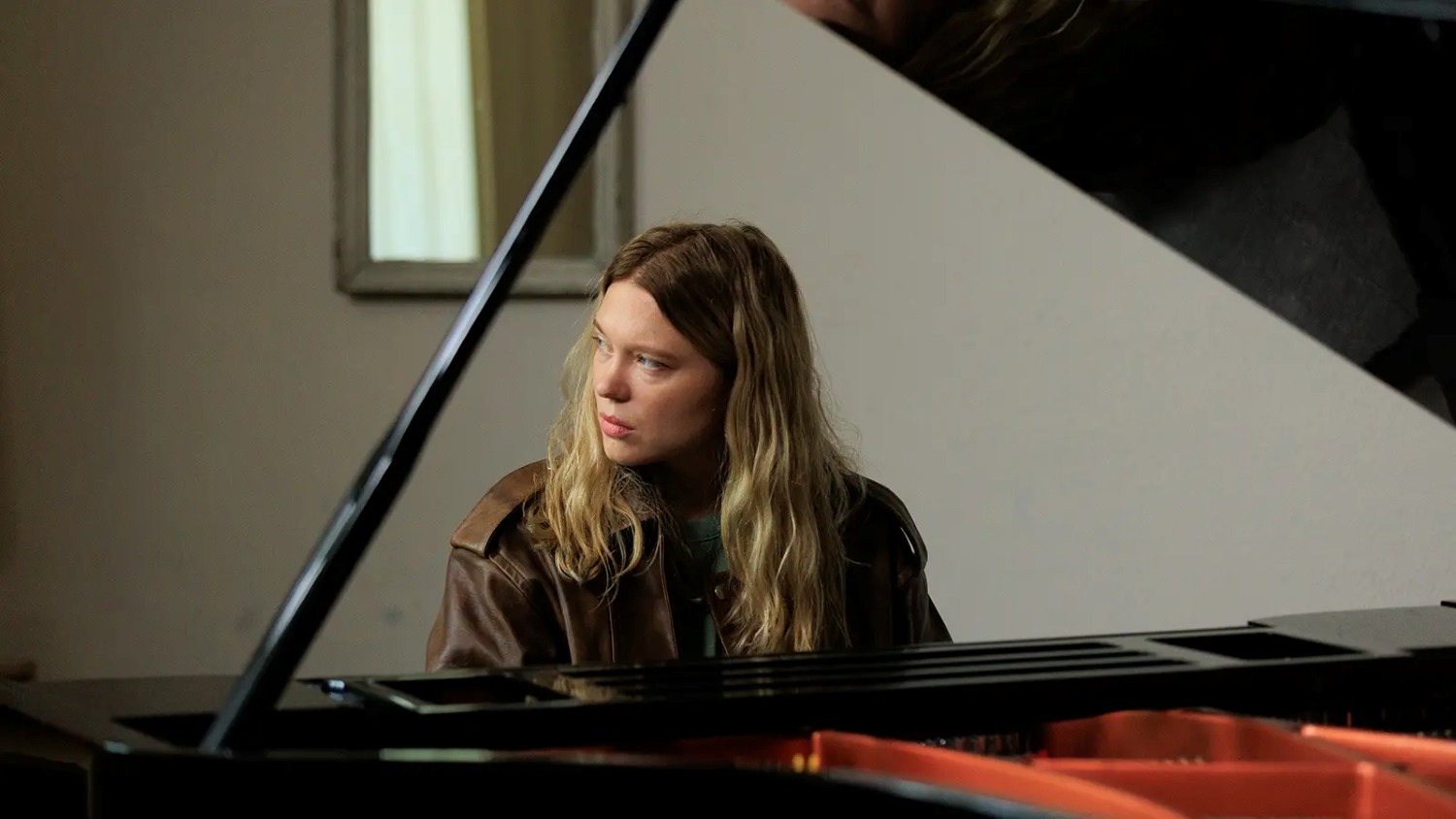
Lucy, played by Léa Seydoux, is not framed as a victim in the conventional sense. She is introduced as someone in control: a musician with a defined aesthetic, a family that appears stable, a life carefully structured around creative and emotional choices. That illusion doesn’t shatter instantly when the police arrive — it erodes. Kreutzer stretches that process, allowing doubt to seep in gradually, almost imperceptibly, until uncertainty becomes the film’s dominant texture.
What makes Gentle Monster particularly unsettling is its refusal to dramatise revelation. There is no single moment of truth, no cathartic confrontation. Information accumulates in fragments, and Lucy processes it in the only way she can — by hesitating. The film understands that belief doesn’t collapse on command. Love, habit, and denial form a kind of resistance, and Lucy clings to that resistance longer than she perhaps should. Not because she is naïve, but because the alternative is too devastating to accept all at once.
Kreutzer constructs the narrative around this psychological delay. Scenes linger past their apparent endpoint, conversations trail off without resolution, and silence becomes a primary mode of expression. The domestic space — the countryside house that was meant to provide refuge — gradually transforms into something ambiguous, almost hostile. It is not a site of safety but a container for suspicion.
Seydoux’s performance is key to sustaining this tension. She avoids overt breakdowns, instead working through micro-shifts in expression and posture. Lucy is constantly recalibrating — not only her understanding of her husband, but also her perception of herself. The question is not just what he has done, but how she failed to see it, and what that blindness says about her own identity.
The film briefly extends beyond Lucy’s perspective through the character of Elsa, the investigator. While her storyline introduces an interesting parallel — another woman negotiating male behaviour and its consequences — it never fully integrates into the central narrative. Still, her presence reinforces the film’s broader concern: how women are left to process, absorb, and respond to the damage created by men who remain, even in absence, structurally dominant.
Kreutzer’s direction is deliberately controlled, almost austere. She avoids sensationalism despite the severity of the subject matter, choosing instead to emphasise emotional inertia. This restraint is both the film’s strength and its limitation. On one hand, it creates a suffocating atmosphere where dread builds quietly but persistently. On the other, it occasionally feels as though the film stops short of interrogating its own implications more deeply.
What Gentle Monster ultimately captures is not the horror of the crime itself, but the banality that surrounds it — the ordinary life that coexists with something unthinkable. It suggests that the most disturbing aspect is not the existence of such acts, but their ability to remain hidden within structures that appear entirely normal.
There are moments when the film edges toward a sharper critique — of masculinity, of cultural complacency, of the narratives that people construct to protect themselves from uncomfortable truths — but it rarely pushes those ideas to their limit. Instead, it settles into observation, maintaining a steady, controlled gaze.
And yet, that may be precisely the point. Gentle Monster is less about exposing something new than about forcing the viewer to sit with what is already known but often avoided. It denies resolution, clarity, and comfort. By the end, Lucy is left not with answers, but with the necessity of making a choice in a reality that no longer makes sense.
It is a film about recognition arriving too late — and about what remains when belief, once broken, cannot be restored.
