



By Erin Free
FilmInk salutes the work of creatives who have never truly received the credit that they deserve. In this installment: director Kevin Connor, who helmed The Land That Time Forgot, At The Earth’s Core, The People That Time Forgot, Warlords Of Atlantis and Arabian Adventure.
With the rise and rise (and rise) of computer-generated special effects, now aided and abetted by AI (it’s not going to be the end of the human race, really!), the films of yesteryear that relied on in-camera tricks as quaint as models, figurines on strings, and men in monster suits are now viewed as items of antiquity. With the exception of the original Star Wars films (which pretty much ushered in the age of cinema in which we now reside) and some of the work of stop-motion pioneer Ray Harryhausen, most of the less fantastical films of the fantasy and science fiction genres of the 1960s and 1970s are now largely forgotten (except for those nostalgists who experienced them the first time around), deemed unwatchable by audiences raised on the slick, polished surfaces of The Marvel Cinematic Universe and other major studio properties. Not surprisingly, the directors who worked principally in these fields, often on low budgets that demanded maximum creativity and extreme effort, are similarly under-appreciated and only infrequently discussed today.
Though he has since amassed an enormous body of work on television (with a very long list of telemovies, mini-series and episodic work to his name) in the years since, director Kevin Connor was one of the most imaginative and consistent directors of low budget fantasy and science fiction in the 1970s, with a number of films whose very titles will likely raise a smile from those people of a certain age who actually grew up in that most freewheeling of decades.

Kevin Connor was born in London in 1937, and first began working on documentary films once he left school. From there, Connor moved into sound editing, and then editing, working with major directors such as Tony Richardson (1966’s Mademoiselle, 1967’s The Sailor From Gibraltar), Richard Attenborough (1969’s Oh! What A Lovely War, 1972’s Young Winston), and Joseph Strick (1967’s Ulysses). Connor was eventually given his directing break courtesy of producer Milton Subotsky, the co-founder and director of Amicus Productions, the only real challenger to Hammer Films when it came to the consistent production of high-quality British horror films.
Kevin Connor made his directorial debut with 1974’s Beyond The Grave, a portmanteau horror film based on the writings of R. Chetwynd-Hayes, starring Peter Cushing, Donald Pleasance, Diana Dors and Ian Bannen. Milton Subotsky handed Connor the reins after being impressed by some spec scripts that the aspiring filmmaker had written from Chetwynd-Hayes’s works, and the result was a creepy, imaginative success made on a very tight, and very restrictive, budget. A likely career in horror filmmaking was curtailed, however, when Connor was offered the chance to direct 1974’s The Land That Time Forgot, an adaptation of Tarzan creator Edgar Rice Burroughs’ novel. It would be the first of Connor’s five 1970s fantasy films, setting up a template of pure entertainment from a decidedly low base. “They were good fun to make and made for next to nothing, something like $300,000 maybe a bit more for some of them,” Connor told Cool Ass Cinema in 2022. “They were made with low budgets and inexpensive casts and dear old Doug McClure and Patrick Wayne. The special effects are all pretty basic with things you could do in-camera the old-fashioned way; all models and hand-puppets long before CGI came in and blew everything up.”
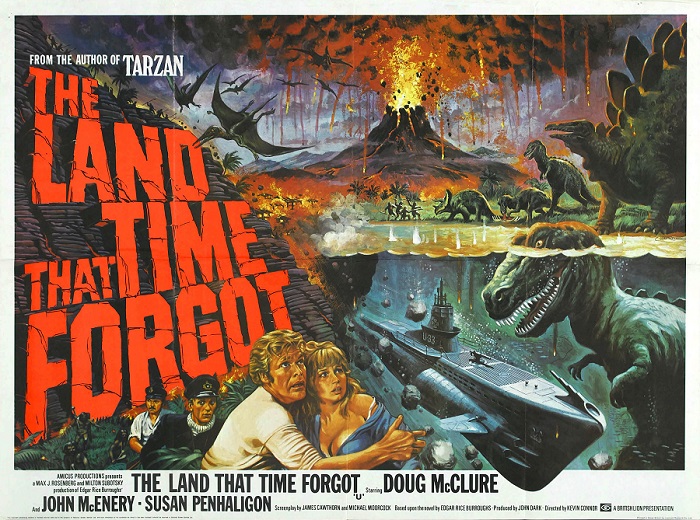
That, however, is very much the basis for what makes The Land That Time Forgot so much fun – you can feel the humanity in every frame, and the hand of man, so to speak, in every fantastical sequence. Starring one-time American TV tough guy and westerner Doug McClure, The Land That Time Forgot follows a collection of lost German, British and American WW1 seafarers into the mysterious land of Caprona, where they encounter dinosaurs, cavemen and other creatures long believed extinct. A thrilling, fun-filled adventure featuring stop-motion animation, life-size models, and monsters flying through the sky on visible strings, The Land That Time Forgot is pure Saturday matinee entertainment, replete with square-jawed heroes and extreme danger, but nothing in the way of overt gore or horror. “Some of the effects are a bit ‘cringe worthy’ when you see them today,” Kevin Connor told Hey U Guys in 2012. “But you have to take them in the time they were created – and the low budget, of course – so I don’t feel too bad about it.” This is, indeed, a major part of the film’s charm.
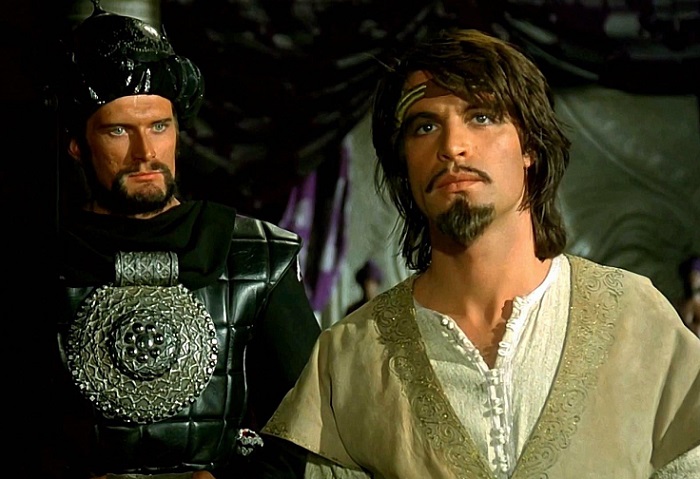
The success of The Land That Time Forgot saw Connor retained for four more films of the same ilk by canny producers Milton Subotsky and Max Rosenberg. That film’s success also saw a slight budget bump-up for its follow-up, 1976’s At The Earth’s Core, another Edgar Rice Burroughs adaptation, once against starring Doug McClure, along with Peter Cushing, as part of a team that drill to the centre of the earth and discover a bizarre world of strange creatures. Connor returned to Edgar Rice Burroughs again for 1977’s The People That Time Forgot (with Doug McClure and Patrick Wayne), but then shifted a little with 1978’s Warlords Of Atlantis, which was penned by Brian Hayles and took the high adventure underwater for a Jules Verne-style tale of a villainous master race and the deep-sea explorers (led by regular Doug McClure) caught in their net. Connor worked from a Hayles script again on 1979’s Arabian Adventure, another thrilling exercise in old school action, this time starring Christopher Lee, Oliver Tobias and Emma Samms.
Though Kevin Connor directed a few more films – including the fascinating horror double of 1980’s Motel Hell (a truly freaky meld of horror and comedy starring Rory Calhoun and boasting some impressive and unforgettably grotesque visuals) and 1982’s The House Where Evil Dwells (a Japan-set ghost story starring Edward Albert, the great Susan George, and old pal Doug McClure) – it is for his five 1970s fantasy flicks that the director really deserves the label of Unsung Auteur. Singular and of their time, they are the work of a filmmaker with a vivid imagination, a real sense for storytelling, and a gritty work ethic. “When you have limited money, you can actually make things look good while doing it cheap,” Kevin Connor told Cool Ass Cinema in 2022. “You can use certain angles to make things look bigger than it really is. It’s how we made films in the old days and I guess we came at the end of that period, if you like; before Spielberg and Jurassic Park and those wonderful CGI effects his crew created for the dinosaurs.”
If you liked this story, check out our features on other unsung auteurs Ralph Nelson, William A. Graham, Judith Rascoe, Michael Pressman, Peter Carter, Leo V. Gordon, Dalene Young, Gary Nelson, Fred Walton, James Frawley, Pete Docter, Max Baer Jr., James Clavell, Ronald F. Maxwell, Frank D. Gilroy, John Hough, Dick Richards, William Girdler, Rayland Jensen, Richard T. Heffron, Christopher Jones, Earl Owensby, James Bridges, Jeff Kanew, Robert Butler, Leigh Chapman, Joe Camp, John Patrick Shanley, William Peter Blatty, Peter Clifton, Peter R. Hunt, Shaun Grant, James B. Harris, Gerald Wilson, Patricia Birch, Buzz Kulik, Kris Kristofferson, Rick Rosenthal, Kirsten Smith & Karen McCullah, Jerrold Freeman, William Dear, Anthony Harvey, Douglas Hickox, Karen Arthur, Larry Peerce, Tony Goldwyn, Brian G. Hutton, Shelley Duvall, Robert Towne, David Giler, William D. Wittliff, Tom DeSimone, Ulu Grosbard, Denis Sanders, Daryl Duke, Jack McCoy, James William Guercio, James Goldstone, Daniel Nettheim, Goran Stolevski, Jared & Jerusha Hess, William Richert, Michael Jenkins, Robert M. Young, Robert Thom, Graeme Clifford, Frank Howson, Oliver Hermanus, Jennings Lang, Matthew Saville, Sophie Hyde, John Curran, Jesse Peretz, Anthony Hayes, Stuart Blumberg, Stewart Copeland, Harriet Frank Jr & Irving Ravetch, Angelo Pizzo, John & Joyce Corrington, Robert Dillon, Irene Kamp, Albert Maltz, Nancy Dowd, Barry Michael Cooper, Gladys Hill, Walon Green, Eleanor Bergstein, William W. Norton, Helen Childress, Bill Lancaster, Lucinda Coxon, Ernest Tidyman, Shauna Cross, Troy Kennedy Martin, Kelly Marcel, Alan Sharp, Leslie Dixon, Jeremy Podeswa, Ferd & Beverly Sebastian, Anthony Page, Julie Gavras, Ted Post, Sarah Jacobson, Anton Corbijn, Gillian Robespierre, Brandon Cronenberg, Laszlo Nemes, Ayelat Menahemi, Ivan Tors, Amanda King & Fabio Cavadini, Cathy Henkel, Colin Higgins, Paul McGuigan, Rose Bosch, Dan Gilroy, Tanya Wexler, Clio Barnard, Robert Aldrich, Maya Forbes, Steven Kastrissios, Talya Lavie, Michael Rowe, Rebecca Cremona, Stephen Hopkins, Tony Bill, Sarah Gavron, Martin Davidson, Fran Rubel Kuzui, Elliot Silverstein, Liz Garbus, Victor Fleming, Barbara Peeters, Robert Benton, Lynn Shelton, Tom Gries, Randa Haines, Leslie H. Martinson, Nancy Kelly, Paul Newman, Brett Haley, Lynne Ramsay, Vernon Zimmerman, Lisa Cholodenko, Robert Greenwald, Phyllida Lloyd, Milton Katselas, Karyn Kusama, Seijun Suzuki, Albert Pyun, Cherie Nowlan, Steve Binder, Jack Cardiff, Anne Fletcher ,Bobcat Goldthwait, Donna Deitch, Frank Pierson, Ann Turner, Jerry Schatzberg, Antonia Bird, Jack Smight, Marielle Heller, James Glickenhaus, Euzhan Palcy, Bill L. Norton, Larysa Kondracki, Mel Stuart, Nanette Burstein, George Armitage, Mary Lambert, James Foley, Lewis John Carlino, Debra Granik, Taylor Sheridan, Laurie Collyer, Jay Roach, Barbara Kopple, John D. Hancock, Sara Colangelo, Michael Lindsay-Hogg, Joyce Chopra, Mike Newell, Gina Prince-Bythewood, John Lee Hancock, Allison Anders, Daniel Petrie Sr., Katt Shea, Frank Perry, Amy Holden Jones, Stuart Rosenberg, Penelope Spheeris, Charles B. Pierce, Tamra Davis, Norman Taurog, Jennifer Lee, Paul Wendkos, Marisa Silver, John Mackenzie, Ida Lupino, John V. Soto, Martha Coolidge, Peter Hyams, Tim Hunter, Stephanie Rothman, Betty Thomas, John Flynn, Lizzie Borden, Lionel Jeffries, Lexi Alexander, Alkinos Tsilimidos, Stewart Raffill, Lamont Johnson, Maggie Greenwald and Tamara Jenkins.