


by Cain Noble-Davies
Worth: $15.00
FilmInk rates movies out of $20 — the score indicates the amount we believe a ticket to the movie to be worth
Intro:
… as warm as it is a bit frustrating thanks to hindsight …
It has been less than two years since the Australian Indigenous Voice referendum was formally voted upon, and regardless of one’s own stance on the topic, it’s reasonable to say that the entire event was a bit of a shitshow. Much like the 2017 same-sex marriage plebiscite (irrespective of its outcome), it was an expensive ordeal where people outside of a specific group decided that group’s fate, and the ensuing outrage in online spaces saw ugliness assert itself.
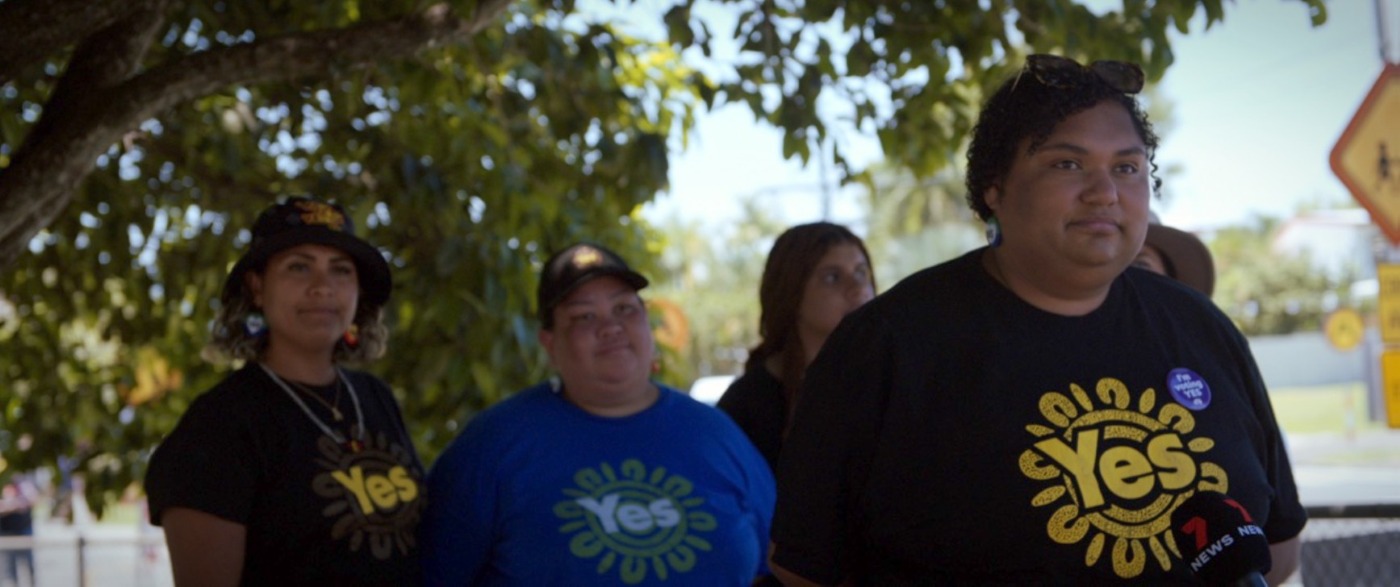
Voice, written, directed, and shot by documentarian Krunal Padhiar, seeks to recenter that moment to what it actually pertained to underneath all the political blustering: Indigenous communities having a say in their circumstances. It follows the grassroots group DIYDG (Deadly Inspiring Youth Doing Good) as they take a road trip across Australia to drum up support for the Yes movement.
Beyond merely putting indigenous voices first and foremost within the larger debate, the film also takes time to highlight specific members of DIYDG as they find their own voice, sharing stories about their upbringing, their connection to the land and the culture, and the reasons for why they are fighting as hard as they are for this to happen. The generation that lived with the impact of the Stolen Generation, with forced estrangement from their people and their culture, and finding ways to re-establish that connection through each other.
The film basically serves as a microcosm for the debate itself, examining the larger question about Parliamentary agency by showing more intimate and personal examples of communities interacting and forming ties.
The lead-up to the vote was dominated by tokenism, reverse colourism, and a party line that essentially translated to ‘if you don’t care to learn, you don’t have to because you’re already right’, presenting documentation of these communities and their own responses is important.
Of course, as is usually the case with docos about recent real-world events, the experience of watching this has quite the melancholic air, knowing what ultimately happened. When a DIYDG member says “They can’t do that for us” in regards to indigenous communities uniting and making decisions, it hits a similar tone to Richie Bell saying “There is no hope, unless we make it happen” in the 2022 doco You Can Go Now in how unfortunately prophetic it becomes now knowing the vote’s results.
And yet, even with that result being played out during the film’s finale, Padhiar and DIYDG refuse for this to become a tragic story. Instead, it uses those moments of introspection and community to bolster the notion that, as with a lot of modern activism, the work never truly stops even in the face of seeming defeat. There will always be nuances to the Voice debate itself from an indigenous perspective (not that most of those who voted even consider such things, both at the time and now), but in showing that kind of unity and drive, Voice proffers the Voice as an ideal that is still possible and crucial.
Voice is an insightful look at the groundwork behind one of the bigger political outcomes in recent Australian history, bringing a personal dimension to a concept and surrounding debate that is worth preserving and, for those who are willing to lend an open ear, learning from. It is as warm as it is a bit frustrating thanks to hindsight, but this year has already shown the limits of the Apathy And Ignorance platform that helped fuel the No movement; hope is still on the horizon. Continue sharing dreams and singing with one voice.
