



by Nataliia Serebriakova
Worth: $13.00
FilmInk rates movies out of $20 — the score indicates the amount we believe a ticket to the movie to be worth
Cast:
Sophie Thatcher, Charles Melton, Havana Rose Liu, Dougray Scott, Diego Calva
Intro:
... a film about an author in crisis — an artist searching for a new form but becoming trapped within his own imagery.
At the Cannes Film Festival, a non-competitive screening introduced Nicolas Winding Refn’s new film, Her Private Hell. The Danish auteur, long associated with neon-drenched stylistic cinema, once again pushes his approach to the extreme. In this film, he seems to fully abandon conventional storytelling in favour of pure visual experience. What begins as a futuristic neo-noir with mythological undertones gradually transforms into a hypnotic but fragmented flow of images, where style no longer guarantees meaning.
Refn’s cinema has always existed on the borderline between narrative film and pure sensation. Her Private Hell radicalises this tendency to such an extent that traditional dramaturgy appears almost irrelevant. In this sense, Refn steps into territory reminiscent of Bertrand Mandico, where plot dissolves into visual rhythm and meaning is felt rather than articulated.
The story unfolds in a futuristic metropolis shrouded in a mysterious fog that hides a demonic presence. A young actress, Elle (Sophie Thatcher), searches for her father, while an American soldier embarks on a near-mythological journey to rescue his daughter from hell.
On paper, this could function as the foundation for a tense neo-noir or science fiction narrative, but Refn treats it primarily as a pretext — a decorative structure for his aesthetic exploration.
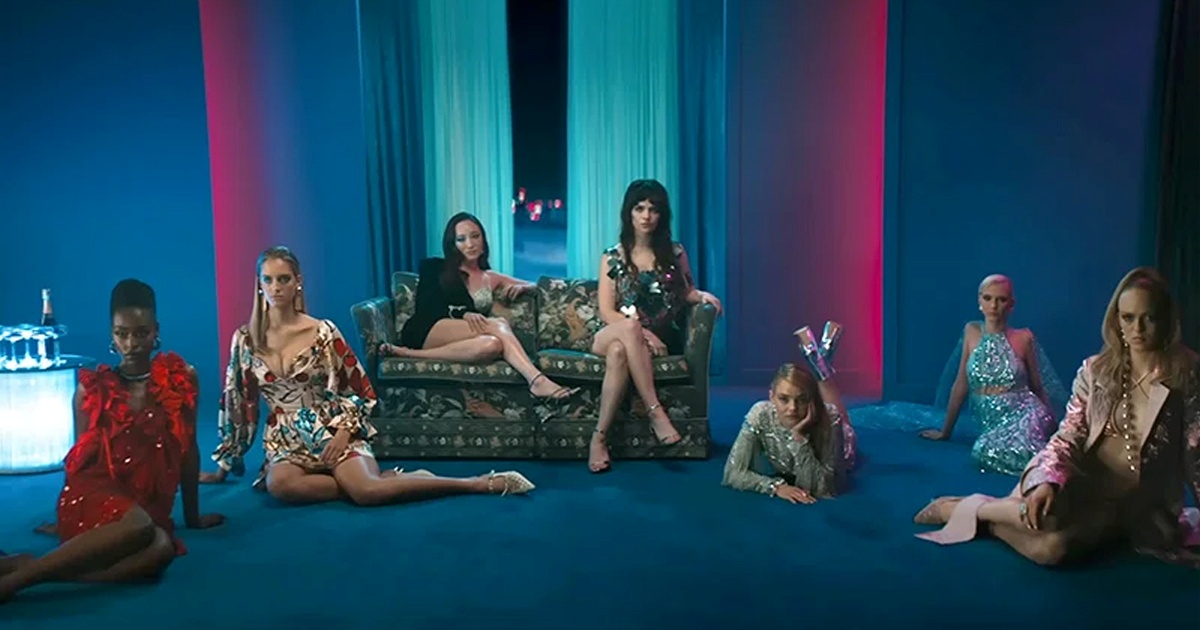
That aesthetic is instantly recognisable: neon colour palettes, fetishisation of bodies and surfaces, a fusion of sexuality and violence, and slow, hypnotic camera movements. The film resembles a “greatest hits” compilation of Refn’s career, echoing Drive and The Neon Demon, yet without the inner tension that gave those works emotional weight. Instead, it offers a series of stylised sequences that exist independently, failing to form a cohesive statement.
At the centre lies a strange female community living in a luxurious high-rise above the fog. Their dialogue often sounds like fragmented poetic utterances, emotionally charged but narratively empty. Parallel to this is the storyline of the soldier (Charles Melton), wandering through a dark, violent lower city. The two narrative strands rarely intersect, reflecting the film’s broader refusal to connect its own elements.
Refn treats cinema as a dream or hallucination, but unlike Mandico — where fragmentation generates myth and new meaning — Her Private Hell often feels structurally hollow. The director appears so absorbed in his own style that he loses sight of its purpose.
This becomes especially evident in the second half of the film, where any remaining traces of plot disappear entirely. The camera glides over bodies, fabrics, and interiors with almost advertising-like fascination. The images grow increasingly self-sufficient and, paradoxically, less significant. One gets the sense of Refn repeating himself without the creative necessity that once justified his mannerism.
The acting further amplifies this sense of disconnection. Each performer seems to inhabit a different film: some play cold arthouse abstraction, others lean toward near-parodic melodrama. Sophie Thatcher attempts to anchor the emotional centre, but even her character is lost in the stylistic noise. Charles Melton becomes yet another object of visual fetishisation, his body filmed with the same attention as the sets surrounding him.
Still, Her Private Hell cannot simply be dismissed as a failure. It represents another step in Refn’s ongoing evolution toward a more radical, uncompromising form of cinema. He fully abandons traditional storytelling in favour of audiovisual abstraction. The question is whether this gesture ultimately alienates the viewer more than it engages them.
The absence of narrative here is not just an artistic choice but a barrier. The film demands total surrender to its internal logic while offering limited emotional or intellectual payoff. Its hypnotic quality appears in brief flashes, while its provocation often feels exhausted.
In the end, Her Private Hell resembles a film about an author in crisis — an artist searching for a new form but becoming trapped within his own imagery. It is a step forward in terms of experimentation, and simultaneously a step away from the audience. Perhaps this is Refn’s true private hell: the realisation that style alone can no longer guarantee meaning.
