


by Joe Phelan
The Siege of Paradise refuses to frame its story in black and white.
Tourism sustains Cinque Terre, yet strains it; preservation attracts visitors, yet those visitors make preservation more difficult. While long-time residents lament what’s been lost, they also recognise what tourism has made possible.
O’Rourke’s sun-drenched documentary artfully explores these tensions without attempting to resolve them, presenting competing perspectives without judgement or agenda.
This isn’t a story about tourists; it’s about people whose lives have become intertwined with tourism, whether they welcome it, resent it or, like a number of the film’s memorable contributors, occupy the uneasy ground somewhere in between.
We’re introduced to Bartolo, a charming vintner working vines cut into near-vertical cliffs, whose traditional way of life now exists alongside the visitors drawn to it; Carmelo, a jaded but successful restaurateur weighing whether to pass the family kitchen to his daughter, Giorgia; Guido, a fisherman stubbornly preserving a trade increasingly pushed to the margins by tourism; and Fabrizia Pecunia, the mayor of Riomaggiore, who is determined to find a balance between preserving the character of her town and maintaining the tourism economy on which it depends.
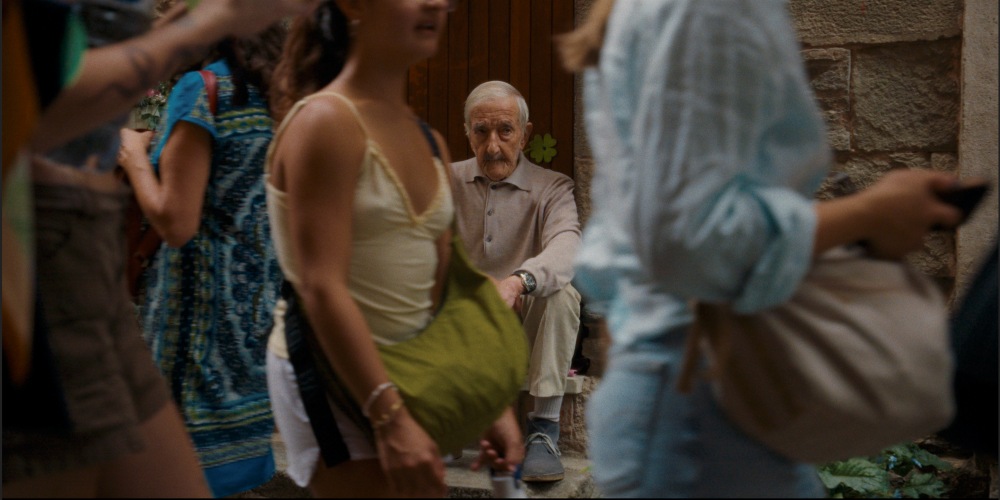
It would have been easy to frame The Siege of Paradise as a parable of overtourism: the embattled local versus the oblivious tourist. But O’Rourke is more interested in what happens when those archetypes blur.
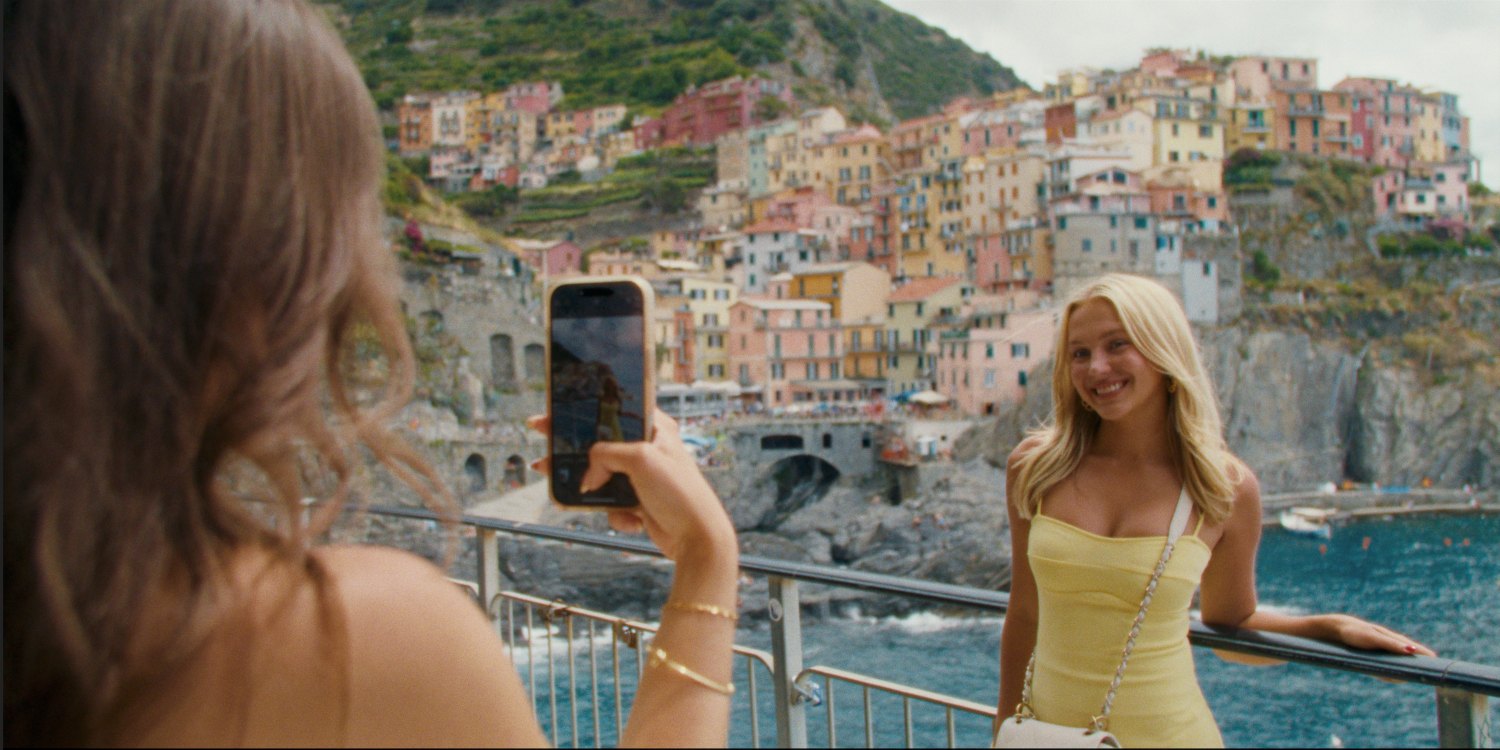
Grace and Izabel, the content creators who might initially appear to represent the superficial culture of aesthetic-driven travel, are instead given space to grapple with their own role in bringing attention to the places they capture.
 “The moment you appoint a villain, the audience relaxes; they know who to blame and they stop thinking,” O’Rourke [left] says. “I wanted the opposite: for people to keep shifting allegiance scene by scene. Overtourism isn’t a story with a wrong side. It’s a story where everyone’s acting rationally, and the result is still a crisis.”
This refusal to simplify its subjects is also what allows the film to move so effortlessly between humour and unease. O’Rourke’s tonal control is like a magician’s sleight of hand: you’re rolling your eyes at a banal tête-à-tête one moment and fearing for the town’s future the next, yet you never quite catch the moment where the ground shifts.
It’s an approach most evident in O’Rourke’s treatment of modern tourism itself. The film captures the strange theatre of travel: guides repeat rehearsed lines about “special, authentic experiences” while visitors instinctively reach for their phones, eager to document a moment they’ve been told they simply must cherish. It’s uncomfortably recognisable. Who among us hasn’t been that tourist in one guise or another, arriving somewhere with a list of must-sees, faithfully following the routes we’ve been told are unmissable?
O’Rourke’s wry sense of humour is on full display in one of the film’s most memorable sequences, where the arrival of tourists is framed as an impending invasion. A church bell tolls like a warning, while the score carries more than a hint of Sergio Leone: a playful nod to the Italian master of cinematic tension who was born just a few hours down the coast.
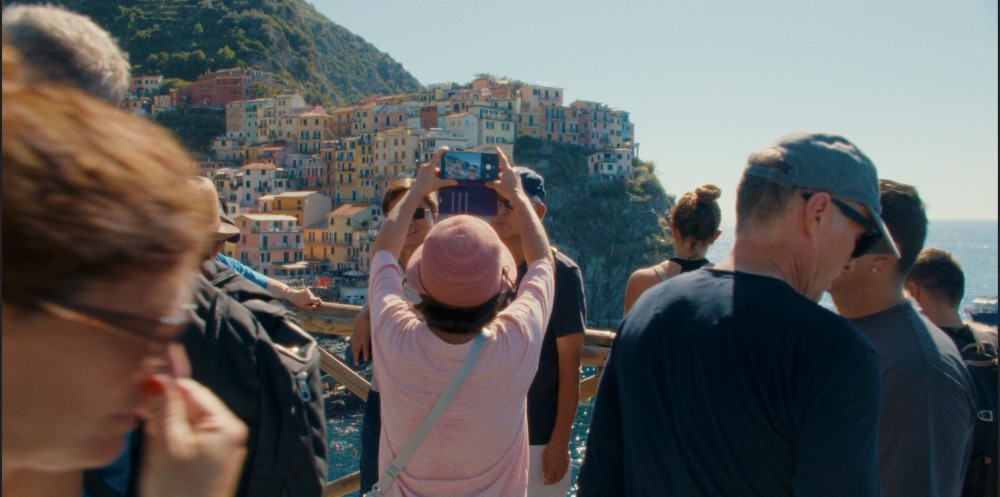
“The idea came from watching the ferries arrive each morning,” O’Rourke reflects. “There’s genuinely something of a landing force about it. Once you pick up on it, the parallels become tough to ignore.
“I wanted to have some fun with this sequence and play into the idea of a siege. But the comedy is helping to do more serious work. You laugh at the bell and the score, but somewhere in that laugh you register that the boats are real and they just keep coming. Humour can get an idea past people’s defences in a way earnestness sometimes struggles to.”
For O’Rourke and his team, the film also presented an obvious dilemma: how do you showcase the beauty of a place without inadvertently contributing to the overtourism that threatens it?
“The film had to be seductive,” O’Rourke notes. “I wanted people to feel that tension: being drawn to Cinque Terre because of its incredible beauty, while also having an awareness that overtourism is a real problem. Making it ugly on purpose would have just been dishonest.”
Lukas Gut’s cinematography captures the setting with intoxicating clarity: pastel villages clinging to near-vertical cliffs, terraced vineyards glowing in the Mediterranean sun, the sea shimmering below. You can almost feel the heat coming off the stone roofs, taste the diesel fumes from the idling ferries.
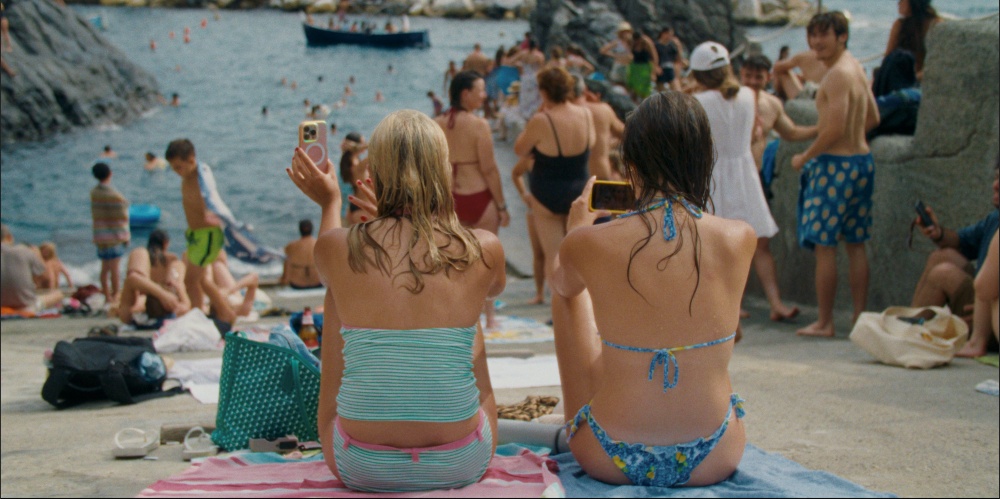
In confronting overtourism through such striking visuals, The Siege of Paradise inevitably enters the same conversation it seeks to explore. Every dazzling frame risks becoming an invitation to book a flight. It’s a friction O’Rourke is familiar with on a personal level.
“It started with my own phone. I noticed I couldn’t stand somewhere beautiful without reaching for it; the instinct to capture and share was taking priority over the experience itself, and I was posting for followers who had no real place in my life. Once I recognised that in myself, I started seeing it everywhere.
“I’m from Dublin, where the conversation about who the city is for has become impossible to avoid, and I live in Lisbon, where you can watch it happening in real time: neighbourhoods reorienting themselves around people passing through, with daily life slowly becoming a backdrop. I’m part of that too; I’m the foreigner who moved in. So, the film was personal from every angle. I couldn’t point the lens at Cinque Terre without pointing it back at myself.”
O’Rourke’s insistence on entertaining nuance is ultimately what shapes The Siege of Paradise. The film recognises that the same qualities that make Cinque Terre worth protecting are the things that draw people there in the first place. It’s the catch-22 of heritage tourism: the more successfully a community preserves its history and environment, the more irresistible it will become to the crowds that threaten to suffocate it.
O’Rourke gives divergent perspectives space to exist. In doing so, he’s created a documentary that’s less interested in telling audiences what to think than in encouraging them to look more closely: not just at Cinque Terre, but at the role each of us plays in shaping the places we visit.
