


by Nataliia Serebriakova
Worth: $16.00
FilmInk rates movies out of $20 — the score indicates the amount we believe a ticket to the movie to be worth
Cannes Film Festival
Cast:
Alain Chabat, Jonathan Cohen, Anaïs Demoustier
Intro:
Its achievement lies not in offering a profound new theory of existence, but in finding a form perfectly suited to its concept.
Quentin Dupieux has built a career out of absurd premises, deadpan humour and stories that seem to follow their own inexplicable logic. With Le Vertige, he takes the familiar idea that reality might be a computer simulation and turns it into an animated comedy that looks as though its own universe is about to crash.
At 5:52 a.m., Jacky (Alain Chabat) turns up at his friend Bruno’s (Jonathan Cohen) door, desperate to share a discovery: nothing in the world is real. Bruno is understandably reluctant to entertain this theory. His girlfriend Fabienne (Anaïs Demoustier) is heavily pregnant and about to give birth, and he has more immediate concerns than the nature of existence. But when Fabienne suddenly delivers her baby in the kitchen, without an umbilical cord, Jacky sees confirmation of his suspicions. It is a bug in the system, he explains. And he has a whole list of them.
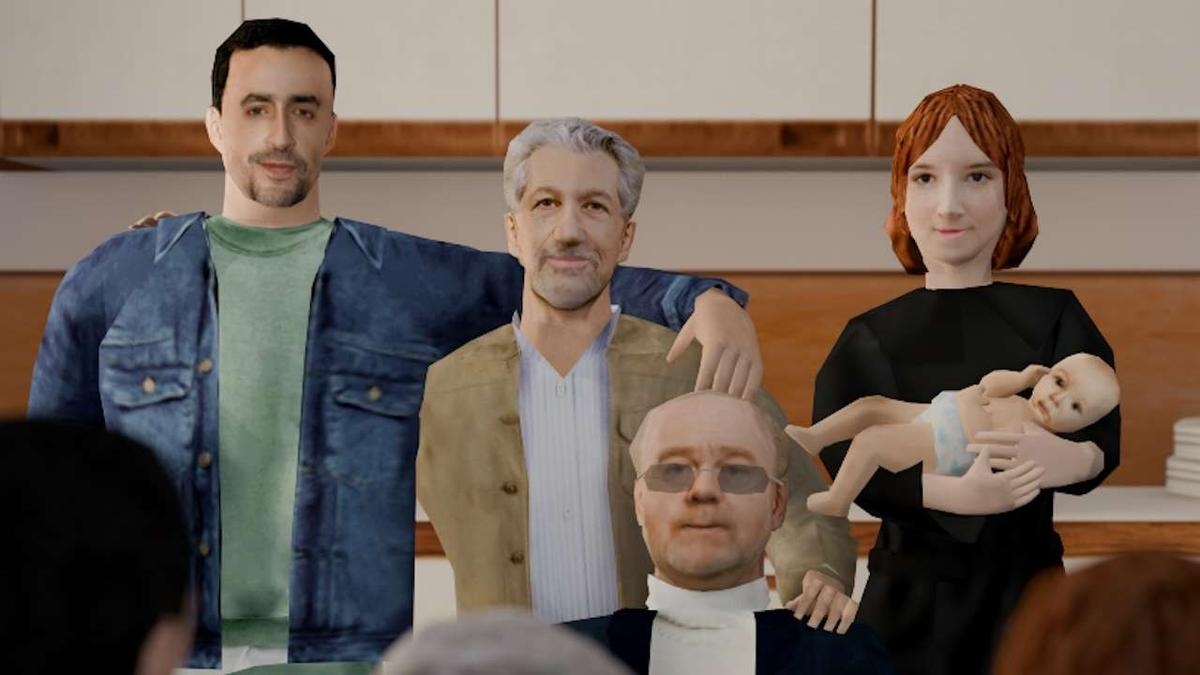
The visual style is the first clue that Dupieux is playing by different rules. The crude 3D graphics evoke the early Grand Theft Auto games, with awkward character models, stiff movements and an overall sense of a virtual world that has not been rendered particularly well. Nothing looks quite right. Characters move strangely, objects behave unpredictably, and the animation seems permanently on the verge of malfunctioning. The result is a film-concept in which the form and the central idea are inseparable: if reality is a simulation, why should it look convincing? Perhaps a badly programmed world, full of glitches and unfinished details, is exactly what we should expect.
One of the funniest sequences comes when Jacky reads Bruno his catalogue of supposed errors. A grocer has eight fingers; an elevator always arrives when summoned; and a legless homeless man floats in mid-air, his torso detached from any visible support. The list turns everyday absurdities into evidence of a universe that has been assembled carelessly, with shortcuts and mistakes left in plain sight. These are not merely visual jokes. They are the film’s central argument, delivered with Dupieux’s characteristic straight-faced humour: what if the things we take for granted are simply the result of somebody’s poor programming?
The roughness of the animation is essential to the joke. Rather than disguising its technical limitations, Le Vertige makes them its aesthetic principle. The world feels unfinished, as if a computer might freeze at any moment and leave its inhabitants suspended in the middle of an ordinary activity. There is something oddly satisfying about how completely Dupieux commits to this idea.
Dupieux also makes two playful cameo appearances. In one, he appears as an animated version of himself; in another, he turns up as a toy of his yellow character, Mr. Oizo. The latter is a particularly amusing nod to his other creative identity: before becoming known internationally as a filmmaker, Dupieux made his name as an electronic musician in the 1990s under the Mr. Oizo moniker.
There is, however, a limit to how far the central joke can go. Although the film runs for only 67 minutes, its middle section occasionally circles around the same ideas without adding much. But Dupieux knows how to bring the audience back. A sequence that takes aim at Steve Jobs provides another burst of absurdity, while the animated bloopers offer a fitting final wink.
Dupieux remains a master of surrealism, and Le Vertige is a more inventive use of his eccentric sensibility than a conventional science-fiction comedy would have been. Of the two films he presented at Cannes this year, alongside Full Phil, starring Kristen Stewart, Le Vertige feels considerably more original. Its achievement lies not in offering a profound new theory of existence, but in finding a form perfectly suited to its concept.
