


by Stephen Vagg
The Australian film industry had numerous false dawns before the late sixties revival – periods where it seemed that the film industry might get up and going again. There were ones immediately after World Wars One and Two, and at the beginning and end of the 1950s. Perhaps the most frustrating false dawn of them all, however, came in the mid 1930s.
The reason for this is that the New South Wales Government had finally come to the party and introduced film distributor and exhibitor quotas for Australian films (the former starting at five percent going up to fifteen percent over the next few years).
For the first time, it seemed, local moviemakers had some legislative protection – protection introduced by a conservative government, incidentally (Bertram Stevens, premier of New South Wales, was from the UAP, forerunner of the Liberal Party). And, indeed, these quotas did prompt a mini boom, for a year or two… But distributors and exhibitors responded to the quota by lobbying against it, claiming it was unconstitutional, crying poor, saying Australian audiences don’t want to see Australian stories and Australian films weren’t good enough, market forces, making threats to withdraw Hollywood films, etc (all the standard tricks… the streamers are using them right now to keep our screens quota free; our cinema chains and subsidised theatre companies would be doing it too it if anyone was pressing them for a quota, which for some reason they aren’t).
The film industry couldn’t muster enough support, especially not from the press (which can never, ever be relied upon to help Australian artists and/or understanding the basic economics of the industry they report on). And so, the government, having introduced quota legislation, decided not to enforce it… and thus a tremendous chance at creating a genuinely sustainable film industry – perhaps the greatest ever chance in the history of Australian cinema – withered on the vine.

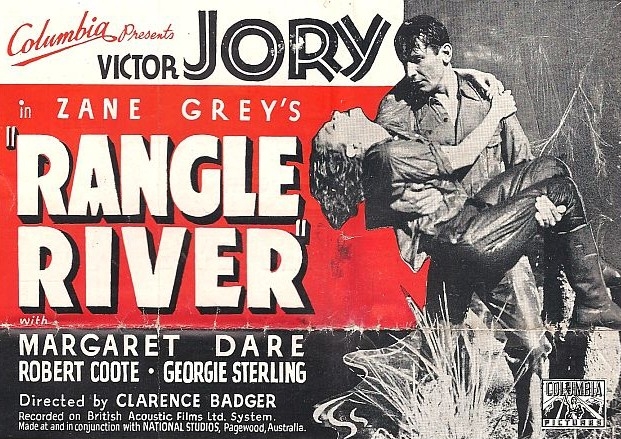
Still, as mentioned, the 1935 quota did prompt some increased activity, including the formation of a new company, National Studios Ltd, which built a brand spanking studio complex in Sydney called Pagewood Studios, and started looking for something to film in it. National Studios formed an agreement with a Hollywood studio, Columbia, who agreed to invest some cash in an Australian-shot movie. Part of the deal involved importing an American director and star: the former was Clarence Badger, best known for making It with Clara Bow but then on a career downslide, and the star was Victor Jory, a well-established character actor then under contract to Columbia.
National Studios and Columbia decided to make a Western set in Australia, Rangle River. The film was based on a story by famed Western author Zane Grey, who no one reads much now, at least not outside a dwindling hardcore fan base, but who in his day was hugely popular. Grey toured Australia in 1935 to fish at various spots around the country, a visit eagerly covered by the local press – indeed, Grey even starred in an Australian movie about his trip, White Death (1936), which we will write about for this series one day.
He also wrote a book about his experiences called An American Angler in Australia as well as gathering material for an Australian-set novel, Wilderness Trek, which was published in 1947, after his death in 1939 (we’re surprised no film has been made of that book). Oh, and he cranked out the story for Rangle River.
According to Sir Samuel Walder, a director of National Studios Ltd, Grey’s original story for the film consisted of “two sheets of foolscap” which the author passed on to the producers. Grey did later write up Rangle River as a short story, although that wasn’t published until 1976, when it appeared in a collection of his short stories.
It’s interesting to compare the short story of Rangle River with the final movie. The former concerned an English woman, Marian, who inherits a broken-down Queensland property “on the edge of the desert” called Rangle River. She bickers with Rangle River’s tough/sexy foreman, Dick Drake, but they fall in love, and he rescues her when she’s kidnapped by a bushranger/outlaw called Black who wants Marian’s horses. To be frank, Grey’s short story isn’t very good; a biographer of the author suggested this might have been due to Grey writing it after his stroke in 1937. Now, this was after the film of Rangle River had been made – so presumably Grey sold his two-page outline for the movie to National Studios, then, after the film came out, typed it up into short story form, basing it on his original outline rather than the movie.
Peggy Scott, who worked on continuity for the movie of Rangle River, did an oral history with Graham Shirley where she claimed several people “had a go” at turning Grey’s basic plotline for Rangle River into a script, including herself, “and they finally mixed it all together”. Chief among those writers “having a go” were Australian filmmakers Charles and Elsa Chauvel, who were reasonably well established at the time, having launched Errol Flynn’s film career with In the Wake of the Bounty and made Heritage, but whose great films (Forty Thousand Horsemen, Jedda, Sons of Matthew) were ahead of them. The star and director of Rangle River may have contributed to the script as well – according to Walder, “it was left to Mr Jory and Mr Badger to make it [the story] ready to go before the cameras”.
Peggy Scott said Elsa Chauvel wrote “lines and lines and lines of dialogue” but then Jory “changed it all and gave himself all the long speeches”. Jory later complained that “we were supposed to do the whole project in eight weeks but the script wasn’t even ready in that time.” If we had to guess, it was the Chauvels who did the bulk of the work on the script, with Badger and Jory doing last minute changes – but that is just a guess on our part.
The script of Rangle River was different from Grey’s short story in a number of ways: in the latter, the main villain is an outlaw called Black, but in the film the character of Black is a sidekick for the real villain, Lawton, the owner of a neighbouring property who wants Marian’s water rights (there’s a neighbour character in the Grey short story, Melville, but he doesn’t do much). The script didn’t have Marian inherit Rangle River but made her the daughter of the owner, her father, who was still alive, and turned the character of Marian into a globe-trotting playgirl – the latter was an especially good change as it gave her character a real arc (one wonders if this was the contribution of Elsa Chauvel, to ensure the female lead had a bit of dimension).
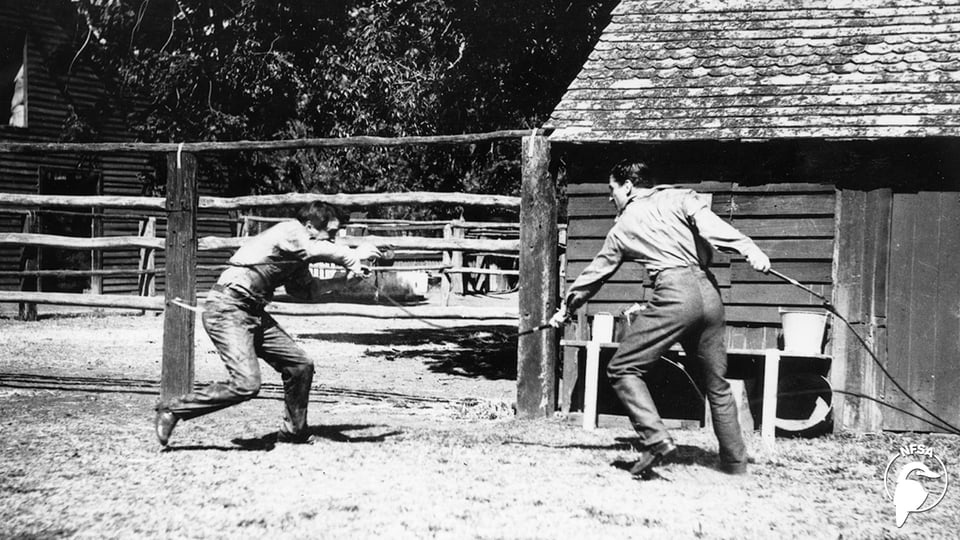
The script kept alive Marian’s father and gave her an aunt – neither really contribute that much. Grey’s short story had a passing mention to a man who pursued Marian on the boat to Australia called Mannister; in the film, Mannister is an important character, the second male lead: he’s a silly-ass Englishman who comes to Rangle River and helps Marian and Dick Drake, a function performed in the short story by an Aussie character called Jim Bates. The short story ends with Marian’s abduction but the script finishes with a dam flooding and a whip duel between Dick Drake and Lawton.
Still, for all the hands that went into writing, the script for Rangle River was solid – characters are clear, motivations logical, there is conflict, comedy, action and romance (plus an odd amount of singing – both Dick and Marian warble a tune each). Whoever wrote the script – whether it was the Chauvels, or Badger, or Jory, or someone else (or everyone) – it does feel like a cohesive body of work. This is probably because the film copies the structure of another movie quite closely: to wit, 1933’s The Squatter’s Daughter. There are numerous similarities between the films: the squatter’s daughter heroine and hunky foreman love interest, the villainous neighbour, a battle over water rights, an Aboriginal gum leaf band, a scene with the heroine singing at the piano, the fact that the story feels as though it should take place in the nineteenth century but is set in the present day, an absence of bushrangers (which were then banned from Australian screens – we note that distributors, exhibitors and cultural leaders who were anti quota had no trouble supporting that legislation). There’s no silly ass English character in the 1933 film of The Squatter’s Daughter but there was in the 1907 stage original of that film (author Bert Bailey wrote this part for himself) – though, to be fair, silly Englishmen popped up in a lot of Australian films and plays from this time.
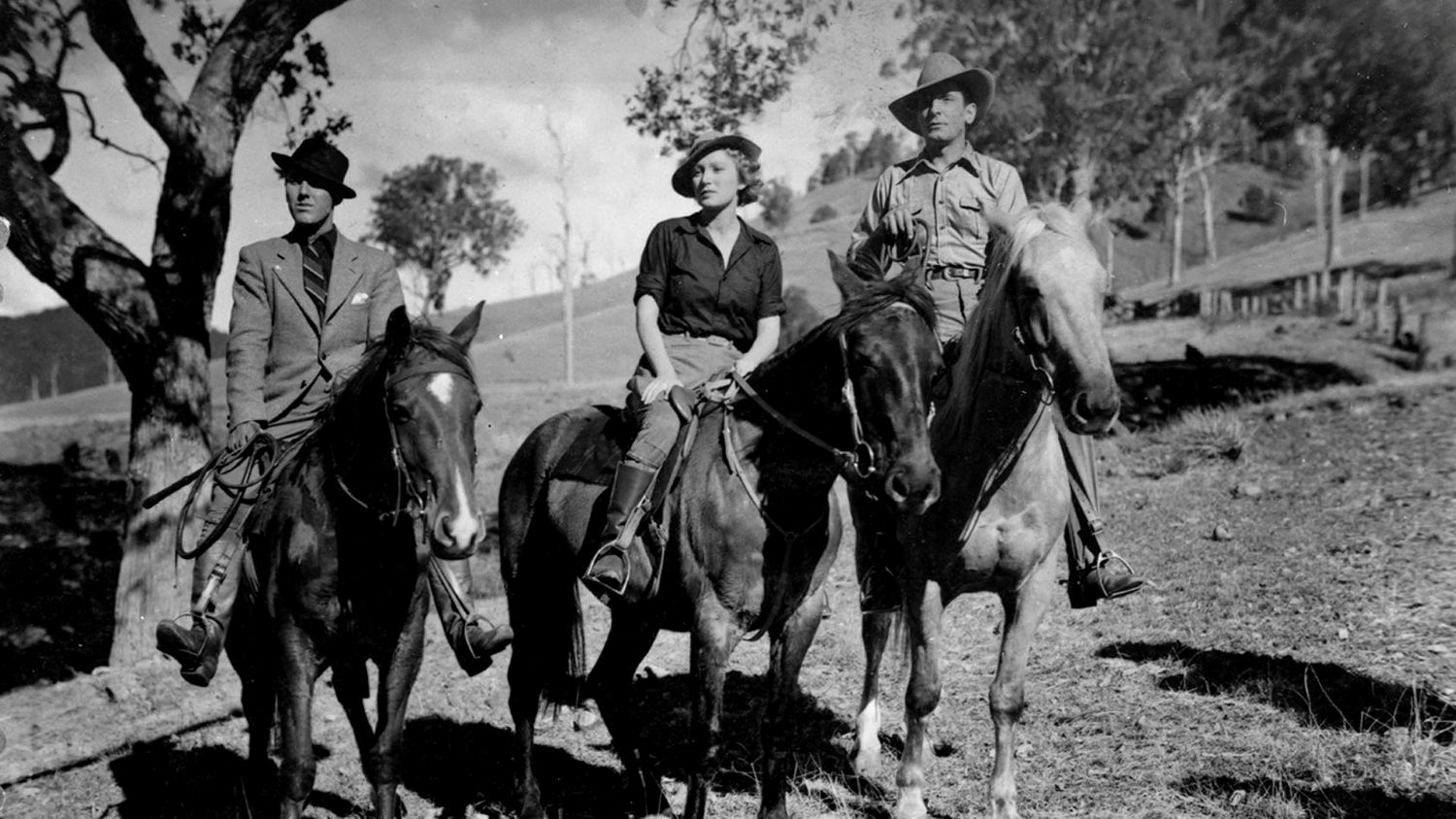
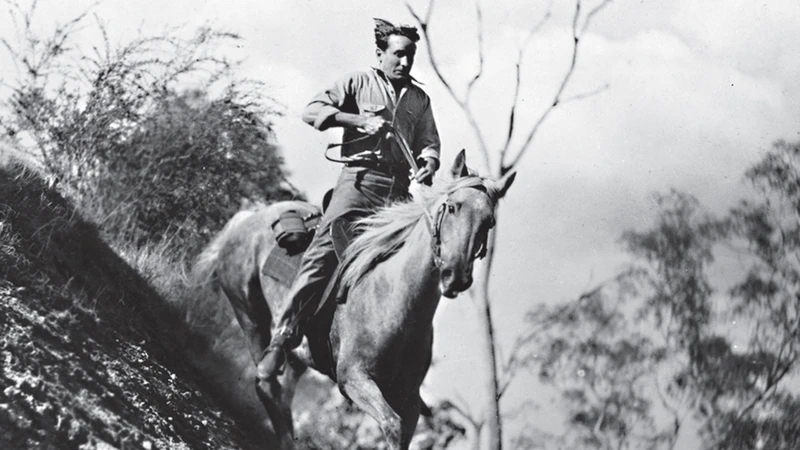
Victor Jory, who plays Dick Drake, was a Hollywood character actor with a wonderful deep speaking voice, and (to be blunt), a character actor face which meant that he was mostly typed as villains (most famously as the overseer in Gone with the Wind). He’s not conventionally handsome, which is probably why he accepted the role in Rangle River on the other side of the world, as it gave him the chance to play a romantic leading man (while in Australia, his actress wife appeared in a few stage plays). The role of Marian was played by Margaret Dare, a model discovered for this movie by Charles Chauvel; Dare is spirited, beautiful and quite a good performer – she tried her luck in Hollywood after Rangle River but didn’t get far: this was her only role (apparently the fact that she was terrified of horses caused troubles during the shoot). There’s a fun bit in the movie when Dare/Mirian says “I’m not going to be ornamental” while literally taking off her clothes to get into a nightie.
The third lead, playing Mannister, was Robert Coote, an English actor who specialised in be monocled type roles and was touring Australia. He went to Hollywood after Rangle River and had a super busy career as a character actor, one of those “hey it’s that guy” performers.
Rangle River is very slick and nicely shot (by Errol Hinds, a Britisher working for National, who was assisted by soon to be legendary camera man Damien Parer). It’s a totally cohesive film, in sharp contrast to another movie made around this time, The Flying Doctor (1936), which was produced by National Studios’ sister company, National Productions. Rangle River does contain a lot of campy stuff, even for a Western, perhaps the most homoerotic of genres – Robert Coote and Victor Jory seem to flirt in their scenes together, Jory and Dare have enjoyable banter but he’s reluctant to kiss her even though her character is up for it, Jory and Cecil Parry have a whip duel at the end that is downright kinky and became legendary (and possibly inspired the whip duel at the end of 1952’s Kangaroo).
Reviews were positive and public response appears to have been reasonably enthusiastic, although it wasn’t as big a hit as, say, some of Ken G Hall’s bigger movies – there were reports that the movie lost money for its backers. Rangle River was released in the UK and the US, where it had a long run, in cinemas and on television, so it likely made money, but all this may have gone to Columbia rather than National Studios. Clarence Badger liked Australia so much, he decided to settle here, and a script was written for a sequel to Rangle River, with Columbia prepared to invest. But then…
The quota wasn’t enforced, Columbia was spooked, investors didn’t make up the difference, the boom ended, and a great opportunity slipped through our industry’s fingers, no doubt to the great relief of distributors, exhibitors and culture warriors who worried that the 99% domination of Australian screens by foreign movies might plummet to something horrendous like 95%. Badger did make one more film in Australia, That Certain Something (1941), before his death in Sydney in 1964 – we’ve no idea what he did during his last twenty-odd years, if anyone knows please drop us a line.
We came across a 1980 interview with Victor Jory where – while attending a Victory Jory Film Festival in Louisville – he said that he thought Rangle River “stinks” and complained that the script wasn’t ready in time. That’s a bit harsh. Maybe he had higher expectations that the movie would turn him into more of a leading man. Maybe his memory was scarred by the inexperience of his collaborators on Rangle River and/or his trip to Australia. Because Rangle River is an entirely decent, unpretentious, watchable Australian film that offered a practical way of telling Australian stories that might appeal internationally.
If the 1935 quota had been enforced, Australia would have made scores more features like Rangle River. So many movies were announced but not made, which might have been made if a quota had been around to give that final push; these included titles like Robbery Under Arms (Ken G Hall’s version), Collits’ Inn, Ginger Murdoch, Overland Telegraph, Come Away Pearler, Redheap, Wards of the Outer March, When Cobb and Co Was King, My Love Must Wait, Storm Hill, The Life of Nellie Melba, The Les Darcy Story. But they, and so many other projects died on the rocks of greed and apathy. All who were part of the campaign to ignore the quota should be ashamed of themselves.
Sorry, just had to get that out of our system. As mentioned, these issues are very much with us today.
Anyway, Rangle River is a fun watch, and you can rent and watch it here.
The author would like to thank Graham Shirley for his assistance with his article. Unless otherwise specified, all opinions are those of the author’s.
