


by Gary Couzens
Ever since Mark Hartley’s documentary Not Quite Hollywood came out in 2008, what became called Ozploitation has had a high profile in Australian cinema. Ozploitation covers several genres, but horror was a major part of it and continues to be so to this day. However, horror films barely featured in the country before the 1970s. You can find the genre emerging as long ago as the silent era – or at least you could if you were able to see those films now – but then it disappeared for three decades.
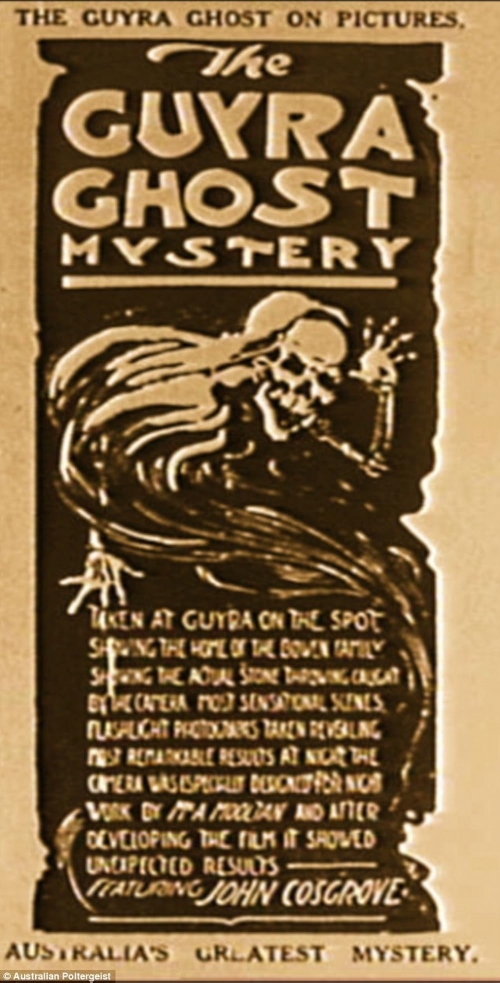 Guyra is a small town in north-eastern New South Wales. In March 1921, there were reports of rapping on the walls of a house and stones crashing through its windows, particularly in the bedroom of twelve-year-old Minnie Bowen. Even with local men maintaining a cordon around the house, the noises and damage continued. Throughout the disturbances, men and women slept with guns within easy reach. Minnie Bowen was suspected of being the cause of the activity, which ceased when she was sent to stay with her grandmother in nearby Glen Innes. Yet, over two nights in May, there were knockings, thumps and a shower of stones on the roof of Minnie’s grandmother’s house. Minnie was suspected, but no one could explain the enormous thuds and the stones which came from outside when she had been under observation. One H.J. Moors, a friend of Sir Arthur Conan Doyle who was then visiting Australia, helped in the investigations. Psychic investigators suspected the work of a poltergeist. The mystery has never been solved.
The story attracted the attention of the film industry, but just one film was made. This was The Guyra Ghost Mystery, the only film directed by actor John Cosgrove, who also wrote the script and played the leading role. Cosgrove received financing from a local cinema manager, whose business had suffered during the period of the disturbances.
The Guyra Ghost Mystery was made quickly. Accounts differ as to whether it took three days or two weeks, but shooting began on 24 May 1921. The film features an investigation into the mystery led by one Sherlock Doyle (Cosgrove), a reference to the celebrity friend of the real-life investigator. This Doyle was likely an imposing figure as Cosgrove was a big man, weighing eighteen stone. The Bowen family appeared as themselves. Mr Bowen was seen to shoot his rifle at a ghostly apparition created by trick photography. It is not known if other real-life participants appeared, as The Guyra Ghost Mystery is lost, sadly the case with very many films of the time.
Publicity for the film, some fifty minutes long, promised “five reels of laughter”, implying that the story was played for comedy. The Guyra Ghost Mystery was released on 25 June 1921 in Sydney for a three-day run, but was not successful. It was reported in November 1922 that the film had sat on the shelf since then. Cosgrove continued as an actor and occasional writer, dying in 1925.
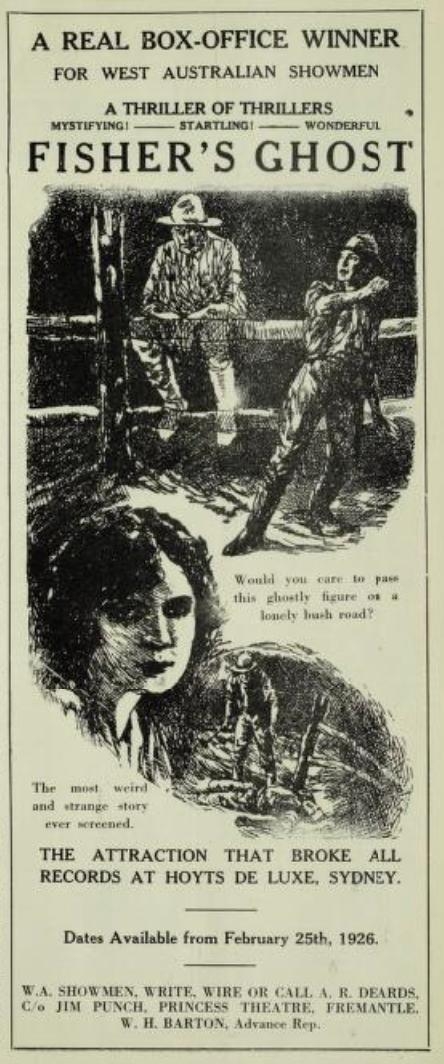 Cosgrove is now a forgotten name, but Raymond Longford was the most distinguished Australian director of the silent era. The Sentimental Bloke, released in 1919, was fifty years later described as “the only indisputable Australian classic, charming, human and surprisingly undated” when it was shown at the National Film Theatre in 1969. (It was the only Australian feature film shown there, twice, during the whole of the 1960s. This showing was introduced by Barry Humphries.) However, Longford was not averse to the darker side. One of his films was even called The Woman Suffers (1918), which starred Lottie Lyell, his partner in life as well as his creative partner on screen. In 1924, Longford and Lyell’s company made Fisher’s Ghost. Like The Guyra Ghost Mystery, the film recreated a real-life story of haunting, though one set much further in the past. Fisher’s Ghost is again lost, but the scenario survives, and the film establishes its realistic credentials at the start with a shot of “the producer” visiting the Mitchell Library in Sydney to research the story, which Longford did indeed do.
Fisher’s Ghost takes us back to New South Wales in 1826. Two convicts, George Worrall (Robert Purdie) and Frederick Fisher (Fred Twitcham), are released and set themselves up as farmers. Fisher visits England and decides to stay there, authorising Worrall (who is called Smith in the surviving scenario) to sell his farm. However, six weeks later, a settler sees an apparition of Fisher sitting on a fence. Fisher tells him that he has in fact been murdered and tells him where his body can be found…
Longford shot the film in Campbelltown, New South Wales, the scene of the original events. Fisher’s Ghost was completed in April 1924 and released in October of the same year. Longford-Lyell had problems with the release, with one exhibitor rejecting the film as being too gruesome for their audiences. So a rival exhibitor showed it and the film was successful in their cinemas, taking £1300 (Australian) in its first week, one venue reported by Everyone’s to be “packed to standing room in the stalls and hardly a vacant seat in the circle”. In 1934, Longford registered the copyright for a sound remake, but it was never made.
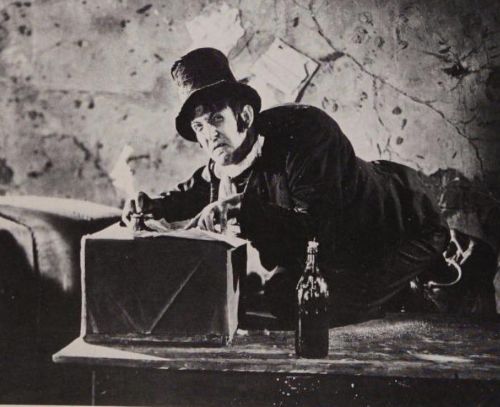 No other Australian horror film was released as a main feature until the 1970s, but the beginning of the sound era brought us The Haunted Barn, in 1931. This mid-length film (about forty-five minutes) was made by F.W. Thring’s Efftee Productions and played in support to the same company’s comedy Diggers. The Haunted Barn is also a comedy, with businessman John Moon (Phil Smith) spending the night in the barn of the title hoping to see the ghost of a bushranger who was killed by the police there. The State of Victoria did ban The Haunted Barn for children between the ages of six and sixteen due to the title and the sound of the blowing wind being too scary for them. This ban was later lifted and the double bill was popular with audiences. Unlike The Guyra Ghost Mystery and Fisher’s Ghost, The Haunted Barn does still survive in the archive. The comic possibilities of the haunted house were also explored in a sequence in Gone to the Dogs (1939), a vehicle for local star George Wallace, directed by Ken G. Hall. Around the same time, Hall considered Dad and Dave in a Haunted House as the fourth of the series which had begun with On Our Selection in 1932, but instead made Dad Rudd M.P. in 1940. And that was it for horror in Australian cinema for more than thirty years.
By the end of the silent era, Australian cinemas were dominated by Hollywood product and the local industry was in decline. Films continued to be made in the country, but more often Australia became an exotic location for overseas productions, taking advantage of the country’s vast landscapes. Many directors and actors worked abroad, in the UK and USA especially, for the greater opportunities. By the 1960s, local filmmaking was at a low ebb, with very few films being made, and even fewer receiving commercial releases. Michael Powell’s film They’re a Weird Mob, whose production in the country attracted a lot of attention and which was a big hit with local audiences, led to questions being asked about the possibility of government support for an Australian film industry.
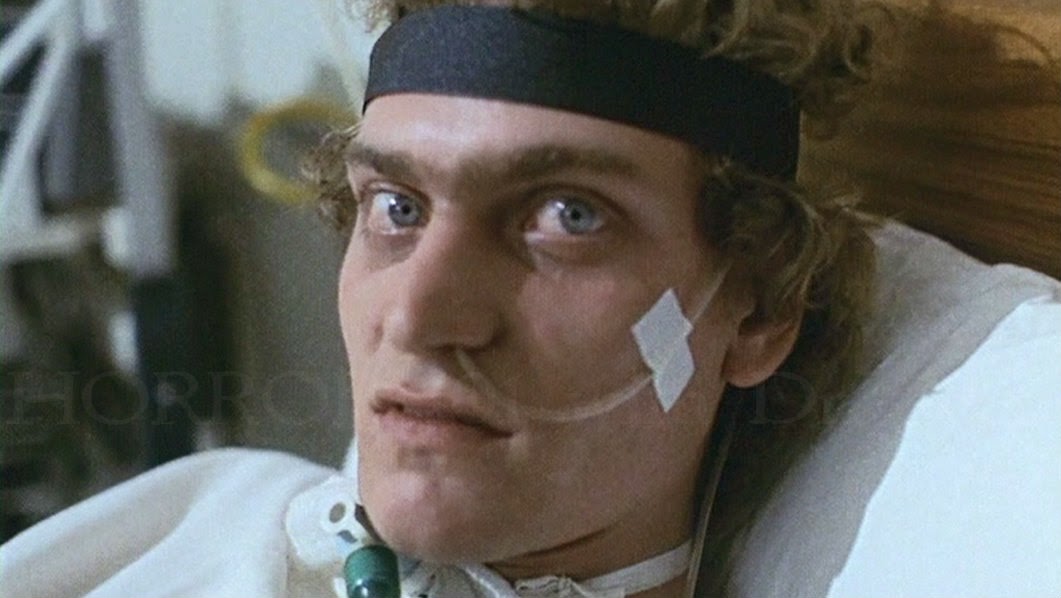
One of the key earliest films of the revival of the film industry in the 1970s was Wake in Fright, originally released outside Australia as Outback. It was a US/Australian coproduction, directed by the Canadian Ted Kotcheff. Three lead actors were British: Gary Bond, Donald Pleasence and Sylvia Kay (Kotcheff’s then wife). It was also the final film of Chips Rafferty, who had been a major star from the 1940s, and the first to be released for Jack Thompson, who would become a star in the coming decade.
Based faithfully on a novel by Kenneth Cook, Wake in Fright is the story of John Grant (Bond), a teacher who is on his way home to Sydney for the Christmas holidays. Stopping for the night in Bundunyabba, he is drawn into a gambling game, tempted to win enough to leave teaching…but loses all his money. Stranded in “The Yabba” and its culture of drinking and fighting, Grant finds a much darker side of himself.
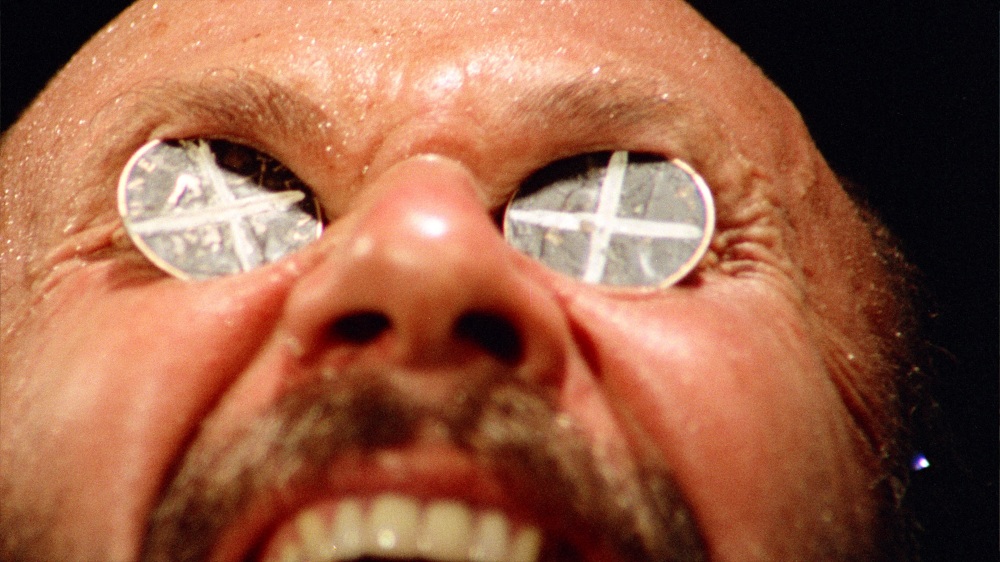
While nothing supernatural or fantastic occurs, Wake in Fright is certainly a horror film of the psychological kind, as a man’s veneer of civilisation breaks down in just a few days. If horror had emerged in the country’s cinema it had changed from the ghost stories more than forty years earlier to a tale of monstrosity, of the human kind, and that monstrosity being rooted in what many would have found unremarkable aspects of Australian society. The major setpiece is a bloody kangaroo hunt. Kotcheff and his crew filmed a real one; the results are not for the squeamish. Premiering at Cannes in 1971, Wake in Fright was a critical success but other than in France not a commercial one. Australian audiences found its depiction of their own culture and society rather too confronting. However, along with another coproduction, Walkabout (which premiered at the same Cannes festival), it was an important step in the revival of the Australian film industry in the coming decade, sometimes called the Australian New Wave.
Up to then, Australia had one of the most draconian film censorship regimes in the western world. Horror films from other countries were frequently heavily cut, if not banned outright. It was estimated that in the mid-1960s, about one in three films imported to Australia, of all kinds, suffered cuts. These included Repulsion, which lost the scene where Carol (Catherine Deneuve) overhears her sister’s lovemaking through her bedroom ceiling. Ingmar Bergman’s The Virgin Spring, which later was the source for Wes Craven’s The Last House on the Left, had its rape scene shortened. However, things would soon change. In 1971. The Office of Film and Literature Classification (OFLC) introduced the R rating, which banned under-seventeens from watching. It was hoped that this would result in much less cutting and banning of adult films, though that wasn’t the case. However, filmmakers were quick to take advantage, and so what would later be called Ozploitation was born.
The first Australian film made squarely in the horror genre as many would recognise it, and rivalling in gruesomeness what was being produced in other countries at the time, was Night of Fear. It was actually originally made for the ABC as a pilot for a proposed horror anthology series to be called Fright. While Australian cinema had stagnated in the previous decade, television was thriving, and several of the film directors of the 1970s would have their starts there. However, given how much Australian television was censored, you might wonder how Night of Fear would ever have been considered viable for the small screen. The ABC clearly didn’t think so, as they rejected it. Writer/director Terry Bourke and his producing partner Rod Hay released the film into cinemas, despite its being under an hour long. However, the OFLC rejected the film initially, its cited reason being “indecency”, before passing it with an R. It was released in cinemas in March 1973.
As well as for its short length, Night of Fear is notable for having no spoken dialogue, but plenty of grunts and screams. A young woman (Carla Hoogeveen) crashes her car out in the countryside. There she encounters a man (Norman Yemm) who lives alone with a colony of rats. The film has a prologue with a previous victim (Briony Behets), before Hoogeveen and Yemm face off for the remainder of the running time. You couldn’t call Night of Fear subtle, and it probably couldn’t sustain a longer duration, but in its crude, sometimes in-your-face way it’s effective. Critical reaction was divided. Romola Costantino of the Sun-Herald found it “one of the most encouraging pointers towards the future of the Australian film industry” and “second only to Straw Dogs”. On the other hand, in the Sydney Morning Herald, Martha duBose’s opinion is summed up by the headline of her review: “‘Night of Fear’ – Rats to That”. Night of Fear was reported as doing good business in independent cinemas and drive-ins. There was talk of Hammer picking it up for the UK, presumably as a supporting feature, but this didn’t come to pass. After being unavailable for many years, Night of Fear had a DVD release in 2005, paired with Bourke’s much inferior 1975 feature Inn of the Damned.
As the 1970s progressed, there was a sense that what in other countries would be arthouse projects, often literary adaptations and/or period pieces, prestigious as they might have been, were the mainstream and commercially-intended genre filmmakers were somehow marginalised. But now the genie was out of the bottle, filmmakers set out to make more commercial films, horror included, often with a view to an international audience. Sometimes international actors were brought in, in an attempt to further appeal to that audience. Some filmmakers had a foot in both camps. Peter Weir’s Picnic at Hanging Rock (1975) is very much a historically-set literary adaptation, heavy on gorgeously-photographed atmosphere, but Weir was also the director of the earlier The Cars That Ate Paris (1974), which brought him into the Ozploitation fold. Fred Schepisi’s The Chant of Jimmie Blacksmith (1978) was also a historically-set film from a literary source, made on a large budget, but its unsparing violence was a factor in its finding itself on the Video Nasties list in the UK – or maybe that was because it had an axe on the cover of the video sleeve.
Antony I. Ginnane had started his career as a director, with a tiny-budget indie to his name (Sympathy in Summer, 1969, which you’ll need to visit an archive to see). In the mid 1970s, he broke into film production, at first with softcore sexploitation. The True Story of Eskimo Nell and Fantasm were both directed by Richard Franklin, who soon moved into suspense and horror films heavily influenced by Alfred Hitchcock, of whom Franklin was an avowed admirer. For Ginnane, he directed Patrick, a horror piece in which inexplicable events centre on the title character, a man in a coma. Without Franklin, Ginnane produced such films as the vampire movie Thirst (directed by Rod Hardy in 1979), Harlequin (1980), directed by Simon Wincer and starring Robert Powell as a sinister faith healer with influence over a senator (David Hemmings) and his family, and the James Herbert adaptation The Survivor (1981), which Hemmings directed. Many of these films were written by Everett de Roche, without doubt the leading screenwriter in Australian genre cinema of the time. De Roche also wrote the eco-horror Long Weekend (1977, released in 1979), directed by Colin Eggleston, making his best film. Eggleston had previously made Fantasm Comes Again (1977) for Ginnane and would continue making horror and thrillers with the much less effective Innocent Prey (1984). He also wrote Nightmares (1980), John D. Lamond’s entry in the then-current cycle of slasher films, a change from his usual sex comedies.
By now, horror was firmly established in Australian cinema, and the new video market and such initiatives as the tax break 10BA in the following decade led to even more being made. Nowadays, horror is a leading Australian genre, but just over fifty years ago that certainly wasn’t the case. This was how it all started.
This article was previously published in a different version in The Dark Side, issue 263, February 2025. Thanks to Stephen Morgan and Stephen Vagg.
