



by Stephen Vagg
A 1933 horsey melodrama
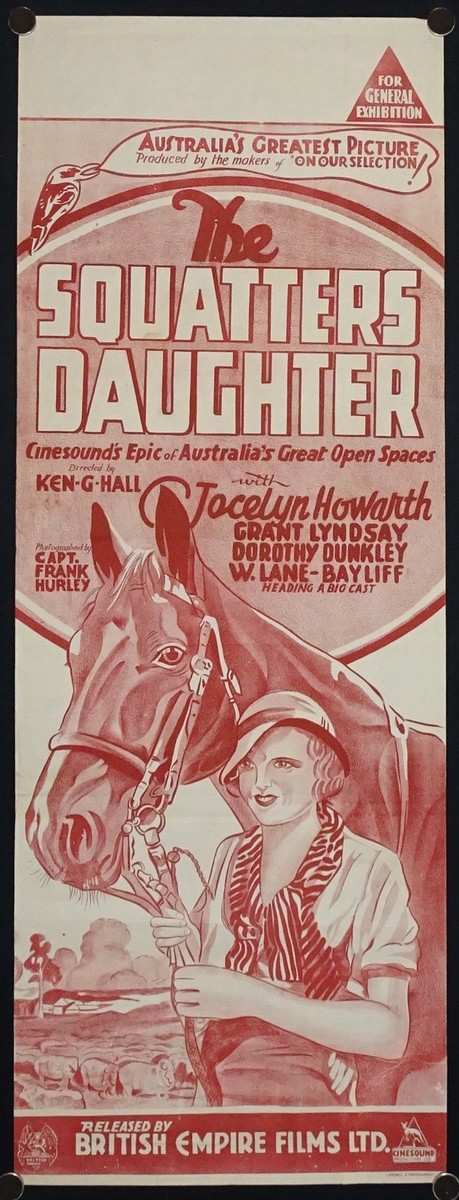 Cinesound Productions and director Ken G. Hall had a massive hit with their first feature, On Our Selection. Keen to make a follow up, they decided to look around for another piece of famous Australian IP that might make a good movie, and came up with The Squatter’s Daughter, a 1907 stage play by Bert Bailey and Edmund Duggan, the same authors of On Our Selection.
We’re guessing you wouldn’t have heard of it, but that wouldn’t have been the case in 1933, because the play had been very popular – not as big as On Our Selection, but it had enjoyed a very successful run, and was turned into a movie in 1910, as well as being ripped off by Bailey and Duggan themselves in the plays The Man from Outback and The Native Son.
The Squatter’s Daughter told of the rivalry between two sheep stations. It had plenty of drama, action, romance, comedy and movement – indeed, the original stage production used real animals on stage like kookaburras, sheep dogs, sheep and kangaroos, as well as scenes featuring woodchopping, whip cracking and a waterfall. OH&S wasn’t too strong back in the day, but all this spectacle was part of the show’s appeal (and might explain why the play is rarely revived).
Cinesound bought the film rights, and an adaption was done by novelist EV Timms and publicist Gayne Dexter. We’ve read a copy of the original stage play and the 1933 adaptation wasn’t very faithful, though some elements were kept. Among the changes were making the story contemporary and removing some bushranger characters (the New South Wales ban on depictions of bushrangers in movies – yes, that was a real thing – was still in effect) and comic relief Aboriginals.
Basically, the plot of the film is this: Joan Enderby, the “squatter’s daughter” of the title (played by Jocelyn Howarth) is struggling to hang on to her family station, which is being sabotaged by her neighbour’s nasty son (John Warwick) and his overseer (Les Warton); there’s a mysterious stranger (Grant Lyndsay) with a past who may or may not be on her side; the neighbour (W. Lane-Bayliff), the father of the nasty son, is going blind; Joan has a crippled brother (Owen Ainley), who is in love with an Afghan girl (Kathleen Esler), whose father (Claude Turton) won’t let her marry a non-Muslim and knows something about the past of the mysterious stranger. There’s also comic relief servants and shearers including Fred MacDonald (Dave from the “Dad and Dave” movies), who is pursued by Joan’s horny cook, and a heroic dog, Bidgee, who gets plenty of screen time (foreshadowing Hall’s successful use of animal actors in Orphan in the Wilderness and Gone to the Dogs). There’s lots of scenes of sheep being mustered and horse galloping, plus an elaborate ball at one of the homesteads, complete with swim suit bunnies jumping in the pool (a recurring feature in Ken Hall films: there was one in Mr Chedworth Steps Out and Let George Do It) and a “gum leaf band” of Aboriginals which, er, is unusual (one featured in the 1936 meat pie Western Rangle River too). Oh and Joan sings a song while playing the piano for some reason and it all ends in a spectacular bushfire sequence.
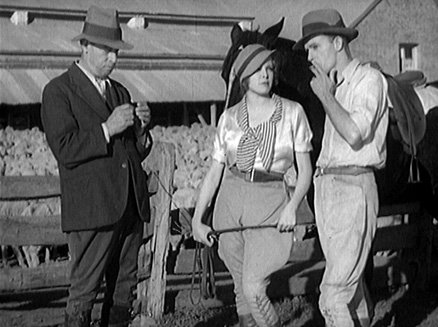 The Squatter’s Daughter is hokey and betrays the inexperience of its makers. For instance, look at the opening scenes with all the exposition – the nasty neighbour and his sidekick talking about how they are scheming, then the squatter’s daughter coming along to report on how they have been scheming… in later years, Hall would have dramatised this. The pacing throughout the movie is slow and the acting awkward – a lot of the time, the actors stand uncomfortably while delivering lines.
It looks fantastic, though – the cinematography is excellent (done by Frank “I went to Antarctica” Hurley) and there is splendid location work. Hall was smart enough to put production value up front: in the first few minutes, in amidst all that clunky exposition, there’s impressive shots of sheep being mustered and a man galloping a horse across a paddock. Later on, there are decent action scenes, particularly the final bushfire and brawl in a creek, where the actors look as though they’re in genuine peril (apparently they were – OH&S wasn’t great on film sets during this period either).
Jocelyn Howarth is raw but a lot of fun in the title role. It’s a great part: she gets to ride a horse, meet cute with a mysterious stranger, sing in an evening dress while playing the piano, go for a romantic stroll holding a koala, hang out at a pool, play kissies, and narrowly escape being burned to death. Howarth went on to have a minor Hollywood career and an unhappy private life, including a short marriage to notorious Hollywood f-boy George Brent, shagging a married screenwriter, and dying young.
The male lead, Grant Lyndsay, is very wet, like a lot of Australian leading men in movies around this time. He later became a successful radio announcer as Dick Fair. Most of the support cast are, to be frank, very hammy – Owen Ainley plays his part like he’s Renfield in Dracula – but in their defence, you can tell that they have been encouraged to make those choices; apparently, this was the influence of dialogue director George Cross. The dog, Bidgee, is very good – he dies in the fire at the end, easily the most heartbreaking moment of the movie.
It’s a shame that Hall couldn’t have made The Squatter’s Daughter later in his career when he had a better understanding of his craft – he must have thought that too, because he kind of remade it four years later as Tall Timbers. That’s a much more polished movie than this but has the same feisty heroine, rugged hero with a past, nasty business rivals, tragic love subplot, comic servants, villainous servant, action finale, etc.
Incidentally, the original play of The Squatter’s Daughter is in the public domain now. If anyone wants to adapt it – you could use it to rip off McLeod’s Daughters or something. Because one of the most consistently successful genres in this country is girls doing cool stuff on horseback.
You can see a copy of the film here.
The author would like to thank Graham Shirley for his assistance with this article. Unless otherwise specified all the opinions are the authors.
