


by Stephen Vagg
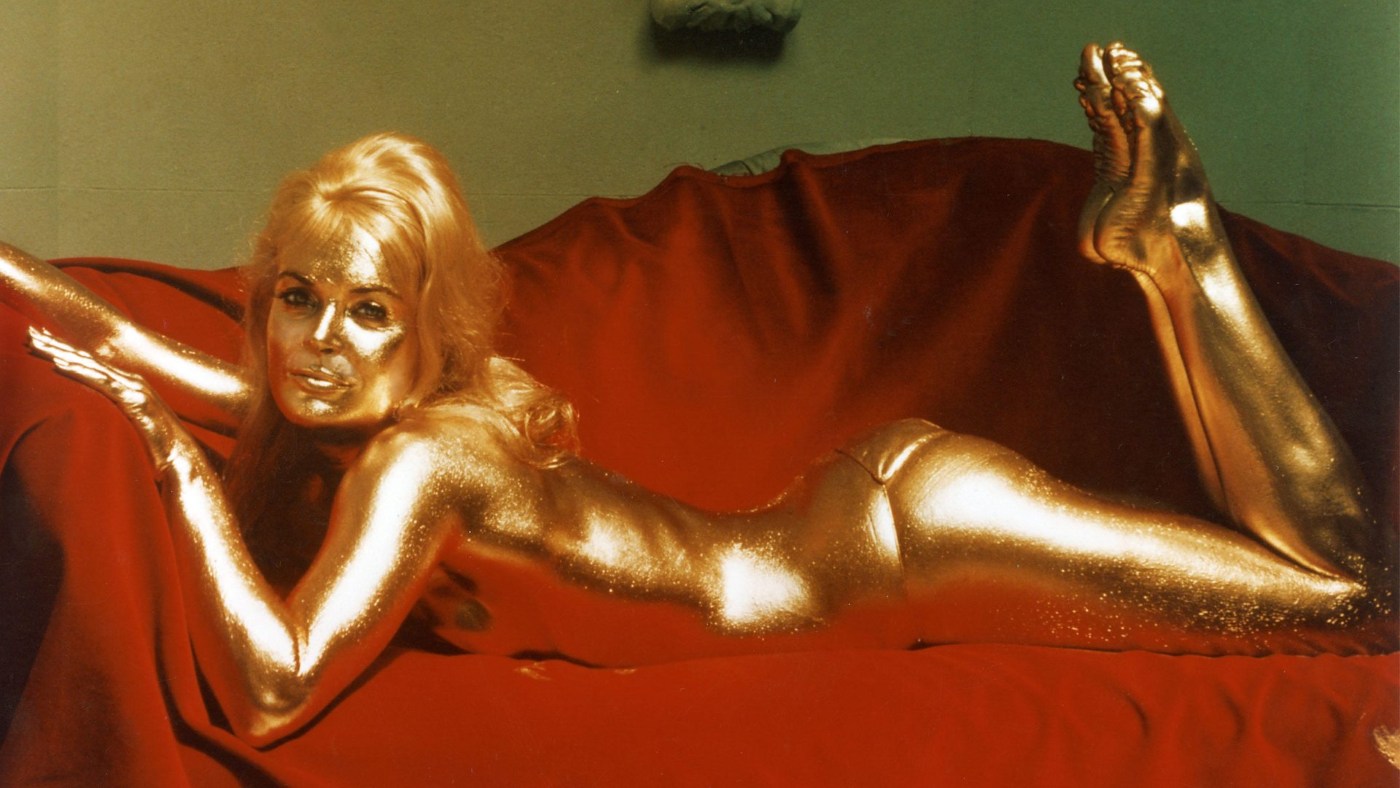
Shirley Eaton is best remembered for one role – image, rather: lying dead, painted in gold, for Goldfinger (1964), in one of the most iconic images in the history of cinema.
The rest of Eaton’s career has been overshadowed by this picture, but actually, she has a rather good resume, and if she never became a star, she livened up numerous movies before her premature retirement in 1969.
Eaton was born in 1937 and started performing at a young age. She was pretty in a way that was much in demand at the time (wholesome, blonde), and could sing and act; this meant that she was in constant employment almost immediately – in particular, displaying a real flair for comedy. She popped up in various stage shows, radio programs, television programs and films, playing “pretty blonde in background” in movies such as A Day to Remember (1953), You Know What Sailors Are (1954), and Doctor in The House (1954).
Her first sizeable movie role was in the Arthur Askey comedy The Love Match (1955), little remembered but a sizeable hit, and in March 1955 producer Alex Korda signed Shirley to an eight year contract worth a reported 45,000 pounds for one movie a year, allowing her to continue on with television, radio and TV work. Eaton’s first film under the contract was Charley Moon (1955) with Max Bygraves, directed by Guy Hamilton who later did Goldfinger.
Eaton had the lead in Sailor Beware (1956), a hugely popular adaptation of a stage farce, starring Ronald Lewis; it’s fairly grim to watch today but she’s immensely likeable on screen, as she always would be. The movie was produced by the Woolf brothers, John and James, who used Eaton again in another comedy hit, Three Men in a Boat (1957).
Korda died in 1956 and Eaton’s contract was taken over by the Rank Organsation, who gave her a decent role in Doctor at Large (1957), very charming as a nurse trying to have a dirty weekend with Dirk Bogarde. For our money, she outshines the other female star in the movie, Muriel Pavlow, and was far warmer and a better actor than other young contract players at Rank like Belinda Lee and Anne Heywood. But they took priority.
Like all British glamour gals of this period, Eaton appeared in a B-picture crime thriller with an imported American, in her case Date with Disaster (1957) with Tom Drake. Then she had a key role in The Naked Truth (1957) with Terry Thomas and Peter Sellers, and is excellent as a model blackmailed by Thomas, holding her own against the cream of British comic talent. She appeared on television in His Excellency (1957) (a British play that was pointlessly filmed by the ABC in Sydney in 1958).
Eaton then went into Carry On Sergeant (1958), a service comedy where she played the wife of Bob Monkhouse. The film was a surprise blockbuster and turned into the legendary Carry On franchise. Eaton made Further Up the Creek (1958) for Val Guest and Hammer, a sequel to Up the Creek; it was not successful but Carry On Nurse (1959) with Eaton in a different role to Carry On Sergeant, was another huge hit.
Nat Cohen sent Eaton to New York to promote the film. Eaton rarely gets any credit for the success of the first Carry Ons but she’s no passenger – she’s warm and lovely, with excellent comic timing.
This success did not necessarily lead to better parts. She was in In the Wake of a Stranger (1960) with Tony Wright and played the girl in another Val Guest comedy, Life is a Circus (1960), an unsuccessful attempt to revive the film career of the Crazy Gang. However, Carry On Constable (1960) was another hit and Eaton was hugely busy in comedies – a pretty girl who could act: Nearly a Nasty Accident (1961) with Jimmy Edwards and Kenneth Connor; Dentist on the Job (1961) with Bob Monkhouse; A Weekend with Lulu (1961) with Monkhouse and Leslie Phillips; What a Carve Up! (1961) with Sid James (this was later inspired a 1990s novel with Eaton as a character).
For a change of pace, there was a crime film, The Girl Hunters (1963) starring American author Mickey Spillane, and an American film, Rhino (1964) from Ivan Tors.
Then came Goldfinger. Such was Eaton’s impact as Jilly Masterton, it’s a shock to realise that she’s only in the film for three scenes – one where she flirts with Bond (Sean Connery), one post sex, and then when she’s dead. Eaton’s so clever, sexy, warm, smart and flirtatious that her death feels like a genuine emotional wallop. It’s a terrific performance. (Sidebar: the 1946 Val Lewton classic Bedlam featured a small boy character covered in paint who dies.)
The movie made Eaton internationally famous, and she leapt to top billing, but the projects weren’t that great. Maybe these were the best projects on offer (being in a Bond film gave actors fame but not a lot of street credit). She was in war film The Naked Brigade (1965), then starred in Harry Alan Towers’ fun version of Ten Little Indians (1965), where she is splendid, very sexy but also ambiguous… you buy that she could be a killer.
She did another for Ivan Tors, Around the World Under the Sea (1966); made a thriller for TV, The Scorpio Letters (1967) starring then-hot Alex Cord; was spotted in the canteen while making Scorpio Letters by Bob Hope, who remembered her from a revue that they’d done in Britain and offered her a role in a dire comedy, Eight on the Lam (1967).
Hary Allan Towers came calling again. He’d made a series of popular films with Christopher Lee based on Sax Rohmer’s Fu Manchu novels and, while looking around for something similar, decided to adapt Rohmer’s stories about the man-hating supervillain femme fatale Sumuru (which Rohmer started writing when people kept pointing out how racist the Fu Manchu stories were and he needed another villain so he turned to women villains instead of Asian ones). Eaton was cast in the lead in The Million Eyes of Sumuru (1967) with Frankie Avalon and The Girl from Rio (1969) (a scene from which pops up in The Blood of Fu Manchu). She’s clearly having the time of her life and is wonderful, though the films aren’t very good (we wish Don Sharp had directed and Peter Yeldham wrote the script – those two made the best Harry Allan Towers movies). Still, we’re surprised no one’s tried for a Sumuru reboot.
Eaton decided to retire. She had two young boys who she wanted to raise and probably got sick of the grind. Her agent suggested her for the role of Camilla in The Vampire Lovers (1970) but James Carreras said that she was too old at 32; a factor may have been Eaton’s refusal to do any frontal nudity, which was no issue for Ingrid Pitt. Eaton went to art school, did some writing and appears to have always been a totally well-adjusted person with nothing but fond memories of her career.
Could Shirley Eaton have become a bigger star? Well, she was terrific in all those comedies and thrillers, but it would have been nice to see her in a proper romcom, or really meaty drama, or something from a top rank director. It’s surprising that no one tried her in a musical. Every single movie that she made was basically a programmer; they included some of the most successful programmers of all time (Goldfinger, the Carry On movies) as well as a few cult items (Ten Little Indians, Sumuru, What a Carve Up) but it would have been nice to see her really stretch her wings. Still, it’s not a bad legacy. There was certainly more to her than one memorable death.
