


by Gill Pringle
A patriarchy-smashing epic written by Matt Damon, Ben Affleck and Nicole Holofcener (Enough Said, Friends With Money), the film stars Matt and Ben with Adam Driver and Killing Eve’s Jodie Comer.
Set in 14th century France, but with a plot pulled straight from today’s headlines, Comer’s Marguerite Carrouges – married to Damon’s Jean de Carrouges – petitions the King after she is brutally assaulted by Adam Driver’s Jacques Le Gris.
Based on Eric Jager’s book The Last Duel: A True Story of Crime, Scandal, and Trial by Combat in Medieval France, Scott’s retelling brings this brutal era to life in striking detail, as fans of his movies The Gladiator, The Martian and Alien would expect.
When etiquette, social aspirations and justice were driven by the codes of chivalry, the consequences for defying the institutions of the time – the Church, the nobility at court, a teenage king – could be severe. For a woman navigating these violent times, the stakes were even higher.
Concluding the story with a bloody duel, Marguerite and her husband have everything to lose in this gripping saga told from the three main players’ perspective.
FilmInk spars with Affleck, Damon, Comer and Holofcener.
The Last Duel is told from three slightly conflicting viewpoints. What was behind this decision?
 NICOLE: We chose to use the device of telling the story from several characters’ perspectives in order to examine the immutable fact that although often multiple people who experience the same event come away with differing accounts, there can only be one truth.
Strong women are rarely depicted from this era? What attracted you to this story?
NICOLE: This film is an effort to retell the story of a heroic woman from history whom most people haven’t heard of. We admired her bravery and resolute determination and felt this was both a story that needed to be told and one whose drama would captivate audiences the way it moved us as writers. As we further explored the story, we found so many aspects of the formal, codified patriarchy of 14th century Western Europe to still be present in vestigial ways in today’s society.
Nicole, you chiefly wrote the Third Act, from Jodie’s perspective. Did that involve passing the thought-log between the three of you through the various chapters like with a google doc? And, given Matt and Ben’s long-term friendship was that a little intimidating?
NICOLE: We actually wrote it before the pandemic. Matt and Ben had already started writing and had decided to write it in this three-part point of view kind of way. They asked me to come and write the last part, and I was thrilled. They did not have to beg me. No way. I was flattered and I wasn’t sure I could do it but did. And then, I would send pages to them, and we’d sit down together, and we’d work on each other’s scenes. Like, I basically wrote the third act, but they also had a hand in it because it had to be a part of the whole movie. When smart writers have ideas, one should take them. And so, between Jodie and them, it was really collaborative as it was with all the other actors too.
Was there something from the first two acts that you wanted to shape into Marguerite’s third act?
NICOLE: Well, I wanted people to wonder why Jodie Comer took this lousy part, basically. Um, isn’t she really successful?
MATT: Yeah, why would she do this?
NICOLE: Why? She’s barely in this movie playing this kind of obsequious wife who thinks her husband is all that. And then by the time we got to the third act, I wanted really to say, like, no. This is actually the truth. And she’s actually a human being.
MATT: The construct was that the world of women is totally ignored, and overlooked, and is invisible for the first two acts of the movie. And then it’s revealed in the third act. And that was actually because Ben and I were adapting a book. Nicole was really writing an original screenplay. Because the men of the time took very fastidious notes about what they were all up to, but they didn’t record what the women were doing. So, Nicole really had to create Jodie’s world, Marguerite’s world, out of a whole new cloth.
BEN: But again, that doesn’t work. Like, the joke she’s making about why Jodie took this part is that it has a lot of truth rooted in it. That doesn’t work unless Jodie is so smart and brave, and complicated in her performance. Where she’s willing to, and I’m not sure every actor would have been, actually play another character’s point of view of themself, rather than their sense of their true self. And because she does that so perfectly, so that it’s seamless, you don’t get a sense that, ‘oh, it’s an exaggerated version of a person’. It feels like versions of women we’ve seen in movies before. And we wanted to exploit the fact that, historically, people are in many ways, largely accustomed to women being secondary and tertiary characters, so that it would seem out of the ordinary. And she was willing to play that and makes the reveal, I think, so much more powerful and elegant, to see the difference between an essentially two-dimensional person, and a fully-realised, three-dimensional human being.
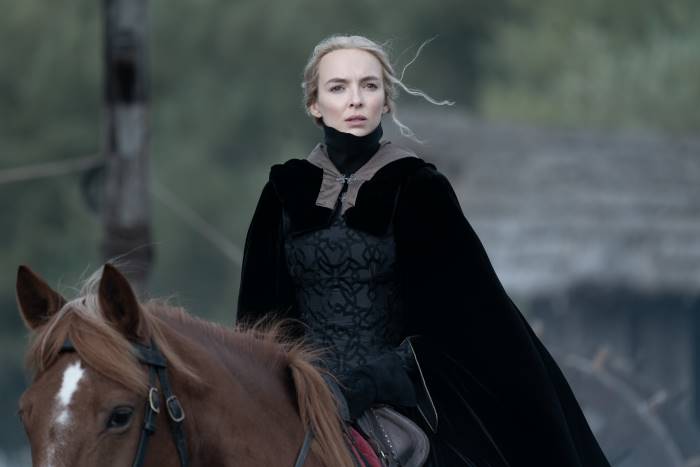
From an acting perspective, what was the most exciting aspect of doing the same scene from three different points of view?
JODIE: I think the most exciting aspect was the fact I’d never done it before and it was so new. Usually, when you approach a character, it’s none of your concern what the other character thinks of you. You don’t have to worry about what they need from you. Whereas, on this film, you really had to think about what the other actor, character, needed from you in that moment, in order for their story to ring true to them. And you never have to usually think about that so, I think that was definitely exciting.
This story happened hundreds of years ago. But there are stories like this happening today. One of the best parts of this whole structure is the fact that modern folks are going to digest this old story and see the similarities. How much of that did you map out early on to make that balance?
BEN: A lot of it. That was a very deliberate thing. And part of what we wanted to point out was the extent to which corrupt, and morally bankrupt, and misogynist institutions create and produce people who reflect those values. And so, rather than just being an indictment of a bad person, a bad man, to say, ‘well, here, look. You have the church, you have science, you have the court. You have this whole Western-European civilisation, of which we are an antecedent, culturally, by and large’. At least, that’s the notion of the United States, is that it’s sort of the result of the Enlightenment and its philosophies, and so forth. Even though it’s actually not true. But the idea is, here, this predominant culture that comes from this other culture that is what produced these values. And this culture, in terms of how it educates people, and in terms of what it rewards, socially. In terms of the behaviour that is encouraged. Like, in the character that I play, yes, he could have been just a complete villain. But really, the idea, that when a person is in power, and represents these values, and says, these are the values we encourage in you, and you’ll be rewarded for following them. It’s more about where Adam’s character is, and how he’s taught to behave, and what he’s rewarded for, than it is about the essential nature of his character. In other words, that people can be changed and created by these large institutions. And that’s the value system that we wanted to indict. And so, that required making sure, on an architectural level, that all those elements were included. And then you have to just throw it away and hope that the great actors make you identify with the people. And so that none of that feels pedantic or like your term paper, you know?

NICOLE: And if only the audience could walk out of this movie and say, ‘wow, it was awful back then. Thank god, it’s not like that anymore’.
How was your experience working with Ridley Scott? And why do you feel he was the right director for this?
JODIE: Well, for me, it’s like, when a script comes from Ridley Scott, and he wants to meet you, you’re like – ‘yes, I will!’ And then I read the script and was so fascinated by the structure of it and this idea of there being three perspectives but, ultimately, only one truth. And then, I remember when I met Matt early on and he was like, ‘you should know, he works at a pace. Like, he has four or five cameras rolling. It’s fast’. He kind of gave me a little heads up. And then I got to set, and I was like, ‘oh, no kidding’. I’ve never worked like this before. It was just really fascinating to see how he makes his decisions and his attention to detail, whether it be through the characters in the story or the locations, and the set-design. He doesn’t miss a trick, and the film has a lot of heart But it also has the spectacle. It has the fighting and the duels, and I think it’s what he’s so great at.
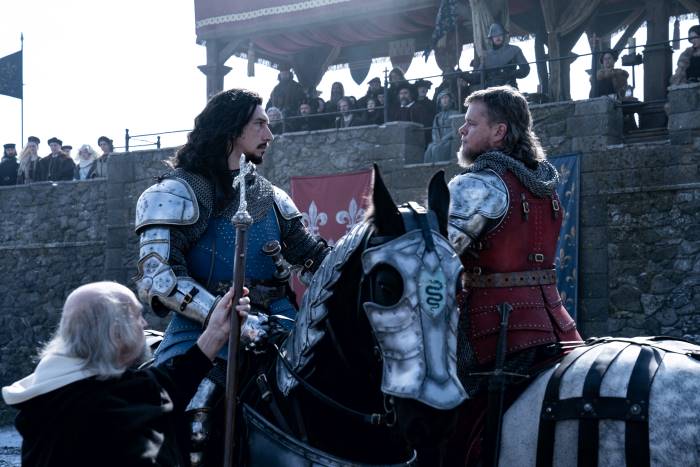
Can you talk about the actual duel?
MATT: The duel was actually in Eric Jager’s book that we adapted. And he meticulously explained the duel and exactly how it happened because it was recorded in history. It was a very famous thing. But it was decidedly un-cinematic, because these guys were, basically, in giant tin cans and the only visual was these tiny eye slits, so it would have been a really awkward affair. And it wouldn’t have looked very good. So, Ridley kept the bones of the duel. The duel did happen, with three joust passes, they came off their horses, they went to axes, swords, then daggers. All that is true. But Rob Inch, our stunt coordinator, invented this beautiful choreography with Ridley and they figured out how to shoot it. And that’s the great thing about collaborating with great people, is that they kept the spirit of the duel and exactly what really happened.
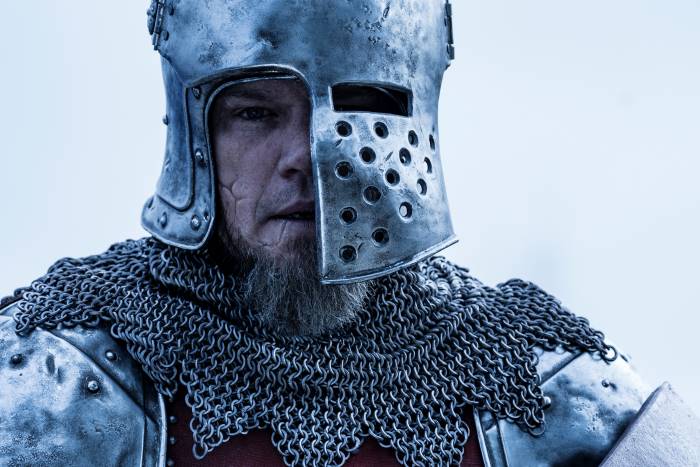
The same person won, in history, who won in our movie. All that stuff is the same. And all the dialogue is from the actual recorded event. But it’s a Ridley Scott duel, so we have visors where half our face is showing and, man, it’s beautiful and visually stunning.
BEN: And we knew Ridley would make it great. It was like, ‘look, here’s what happened. You’re gonna make it; we’re not gonna tell ya how to do it’.
The Last Duel is in cinemas October 21, 2021

