


by Lewis Khan
For decades, the film industry has operated around a single moment.
The greenlight.
A script is developed. Talent is attached. A package is built. Then it goes into a room where someone decides whether the film gets made. That idea still exists. It just doesn’t carry the same weight.
Because the real decision is happening earlier.
Long before a distributor reads the script or a financier looks at the numbers, there are already signals in the market. Audience response to certain concepts. Creators building followings. Platforms backing specific types of projects.
By the time something reaches a formal greenlight conversation, much of the uncertainty has already been exposed. The meeting doesn’t create belief. It tests whether it’s already there.
You can see it in what moves. A horror film with a clear hook and defined audience will often move faster than a well-written drama with no obvious entry point. The pathway is easier to recognise.
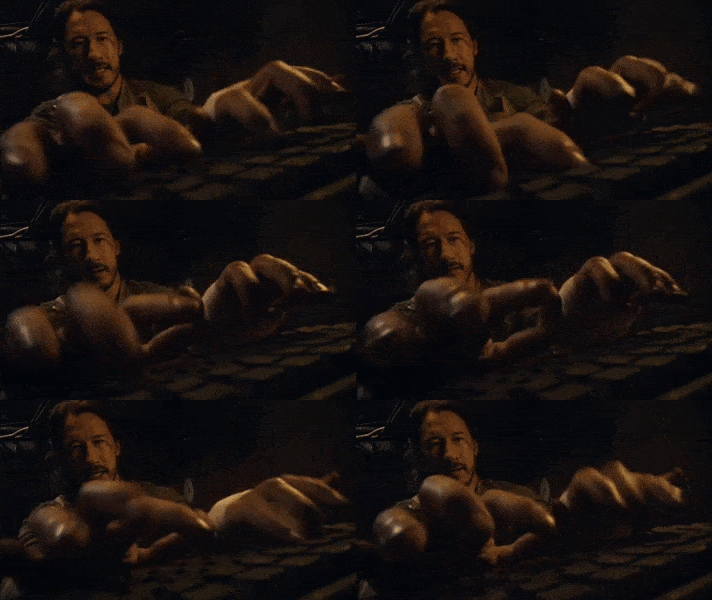
The same applies to creator-led projects. When someone arrives with an audience, they’re not just bringing visibility. They’re bringing proof. We’re already seeing this play out with creator-led films like Iron Lung, where the audience existed before the film did. That shifts the risk calculation. The project is no longer being assessed in a vacuum.
At the higher end, familiar IP continues to dominate for the same reason. Recognition does part of the work before the film even exists.
The industry used to take more swings. Now it looks for evidence. That shift changes where leverage sits. It’s not held only by the person writing the cheque. It sits with whoever can show why the film will be watched.
That doesn’t require a large audience upfront. It does require a visible path to one. Without that, projects become difficult to finance, difficult to sell, and difficult to position. The problem isn’t quality. It’s the absence of something the market can respond to.
This is where many films run into trouble. They’re developed in isolation, then introduced late. At that point, the industry is being asked to commit without enough to anchor the decision.
The projects that move tend to arrive differently. A concept that travels. A piece of IP that carries recognition. A creator or community already paying attention. The form varies. The effect doesn’t. The film shows up with momentum.
What replaces the traditional greenlight isn’t a single decision. It’s a sequence of confirmations that happen earlier and compound. By the time someone formally says yes, the direction is already set.
Risk hasn’t disappeared. It’s just being judged differently.
The question is less about whether the film works on the page, and more about whether there’s a clear reason for it to exist in the market. That’s a harder standard. It also makes the outcome easier to read. Because once that signal is there, the rest of the system tends to follow. And by then, the greenlight isn’t the starting point.
It’s the point where everyone catches up.
Lewis Khan is a producer based in Sydney
