


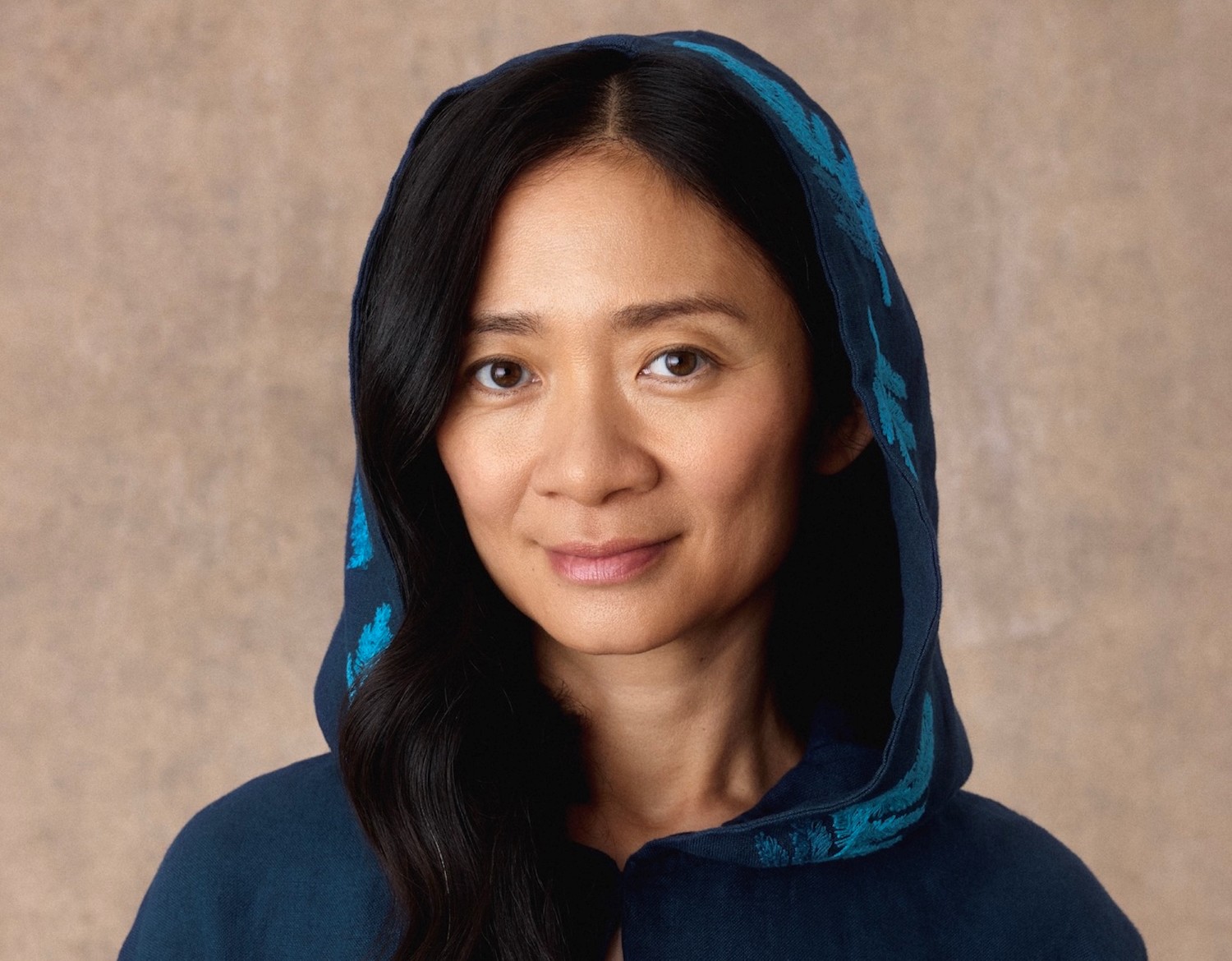
by Andrea Baker
Fan fiction obsessive. Philosophical filmmaker: Chloe Zhao follows her gut instinct in project choices.
“My compulsion to create was strong at a very young age… It’s more important than food and sleep… because the act of creativity is not really a job… It’s become something that we choose to do for a living,” Chloe Zhao told moderator Kumi Taguchi in Sydney on Thursday evening as part of Vivid’s Creative Trailblazers series of talks.
From Songs My Brothers Taught Me (2015), The Rider (2017), Marvel’s Eternals (2021), to the multi-award-winning (Oscars, BAFTAS, Golden Globes) films, such as Nomadland (2020) and Hamnet (2025), Zhao is globally known for intimate portraits of resilience, community and the eternal search for belonging.
After a 36-hour flight from the Cannes Film Festival, after serving on the jury, the China-born filmmaker arrived in Sydney for an exclusive Australian appearance at Vivid 2026 and was delighted to wake to koalas perched in the trees at the wildlife sanctuary where she is staying.
From growing up Chinese to a liberal arts education
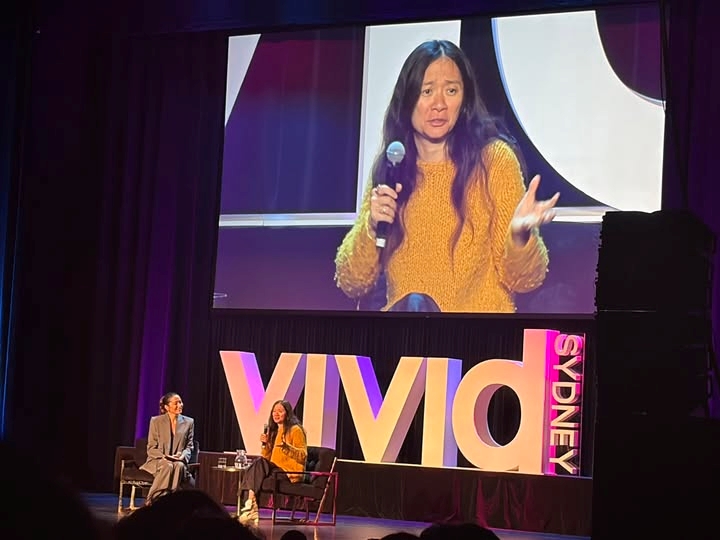 “I grew up in cities [Beijing]. I didn’t really have an education around nature, but there was always an instinctual pull towards it,” Zhao said.
Sent to boarding school at the age of four, “I have very few memories of my life before I was 10 years old, [because it was] turbulent… traumatic.”
As the only child, Zhao said she “wasn’t the easiest kid”. With an intensely inquiring mind and a vivid imagination, she was obsessed with fan fiction, western culture and storytelling.
Zhao loved One Hundred Thousand Whys, a popular science book series for children, written by former Soviet Union writer, Mikhail Il’in, which ponders “questions about the reality we live in”.
She was obsessed with Japanese Manga comic books, because of their “interesting blend of the East and the West… I just wanted to be a manga artist.
“I remember watching Terminator 2 for the first time and Aliens and could not have believed what I was looking at because of the technology and the imagination.”
After studying painting and art in the United Kingdom, she moved to Los Angeles in 1999 to study politics at a liberal arts college, not long after the race riots.
In her mid-20s, after working as a waitress for four years in New York City, Zhao applied to film school, the Tisch School of the Arts. “This is a place that I feel comfortable in… where I belong as a nomadic storyteller.”
The Rider to Nomadland
“I come from the American independent [film] world… I am trying to listen to what my tribe wants… and translate that into success in the capitalistic society,” Zhao said.
Her debut feature (Songs My Brothers Taught Me, 2015) and second film (The Rider, 2017), which Zhao wrote, directed and produced, had budgets of less than $US100,000.
The Rider, based on a horse trainer Zhao knew, after visiting an Indian reservation and witnessing its rituals and ceremonies, caught the attention of Hollywood icon Frances McDormand.
McDormand co-optioned the rights to Nomadland: Surviving America in the Twenty-First Century by journalist Jessica Bruder and approached Zhao to direct the film. The Chinese director then travelled across the American West, spending time with real nomads whose lived experiences shaped the screenplay.
Zhao’s Oscar-winning film, Nomadland (2020), starring McDormand as Fern, a middle-aged woman forced into a van-based, economically insecure nomadic lifestyle after the 2008 financial crisis in the US, opened the door to Hollywood.
Frances [McDormand] had come from the famed Three Billboards, and we needed her to star in Nomadland to make the film work.
“I went to [film studio] Searchlight and said, ‘How much money can you give me that I can do whatever I want, so that if I make no money back, then you’re fine’. And they said five million. I said, ‘I will take it’,” Zhao said.
Nomadland won Best Picture, Best Director, Best Actor and Best Actress. Were you expecting that? Taguchi asked at the Vivid event.
“No, no, no, no, no… How can you judge art… This is the paradox,” Zhao answered.
Hamnet and dealing with death
“I’m not a scholar of [William] Shakespeare, and I’m not a mother in the traditional sense. As I’m driving through the desert again, I got a phone call about a film about Shakespeare’s wife and them losing their child…Was I the right person for that?”
As synchronicities have it, soon after, Zhao met Paul Mescal for the first time at Telluride Film Festival. “There is an animal inside of this young man… if this is young Shakespeare, I’ll watch it.”
Then the next day at the festival, Zhao met Jessie Buckley also for the first time, and knew she had the lead characters, but first she had to read the book written by the Irish-British author Maggie O’Farrell.
“You recently trained to be a death doula. Has that changed your relationship to grief?” Taguchi asked, winding up the evening’s discussion.
“I think the reason why I went there was that I would be very afraid of it, not death itself, but the dying process… especially in the West, there’s some shame around aging and dying, and it’s medicalised… but you know, it’s a very human process”, Zhao said.
“Who is afraid of death?’ she asks, looking out at the audience at the State Theatre. “Oh, not many… That’s amazing. This is Australia.”
Vivid’s Creative Trailblazers continues with Sean Baker: In Conversation on June 7 at The Sydney Town Hall. For all ticketing and venue details, click here.
