



by Stephen Vagg
Few actors were given more advantages that James MacArthur – a legendary actress mother and equally famous writer father, lead roles in his first five movies that all had decent budgets and were based on pre-existing IP, the backing of a major studio. He never converted this into fully-fledged – or indeed any sort of – stardom, but he had an interesting career.
MacArthur was born in 1937 and was adopted by one of the most famous couples in America at the time: actress Helen Hayes (the “First Lady of Broadway” and occasional film performer) and writer Charles MacArthur (best known for his partnership with Ben Hecht that included the stage classic The Front Page and the 1939 script of Wuthering Heights). James grew up around a lot of actors – Lillian Gish was his godmother – so it’s not surprising that he drifted towards the profession; from childhood, he started appearing in various stage and radio projects as a way to earn a little extra money.
Acting might have remained predominantly a part-time gig for James MacArthur until he was cast, when only eighteen years old and studying at Harvard, in a television play directed by John Frankenheimer: Deal a Blow, where James played a juvenile delinquent. This was extremely well received and when Frankenheimer directed the film version of the play under the title The Young Stranger (1957), he used MacArthur again. The movie was not a big hit, but it was a classy credit; Frankenheimer later claimed that he basically taught MacArthur how to act, and maybe there was something to it. According to Helen Hayes’ memoir, her son disliked training, worried that “too much technique night rob me of my natural charm”, which annoyed Hayes. She also wrote after seeing The Young Stranger, her pride in her son “as mixed with a touch of envy. He knew instinctively that the key to screen acting is not to project too much and that’s why my screen acting has never looked right to me: I don’t know how not to project.”
Mother and son were very close, incidentally – when James was only eleven, his sister Mary, also an actress, died of polio; when he was 18, his father Charlie died – so it was him and his mother for a long time. (At least Charlie MacArthur got to see The Young Stranger before he passed on.)
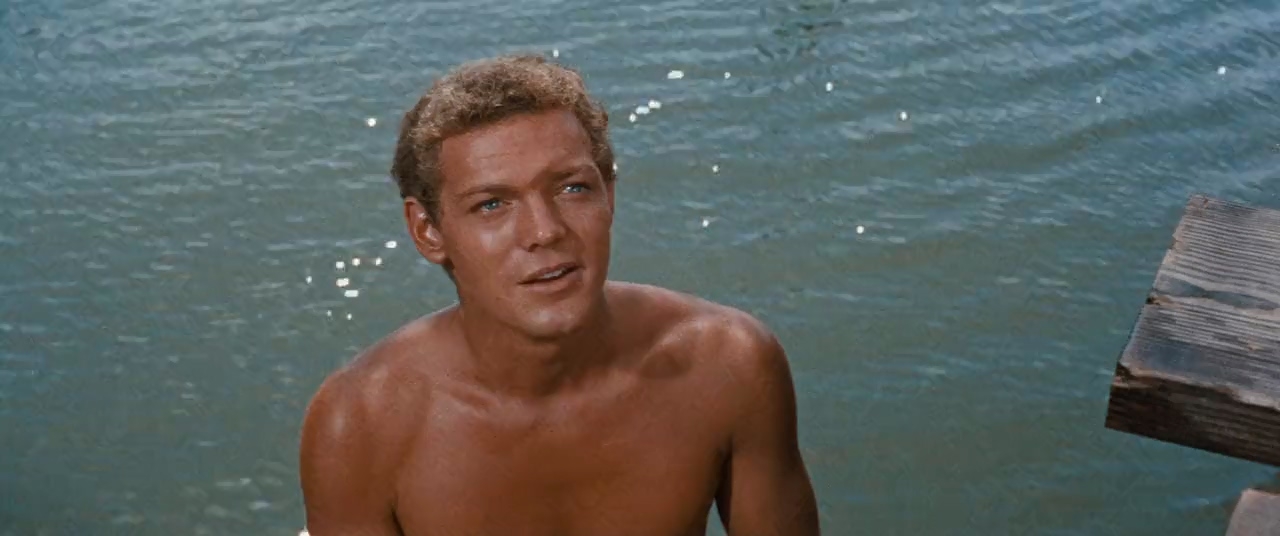
MacArthur’s next break came when Walt Disney – who’d been impressed by The Young Stranger – personally selected the actor to play a white man raised by Indians in The Light in the Forest (1958), one of Disney’s numerous literate Boy’s Own Adventure features from this period. It was a strong performance, helped by wearing a cool Mohawk haircut for most of the running time; the movie wasn’t a big hit, but it did well enough. Disney really liked MacArthur and signed him to a multi picture contract that included the leads in other Boy’s Own Adventures based on novels: Third Man on the Mountain (1959), Kidnapped (1960) and Swiss Family Robinson (1960). In these films, MacArthur played two Swiss and a Scot, but he performed all of them the same way: all-American, keen, bright, physical. He didn’t have the looks to be a leading heart throb of the era, but he was pleasant looking, skilled in action scenes, had approachable vibes and helped give all the movies a contemporary feel.
The four Disney movies were widely seen with one being a massive hit – Swiss Family Robinson. But in most cases, the star of Disney movies was Walt Disney rather than any actor in them; certainly, the success of the aforementioned movies did not turn James MacArthur into a star in Hollywood’s eyes. His other screen appearances around this time were guest shots on television shows like The Untouchables; he also appeared on Broadway with Jane Fonda in Invitation to a March and recorded some songs (as many young leading men did from this era). He later said that he was often confused with Johnny Sheffield who played Boy in the Tarzan films, and the title role in the Bomba the Jungle Boy series.
MacArthur had a juicy part in Columbia’s young medico drama, The Interns (1962), although it was a terrible (if dramatically useful) role – a boorish smug doctor who turns in his mate (Cliff Robertson) for stealing an anti-abortion drug, tracks down an entirely justified mercy killer, and bullies his girlfriend (Stefanie Powers) into marriage before she can go travelling. It was a big hit, though for some reason, MacArthur’s role in the sequel, The New Interns (1964), was taken by Dean Jones (who also made a number of movies for Disney).
MacArthur was in Spencer’s Mountain (1963), a forerunner to the TV series The Waltons, playing the John Boy part, and quite popular. He made Cry of Battle (1963), an early Philippines war movie, then was Hayley Mills’ love interest in The Truth About Spring (1965), an attempt by Universal to do a Disney style adventure film – only he and Mills had no chemistry, he was far too old for her and was not given enough to do.
After that, it was almost entirely character/support roles: TV guest appearances, causing the world to end in The Bedford Incident (1965), as an American soldier in Battle of the Bulge (1965), the Sam Katzman exploitation The Love Ins (1967), a preacher in Hang Em High (1968). He returned to Disney for Mosby’s Marauders (1967), made for television but released theatrically in some markets.
MacArthur found his niche (and “pension role”) when cast as Jack Lord’s sidekick in Hawaii Five 0 (replacing Tim O’Kelly who was in the pilot). He played second banana for over a decade, which made him financially secure. After the show, he mostly did television and stage. He died in 2010.
James MacArthur had an entirely decent career, full of solid credits and even a few classics (Swiss Family Robinson). His career has the aura of anti-climax about it because he started so strong out of the gate with The Young Stranger and a string of leads for Disney; this, along with his famous parents, possibly raised expectations that were impossible to fulfil. He did not work with enough top-rank directors (only one, really – John Frankenheimer) and definitely should have made more action movies. Later, MacArthur’s career “level” adjusted and he found his natural state as a character actor/second lead. He lacked the looks and charisma of a top rank star, but James MacArthur was a competent, accomplished, reliable performer who made some fine movies.
