




By Erin Free
In 1977, the Australian film industry was being buffeted by a monstrous wave of change. Peter Weir had delivered the decade’s first major masterpiece with 1975’s Picnic At Hanging Rock, and Bruce Beresford had started scratching away at the nation’s ocker underbelly with 1972’s The Adventures Of Barry McKenzie and 1976’s Don’s Party. Tim Burstall, meanwhile, had exposed said underbelly completely with bawdy torchbearers like 1971’s Stork, 1973’s Alvin Purple and 1974’s Petersen. Films were being made at a breakneck clip, audiences were flocking to them, and there was a sweet, affirming buzz of positivity in the air. Turned on by this burgeoning spirit of creativity, and electrified by the beginnings of what would become a genuine filmmaking frenzy, was a young, in-demand male model and actor by the name of Phillip Avalon. Tired of the lack of input that he was getting as a guest performer on TV shows like Number 96, this rakish and inventive player-in-waiting was ready to stake his own claim in Australia’s suddenly lush and fertile cinematic landscape. “I realised early on that as an actor in a small production, you didn’t have any weight,” the warm and strikingly candid Avalon tells FilmInk on the line from his offices in Queensland. “You just did your lines, and that was it.”
Desperate to up the ante, Avalon entered the heady orbit of The Sydney Filmmakers Co-operative, a group of independent filmmakers funded by The Australian Film Commission and charged with distributing and exhibiting their films and the films of others. This “young gun hippie group of filmmakers” would get together to show their movies on a Saturday night. “There’d be a box of booze in the middle of the room, and sometimes a box of dope too,” Avalon laughs. A keen surfer, he would roll the documentaries and board riding footage that he’d put together, but it wasn’t until Avalon saw an early cut of Filmmakers Co-operative member Phillip Noyce’s searing low budget drama, Backroads, that he realised there was a lot more that he could be doing cinematically. “That’s when I thought about Australians wanting to see an Australian film,” Avalon says. “They’d never seen a local youth, surfing, rock’n’roll kind of film, so that’s what I wanted to do.”

Avalon then quickly wrote the screenplay for Summer City, a sixties-set drama about three mates – the brash, loudmouthed Boo; his slightly less boorish sidekick, Scollop; the decidedly more sensible Robbie; and the sensitive, conservative Sandy, enjoying his last days as a single man before getting hitched – who hit the coast for a surfing holiday. The story was a simple coming of age drama, but infused with moments of high drama, as Boo’s ill-informed dalliance with an innocent smalltown girl invokes the wrath of her mentally unhinged father, sparking a series of confrontations that ultimately veer into blood-stained tragedy.
Though leaving open ample opportunity for surfing footage, sex and broad humour, Summer City was envisioned as much more than just a lowest-common-denominator comedy. Growing up in the rough-and-tumble town of Newcastle – a rugged mix of surf and steel a few hours north of Sydney – Avalon would sit around a beach campfire at night with his surfing mates, which is when the darker stories would seep out. “There’d be stories about a guy who lived up in the hills,” Avalon explains. “He was allegedly an escaped prisoner who was after the young surf chicks so he could rape and murder them. There were lots of stories about that sort of thing. So even if that wasn’t part of Summer City, it gave me the inspiration to add another layer to the film, which wasn’t just about a bunch of guys away on a bucks’ weekend. There was also this monster out there in the woods, so to speak.”

After knocking his script together, Avalon pulled together all of the money that he’d been earning from his modelling and TV work, and then “passed the hat around to his mates”, who chipped in a bit more. The real money rolled in, however, when Avalon’s PR guy suggested that his father might be interested in investing in the film. “His dad took me to the bank, and we got an agreement together for $26,000,” Avalon explains. “Again, I got lucky there. I didn’t realise it at the time though, but it of course later turned out to be just a loan. Had Summer City failed, I’d be in prison now,” Avalon laughs. “Those were the days!” Despite the drum-tight budgetary restrictions, the burgeoning producer never took a backward step in his aim to “capture the Australian larrikin way of life of the sixties”, and never considered contemporising what he always envisioned as a period film. “At that time in the seventies, it was bell bottoms and long hair, and everyone was smoking dope,” he explains. “It was like The Age Of Aquarius, you know? That was one thing that I did say from the get-go. We really had to set this film in the mid-sixties, and we had to carry that energy into the film. I wanted to capture that Aussie larrikin surfer mateship thing.”
With the script complete and the minimal financing in place, Avalon found a director in the form of Christopher Fraser, a young South African toiling away as a burgeoning director at major production house, Fontana Films, who were pumping out commercials by the truckload. When Avalon – who had done some work for the company – tried to get its main man, Rick Gabriel, to invest in Summer City, he instead offered up some of his employees to work on the film. “He gave me the crew on consignment,” Avalon laughs. “Chris knew nothing about surfing or surf culture or what I was trying to get at. It took quite a while for Chris to get it, but at the end of the day, he captured it on film. Had I had enough money and given him enough people to make the film properly, I’m sure that it would have been a far superior film. But those were the circumstances at the time.”

The real boon for Avalon, however, would come with his casting of the film. Though John Jarratt is now a local legend thanks to his decades spent working continually in Australian television and film – and more recently thanks to his terrifying turn as outback serial killer, Mick Taylor, in the hit horror flick, Wolf Creek – in 1977, he was a young actor just kicking off his career. Jarratt had debuted with the lead role in the 1975 comedy, The Great McCarthy, and had also featured in the ensemble cast of Peter Weir’s Picnic At Hanging Rock, as well as television programmes such as The Young Doctors and Matlock Police. “I didn’t know John, but I saw him in Picnic At Hanging Rock, and I loved what he did,” Avalon explains. “I was absolutely rapt when he said that he could do Summer City.”
John Jarratt was keen to get involved, but a little cagy. “I liked the director, Chris Fraser,” the actor tells FilmInk in his famously laconic drawl. “There was something quirky about the film, I was young, and it seemed okay to me.” Initially offered the role of Robbie – which Avalon himself would end up playing – Jarratt instead plumped for the part of the callow Sandy, the emotional lynchpin of the film. “He was nerdy and different,” the actor explains. “It was a bit different from what I’d done in The Great McCarthy and Picnic At Hanging Rock. I said, ‘Look, I’d like to do this guy; he’s more complex than everyone else, and a little bit different.’ So I chose the nerdy guy, and they cast me in the film.”

It was Jarratt who then became instrumental in putting together the film’s other essential elements. Aware that Avalon was having trouble finding actors to play abrasive alpha male Boo and his dim-but-handsome mate, Scollop, Jarratt – who had recently graduated from NIDA – knew of two students at Sydney’s prestigious drama school who would be perfect for the roles. “I lived on Bondi Road at the time, around the corner from these rogues called Steve Bisley and Mel Gibson,” Jarratt laughs. “Mel was driving an EH Holden…you had to open the boot by putting your hand through the rust hole. A meal for them would be a Vita Wheat and Vegemite. They were mad bastards. I went and saw a couple of their plays at NIDA though, and I thought, ‘Not only are they good fellas to hang out with, but they can act!’ One of my housemates at the time was Judy Davis, who was also in their year. You gotta understand though, at this time, nobody knew any of them. I was bouncing around with these young kids who would eventually become major bloody stars in their own right. So I said, ‘Look, I know two guys who’d be perfect for this movie, and if we don’t get ‘em, someone else will.’ I should’ve chucked it in then and become a casting agent – they seem to drive better cars than I do! So there begins the long history of Bizzo, Mel and I. We’re all still good friends to this day.”
Phil Avalon knew almost straight away that John Jarratt had brought him nothing short of cinematic gold. “You’re blessed sometimes,” he says. “I’ve done a lot of films since, and it doesn’t often happen that you get walk-ins. It might have happened once or twice in my life, and it certainly happened on that film. I take my hat off to John. You only appreciate these things further down the track. You don’t appreciate it at the time. I certainly didn’t.”

When FilmInk asks for his thoughts on initially meeting Summer City producer and actor, Phil Avalon, Jarratt – speaking through what sounds like a nasty head cold – pauses briefly. “He conned us, the old Phil,” he says. “We’re never supposed to admit it. He’s pretty sharp, and we were led to believe that there was a lot more in place than there was. There was very little money to make the movie, and then we ran out of money completely. And being young, and with all three of us being of Irish descent, there was a little fire in the belly, so there were a few blues. But in retrospect, it was a great experience. I don’t think that it did any of us any harm in the long run.”
Avalon’s next-to-no-budget brand of filmmaking was in place right from the beginning of the production. When Steve Bisley and Mel Gibson told him that they wanted to head up to the Catherine Hill Bay location (approximately 100km north of Sydney) early to get a feel for their characters and their environment, their young producer and co-star informed them that he had no money for petrol, and promptly pointed to the base of some cliffs near his home in the Sydney beachside suburb of Tamarama. “I said, ‘Fellas, there’s a car that just rolled over the cliff over there. If you guys don’t mind climbing down the cliff and milking the petrol out of this car, you’re more than welcome.’ So they did.” John Jarratt, meanwhile, was given a couple of hundred empty Coca-Cola bottles (which had been donated to the project) to cash in for petrol money. “This wasn’t low budget filmmaking,” Avalon laughs. “This was guerrilla filmmaking, to a T.”
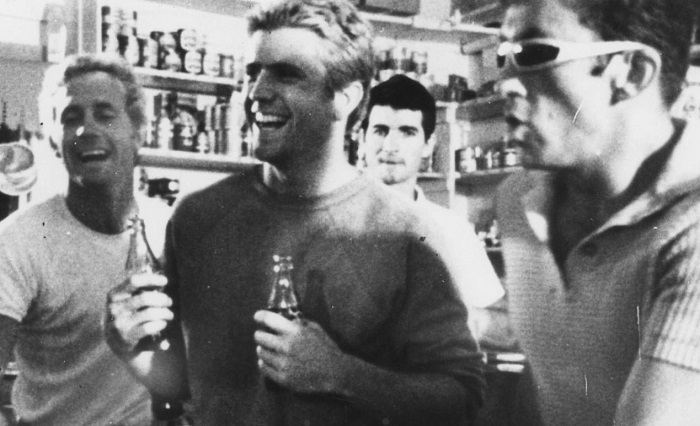
Once on location in Catherine Hill Bay, the situation wasn’t much better, with cast-and-crew lodgings set up in a local RSL hall, and Avalon himself making the sandwiches for lunch and dinner. “All fully accommodated for and catered for,” Jarratt laughs. “All these things that Phil was painting for this marvellous shoot that we were going to have! Yeah, we were sold on a lot of things. It’s like the room with a view, but only if you sleep on the counter in the kitchen. Take your sleeping bag in there! It was like scout camp or something. It was almost like a high school weekend type affair – camping out on Summer City. That’s what it was.”
Despite sleeping on a hall floor, and being in the midst of a production that was literally unfurling on the smell of an oily rag, Jarratt – despite being in the relative beginnings of his career – always maintained focus, even while things were spinning out of control all around him. “As soon as the clapper board goes in, your ego’s big enough to make you give it your best shot,” the actor explains. “And you don’t let anything that’s driving you nuts get in there to destroy it, because that’s what you do for a living. You give it your best shot. They don’t put, ‘Oh, I’m sorry, I’m not really up to scratch, but we’re having a tough time that day’ in subtitles over your performance. We gave it our all. Everyone tried really hard to make it work under extremely tough conditions: there was virtually no budget, and cars had to be towed because they were so dilapidated. They broke down all the time. They had to push them into the shot, and then film it.”

Though it was made in the rough-and-ready guerilla style, the hectic shoot of Summer City hardly inspired a mini-army of imitators. Unlike, say, Robert Rodriguez’ $7,000 wonder, El Mariachi, or any number of much later shot-on-video efforts, Summer City did not start a filmmaking revolution in Australia. “No, it was a one off,” says John Jarratt. “It was just Phil with his matchless determination. Come hell or high water, he rounded up a whole lot of people, gave them enough of a good story to get ‘em there, and made this bloody movie. Somehow we made it. We had nothing. In the town hall dance sequence, for instance, we didn’t have a dolly – the guy was on an army blanket, slipping around the floor! There was a lot of improvising going on. In the script, there’s a scene where an old man gets angry at the boys, and chases their car. That was my dad! We did things like that. ‘We gotta have an old bloke.’ ‘Oh, dad will do! Chuck the old man in!’ I knew that he could do it, and he did a good job. I also worked as the first assistant director, by the way,” Jarratt laughs. “So there was a bit of that going on too.”
It was at the end of the shooting of the film that John Jarratt and Phil Avalon – the two men arguably most responsible for the strongest qualities of the final film – had a major bust-up. And like so many problems that had arisen during the production of Summer City, it involved a car. When the film’s central motor vehicle – “That huge black Chevy,” Jarratt moans – broke down, Jarratt was charged with towing it back to Sydney…on the back of his prized 220S 1959 Mercedes. “I blew my engine doing it,” the actor says. “I told Phil that I’d just blown my car over. I bought this old Hillman Husky because he said that he couldn’t help me with my car. Then about four months later, I came back up to Catherine Hill Bay when they’d got the money together to finish the film. I turned up in a Hillman Husky, and Phil had an almost new Toyota, and inside was [major Australian sex symbol and Summer City cameo star] Abigail, who had been paid handsomely. She turned up in a Rolls-Royce, and I was in a Hillman Husky. I hadn’t been paid a bloody cracker. So I did what I had to do, and then I said, ‘Up yours’ and left. I got in my Hillman Husky and went home. I didn’t really talk to Phil again until the premiere. It’s tough when you’re an actor. There are two kinds of actors in Australia: poor actors, and poor and famous actors. When you lose your Mercedes and you don’t get any help, and he’s driving around in a nice new car, you get a bit pissed off. I helped him make his movie, and I never got anything back, so I got the shits. I haven’t seen any money from it at all.”

Once the hectic hustle-and-bustle of the shoot was over, however, the journey of getting Summer City to the screen didn’t get any easier. In the seemingly safe surrounds of the editing suite, Phil Avalon was informed by his editor, David Stiven, that there were big gaps in the film’s continuity, and that they’d need to get more filler footage to round things out. The big hitch with that situation, however, was that the funds on the production had dried up again. Finding it tough to book cash-raising modelling gigs because he’d cut his long blonde hair to fit with the film’s period details, Avalon looked to another avenue of financial reward: car auctions. “I’d go to the motor auction, every Tuesday, and buy two or three cars for $400 each,” Avalon explains. “We’d polish them up, and one boy who’d worked on the film was a bit of a mechanical wiz, so he’d fix anything that needed to be done to the engine. On Saturday, they were in the paper. We’d put $600 on it, and half the time, there’d be four or five cars parked down my street. That’s how we paid for the post-production of the film. It took us at least six months in post. It was a long, long period. We had our problems. We just didn’t have any money, and we’d get these people involved who weren’t on the same page. They were professionals, and they wanted to be paid. We didn’t have the dough, so they’d hold up the film until they got paid. But thanks to those that were committed and loyal, it got done.”
When it was time to get the finished film into cinemas, Phil Avalon’s wily, entrepreneurial flair continued to get the job done. He booked the film into The Century Cinema, which was across the road from the cavernous Hoyts Centre on Sydney’s George Street. The owner of the space wanted to roll out the cinema and turn it into a pinball arcade, and was only interested in covering his costs and making a profit. Avalon rolled the dice, rented the cinema, and started up the film. With helpful publicity from high profile television journalist, Mike Willesee, who did a story on the film, Summer City started to gain traction in Sydney, luring in surfers and a large slice of the youth market. “I walked into the cinema on a Saturday night,” Avalon says. “I saw a queue right down the street, going around the block. The cinema manager was on the street crying. He said, ‘This is unbelievable. Never have I seen this!’ He’d worked there all his life. We even had Prime Minister Gough Whitlam in the foyer, waiting to see the picture,” Avalon laughs. “I said, ‘Hello, Mr. Whitlam. I’m Phil Avalon. I produced this picture, and I think that you’re in the wrong cinema.’ He said, ‘No, I’m not. I saw the review on the ABC, and this is the film that I’ve come to see.’ I said, ‘Well, you don’t have to buy a ticket’ and he said, ‘No, no. I’m buying a ticket.’”

Summer City then slowly rolled out across Australia. “Everywhere that we opened, we broke their box office records,” Avalon says. “In Newcastle, we cleaned up, and in Wollongong too. We were out on the road. At that point, Greater Union were on board, and away we were nationally. Wherever the film went, I travelled with it. Greater Union paid the airfares and accommodation. I’d get up at the cinema where they opened it, and talk about it. Then we’d move on to the next one.” Summer City then continued on its merry, ramshackle way, finally ended up at the high style cinematic mecca of The Cannes Film Festival. “Everyone was so enthusiastic,” says Avalon. “It was amazing. We had a plane flying around town with a Summer City sign behind it. But it was just clocking up the money. Everything that we did just went back into promoting and playing the film. After about a two-year period, I went to our office manager and said, ‘Where are we?’ and he said, ‘We’ve got to move out of the office. We’ve spent all our money. The AFC are after us because the plane that flew around Cannes hasn’t been paid for.’ There was a lot of that going on, but it was a wonderful experience.”
John Jarratt, meanwhile, bears no real grudges against Phil Avalon for what went on during the production of the film. “All is forgotten and forgiven,” the actor says. “I thank him now. In retrospect, it wasn’t that bad. I lost a car out of it,” Jarratt laughs. “Overall, it was a very interesting and exciting little part of my life. I haven’t got any regrets, and I hold nothing against Phil. I know that he made it by the skin of his teeth, and there are absolutely no hard feelings whatsoever. I was just pissed off for a couple of years! At the time, we were all pissed off! We were three mad Irish actors that were a bit pissed off that we’d been had a lend of, but we all look back on Summer City with a strange sense of nostalgia. It was just the animal that we were dealing with, and how Phil presented the animal at the time. In the end, I got two great mates out of it.” Those two great mates – Steve Bisley and Mel Gibson – would of course, along with Jarratt, go on to become big time local heroes, beginning with their iconic performances in 1979’s Mad Max. Whenever Summer City is re-released on video, or now DVD, it’s usually international star, Mel Gibson, whose face adorns the cover, despite the fact that he has the film’s least eye-catching role.

While Mel Gibson is the biggest figure to have emerged from the film, the forgotten one is undoubtedly director, Christopher Fraser, who never made another film. He largely remained quiet about Summer City, but hinted at his rancor in a 2000 post on www.imdb.com, where he alluded to feuds and ill feeling between Avalon and his actors. “One day, I’ll tell the whole story,” he said. “It’s more complex and funny than the film itself.” Sadly, that will never happen. Fraser – who had since worked successfully in television, commercials, documentaries and music videos (he directed Jimmy Barnes’ classic “Working Class Man” clip) – passed away in January of this year in Nairobi after a short illness at the age of 64. “We were lucky to have him,” says John Jarratt. “He wasn’t a show pony or a know-all. He was a listener, as well as getting what he wanted. He did a terrific job, and he was a really top bloke…a really nice man. He’s sadly missed.”
Though Fraser’s film didn’t exactly receive across-the-board favourable reviews upon its release, and it has never been feted by local critics (“David Stratton dismissed it,” Avalon says with obvious bitterness. “A few other film buffs dismissed it because it didn’t have the production value of the films of the day”), Summer City has well and truly endured. It has remained in circulation since its theatrical release, and has a following amongst rusted-on beach bums and older surfers. Phil Avalon even mounted a (largely unconnected) sequel in 1988 with Breaking Loose: Summer City 2, starring Peter Phelps, and has just released a third installment into cinemas with Sons Of Summer. Though never included in local Best Film lists, Summer City occupies a singular and very important place in our cinematic history, and not just because of the extraordinary talent that it unearthed. For a nation hooked on surfing and deeply enamoured of the beach, it’s one of only a select group of Australian films (along with Puberty Blues, Newcastle and a few others) to celebrate these cornerstones of our cultural identity.

With his new film Sons Of Summer in cinemas now, Phil Avalon – who battled like a man possessed to get Summer City made – has nothing but hard-fought fondness for the 1977 movie that put him on the map. Now a prolific producer (Fatal Bond, Signal One, The Pact) and occasional director (Liquid Bridge), Avalon beautifully conveys the sense of a wholly different era in Australian cinema, and one that could birth a movie like Summer City. “We were young guys,” he says. “It was the beginning of the film industry. We didn’t really understand how a big production happened. I was always hurt by the negative comments that the film initially received, but I don’t care about it anymore. Eventually it did catch on with people, and the fact that Quentin Tarantino likes it has certainly helped. People of his standing have said, ‘It’s one of the better films made in that era.’ Art is in the eyes of whoever’s looking at it. The reason that the film lives on is because the surf culture has taken it. Surf culture, which is a great part of Australiana, has said, ‘This is what it was.’ Summer City has survived, and I’m proud of it now.”
Sons Of Summer is in cinemas now. Summer City is available now on DVD. Warm and sincere thanks to Phil Avalon, John Jarratt and Olga Kay for making this feature story possible.
