



by Damien Spiccia
Worth: $15.00
FilmInk rates movies out of $20 — the score indicates the amount we believe a ticket to the movie to be worth
Revelation Perth International Film Festival
Cast:
Pauline Bullinger, Anne Nothacker, Johannah Wokalek
Intro:
… a tender elegy …
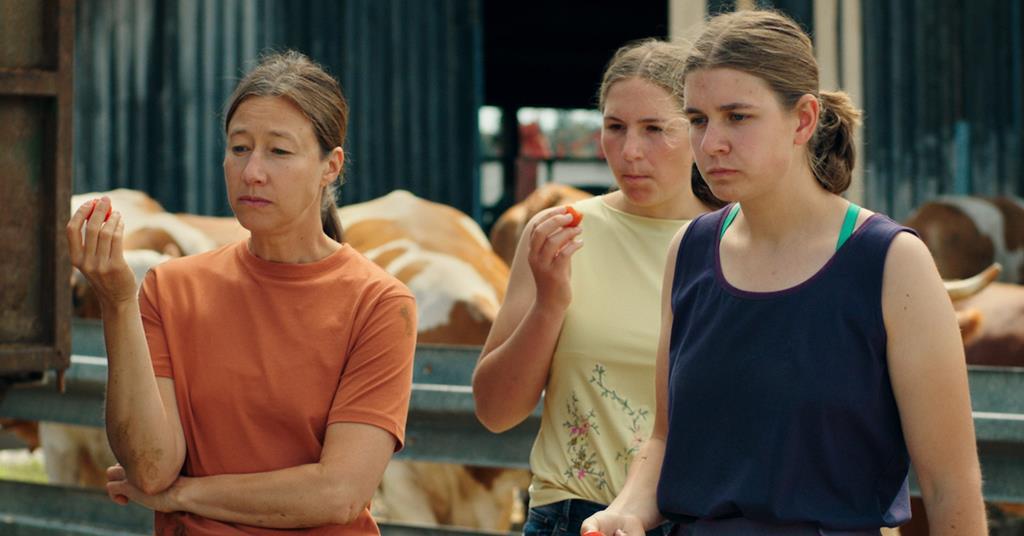
The unstoppable march of time and the uneasy change that it brings lingers over The Smell of Burnt Milk, Justine Bauer’s debut feature (and graduate piece) about four sisters and the small German farm that they all help keep afloat, a matriarchal microcosm framed by the rhythms of rural labour, modern machinery and the cycles of nature.
For the most part, Bauer trades conventional plotting for something closer to docudrama, more interested in workaday snapshots as the film unfolds over a single, languid summer. Attention mainly dwells on teenage Katinka, in her ubiquitous green swimsuit, engaging with chores like herding cows into the milking machine, splitting wood, assisting the vet castrate their llama, and making hay with a tedder, a process that she compares to childbirth. And even though the graft is punctuated with moments of play, beneath the rural routine lies a quiet anxiety.
The girls visit the site of a neighbouring farm, now paved over and turned into housing. Katinka’s grandmother notes that it doesn’t rain as much anymore. The eldest sister announces her unexpected pregnancy. Their mother doubts the future of the family farm, even as Katinka clings stubbornly to her desire of being a farmer. Even so, these three generations of farming women react to inevitable change with resilience, unlike the men who meet it with fury or despair. Like the boyfriend who rages road rules at a group of black cyclists, or the farmer next door who plants life-size green crosses in his field to draw attention to the desperate plight of ancestral farms in the face of mass-industrialisation and climate change.
This empathy doubtlessly stems from Bauer’s own upbringing on an ostrich farm, wise to the rhythms and existential peril facing agricultural life. She brings a solemn, observational clarity, even crediting the animals involved before the human cast in the end titles. Yet despite the looming gloom, she resists the impulse to moralise.
While some viewers may find the film narratively slight, that restraint is entirely by design, and underscores the unseen drama unfolding in the gutter panels. The 4:3 frame recalls the intimacy of home movies, and the sparse, rustic score only occasionally rises into stabbing staccato, amplifying the creeping dread. This is a tender elegy for a way of life weathered over generations, now slowly grinding to a halt. As Katinka says with a shrug, “That’s life.”
