



Worth: $18.00
FilmInk rates movies out of $20 — the score indicates the amount we believe a ticket to the movie to be worth
Cast:
Erin Doherty, Brendan Cowell, Eileen Walsh, Fisayo Akinade, Karl Johnson, Matthew Marsh
Intro:
… visually engaging and chilling in its implications.
In The Crucible, American Playwright Arthur Miller fashioned a work that quickly became a modern classic. The context that Miller was writing in, contained the recent spate of investigations under the notorious HUAC (House of Unamerican Activities). That star chamber became a modern day witch hunt and it ruined many careers for those who were denounced as Communists in a rabidly anti-communist era of the 1940s and 1950s.
Whilst no one at the time was in any doubt what Miller was referring to (he himself was summoned and refused to ‘give names’), the play has wider implications. The idea that denunciation – once unleashed – rapidly corrupts the idea of a fair hearing is one that, alas, has enduring relevance.
In this recent version, directed for the London stage by Lyndsey Turner, we see the twin elements of hysteria spreading contagiously in a small community, and the way in which people try to game the system to their own advantage. The only bulwark against such a degradation of justice is for people of principle to stand up and be counted.
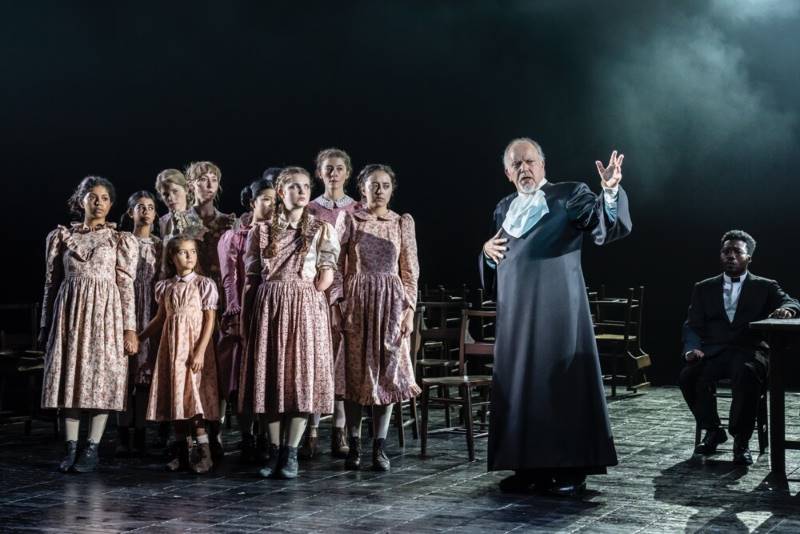
In Miller’s play, the main person who embodies this is John Proctor (played here with a convincing rural American accent by our own Brendan Cowell). John and his wife Elizabeth are trying to live their lives in a decent way, but he is hobbled (as all tragic heroes must be) by a fatal flaw, in that he gave way to the temptation of ‘having knowledge’ of local teenager Abigail Williams (Erin Doherty from The Crown).
Abigail clearly has her own reasons to bring John down, but the witch trial judges who come into town are more concerned with what they see as due process than really looking at people’s actual motivations to commit perjury. They put great store in the witness, but people can also bear false witness which, of course, is precisely what the Good Book enjoins them not to do.
Miller’s brilliant text, written in the rhythms and idioms of the time, catches the tangled intricacies of the battle between truth and lies. The cast are uniformly good at handling the language and the production as a whole, flows seamlessly. The decline of reason closes in on us like a vice.
The set design by Es Devlin has rightly gathered much praise and Lyndsey Turner has done an excellent job in terms of staging. The production uses its starkly-lit set and manages to balance the solemnity of the court proceedings with the intensity of the anguished domestic moments.
The play comes alive yet again and provides a session in the theatre which is both visually engaging and chilling in its implications.
