


by Nataliia Serebriakova
Worth: $15.00
FilmInk rates movies out of $20 — the score indicates the amount we believe a ticket to the movie to be worth
Cast:
Sope Dirisu, Chibuike Marvellous Egbo, Godwin Egbo
Intro:
What lingers most is not the political backdrop or even the narrative itself, but the texture of memory: the heat of the city, the noise of the streets, the quiet intimacy between two brothers navigating a world that is gradually revealing its complexity.
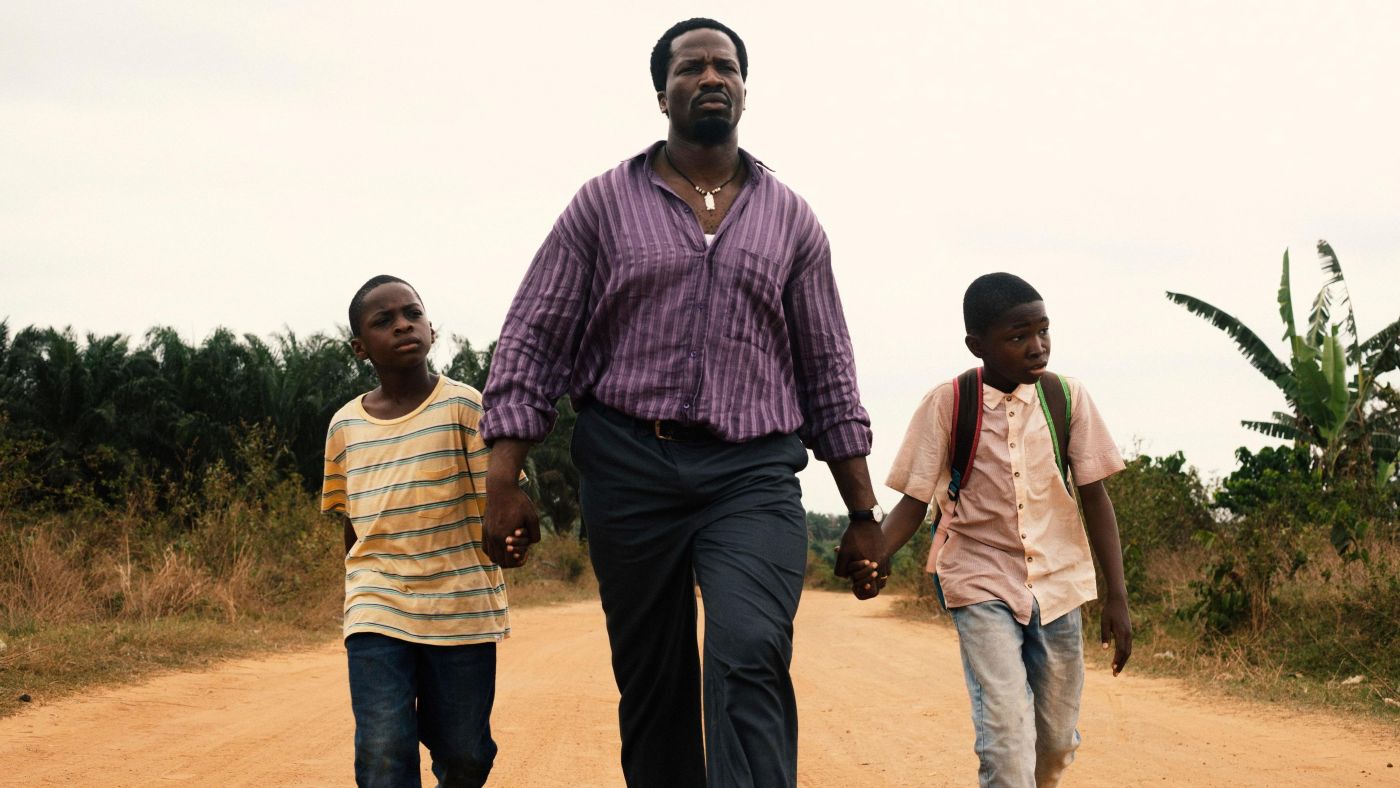
1993, Nigeria. Two brothers, Remi and Akin, are playing in the yard of their modest home in a small village. Their mother has gone out shopping. When they step inside, they discover that their father, Folarin (Sope Dirisu), has unexpectedly returned. He is almost always absent, trying to earn money in Nigeria’s largest city, Lagos. He tells the boys that he has to leave for Lagos again immediately and suggests that they come with him, without waiting for their mother to return.
Father and sons set off for the city on an overcrowded bus, and then continue by hitching a ride. Thus begins their journey to a metropolis caught in the midst of elections in a country weary of totalitarianism and military rule.
The feature debut of British-Nigerian director Akinola Davies was presented a year ago at the Cannes Film Festival in the Un Certain Regard section and later won a BAFTA award. Davies, who has no formal film education — having only attended editing workshops — lives in London but spent his childhood in Nigeria. He co-wrote the screenplay for this semi-autobiographical film with his brother Wale, who also worked on his debut short.
With its fragmented editing and touches of found footage, My Father’s Shadow briefly recalls Nickel Boys, before unfolding into a more linear and relatively traditional narrative. It is a coming-of-age story largely based on the director’s memories of growing up with his brother, and of their life with their mother and father in Nigeria (the family later moved to Britain when he was a teenager).
The audience experiences a vast African metropolis through the eyes of a child — one who refuses to share his ice cream with his brother and catches his father flirting with a waitress. Later, he attempts a more adult conversation, telling his father how difficult it is for their mother to raise two sons alone. Meanwhile, Folarin is preoccupied with his own struggles in the city, trying —unsuccessfully — to recover unpaid wages from a factory.
Through fleeting encounters with other adults — men who respect their father and seem to share some unspoken secret — the boys begin to suspect that their father may be leading a double life in Lagos, possibly connected to a pro-democracy political movement. Yet this is only one layer of a film masterfully shot by Jermaine Canute Edwards, who previously collaborated with Nicolas Winding Refn on Bronson.
Alongside the young protagonists, viewers are immersed in the dense, chaotic life of Lagos, with its motorcycles and trucks filled with soldiers. They cross the longest bridge in Africa and discover an entirely new world within the sprawling city.
Ultimately, My Father’s Shadow is less about uncovering the truth of the father than about capturing the fragile, fleeting nature of childhood perception — how much is felt, intuited, but never fully understood. Davies avoids definitive answers, allowing ambiguity to shape the emotional landscape of the film. The father remains an elusive figure, suspended somewhere between tenderness and distance, myth and reality.
What lingers most is not the political backdrop or even the narrative itself, but the texture of memory: the heat of the city, the noise of the streets, the quiet intimacy between two brothers navigating a world that is gradually revealing its complexity. In this sense, the film achieves something rare — it transforms personal history into a universal meditation on growing up, absence, and the quiet, often painful process of seeing one’s parents as fallible human beings.
