


by Stephen Vagg
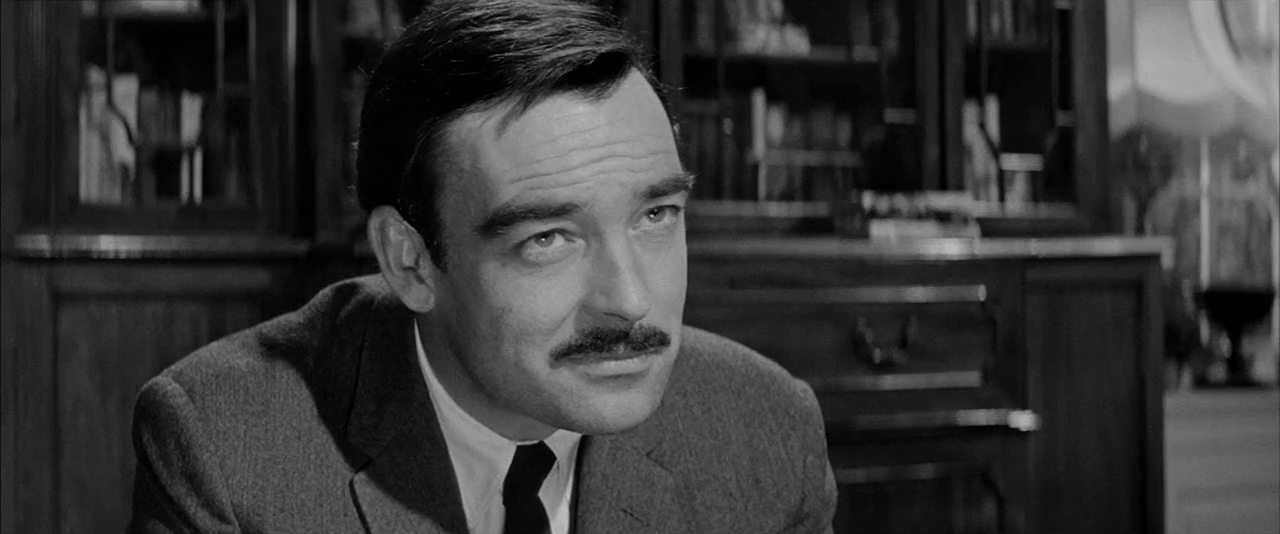
This is a special mash up of two of our regular columns – someone who was both not quite a movie star and a forgotten British mogul. Arguably Donna Reed, who we wrote about earlier, fell into both categories as well, but today we’re talking about Richard Johnson aka Mr Kim Novak.
Chances are you haven’t heard of Richard Johnson, unless you’re British – he would be more familiar to the public over there, being a staple of their stage, radio and screen more than six decades. For one of those decades, Johnson took a red-hot crack at being a movie star, and for another he had a swing at being a film mogul. He never quite got there, but he had a terrific life and career.
Johnson was born in 1927 and wanted to act from an early age, studying at RADA, and carrying a spear in a John Gielgud production of Hamlet before doing his military service in the navy.
Johnson was tall, handsome and could act, ideal in particular for romantic roles, and thus found himself working regularly relatively quickly, alternating between stage and television. (Indeed, he would be seldom unemployed throughout his long career, a tribute to his talent and professionalism.)
Johnson earned a strong reputation on stage – he had a long stint at the Shakespeare Memorial Theatre, which became the Royal Shakespeare Theatre, worked for directors such as Peter Hall, Peter Brook and Tony Richardson, alongside actors such as Paul Scofield and Peggy Ashcroft. Johnson also did television – usually playing “dashing” parts like D’artangnan in an adaptation of The Three Musketeers.
It was Johnson’s stage reputation – particularly a performance in Romeo and Juliet – which earned him a contract at MGM in the late 1950s. The studio gave him a choice support part as Frank Sinatra’s buddy in Never So Few (1959), a World War Two action-drama from director John Sturges that no one much remembers today except for Steve McQueen fans – McQueen stole the movie in a role originally meant for Sammy Davis Jnr.
Johnson went back to stage and television but was then given leads in three films that came out in 1963, the first two made for MGM: Robert Wise’s The Haunting (from the novel by Shirley Jackson), Wolf Rilla’s Cairo (a remake of The Asphalt Jungle alongside George Sanders) and Val Guest’s virus drama 80,000 Suspects. It was predicted that Johnson would become a star and this trio was an excellent way to launch him – broad appeal subjects, some variety, decent parts. It didn’t quite happen. Johnson was handsome, capable, good voice, all that, but on screen he lacked a little spark – a twinkle in the eye, a glimpse of humour/madness/warmth that the great stars have. It didn’t help either that none of the films was a big hit – though The Haunting is now regarded as a classic.
Johnson went back to stage and television, and played support roles in two classy movies: The Pumpkin Eater (1964) as Anne Bancroft’s second husband, and MGM’s Operation Crossbow (1965) as Duncan Sandys, doing wonders with a flat role.
Movie stardom beckoned again when Johnson was cast as the main love interest of Kim Novak in The Amorous Adventures of Moll Flanders (1965). The movie – one of the many attempts to cash in on the success of Tom Jones (1963) – was a commercial disappointment (director Terence Young wasn’t known for his comic flair, and the script was iffy) but Johnson and Novak had genuine chemistry… so much so that they wound up getting married after filming (it didn’t last, though they remained friends). Johnson was also very good as the third lead in Khartoum (1966), getting his head severed by the Mahdis in the Sudan while helping Charlton Heston (who would work with Johnson several times more in his career).
Johnson was then given the choice role of Bulldog Drummond in Deadlier Than the Male (1967), an attempt to update that character for the Bond age (Johnson had been in consideration to play Bond in Doctor No, pushed by Terence Young, before Sean Connery was cast). The resulting film was very fun – though mostly due to its female villains, not so much Johnson who was a little stolid.
Johnson played another Bond type in Danger Route (1967) for director Seth Holt, but it was not a big hit. He also played lead roles in The Witch (1966), The Rover (1967), Oedipus the King (1968) (with Chris Plummer), Twist of Sand (1968) (an adventure tale from director Don Chaffey), The Column (1968) (shot in Romania!), and Emma Hamilton (1968) (playing Lord Hamilton), then reprised his performance as Bulldog Drummond in Some Girls Do (1969) – the sequel was less fun, in part because it lacked the first movie’s excellent villains.
None of these films were particularly successful, though they turned up on television for many years. Despite all these chances as a leading man, Johnson’s essential problem as a movie star remained – he had the looks, the voice, the ability, the talent, but he lacked personality. He was an ideal foil, but he couldn’t carry a movie.
He was in Charlton Heston’s Julius Caesar (1970), the war film The Fifth Day of Peace (1970), and Sin (1971) as Raquel Welch’s cuckolded husband. Then that was kind of it for Richard Johnson the movie star. He always remained in work – we can’t stress enough that just because someone doesn’t become a movie star doesn’t mean they can’t act, and Johnson was a good actor – it’s just that he drifted into support parts and European films, as well as television and theatre, where apparently, he was always terrific.
Despite (or because of) his extensive stage work, Johnson took an utterly unpretentious, pragmatic attitude towards his film career, taking jobs because they were well paid and/or simply fun. He developed a particular fondness for acting in Italy, appearing in titles like Beyond the Door (1974), The Curse Medallion (1975), Take All of Me (1976), Island of the Fishman (1979), Zombi (1979), and The Great Alligator River (1979). He was excellent as a tough copper in Hennessy (1975), an IRA thriller from Australian director Don Sharp who would work with Johnson several times.
Incidentally, Johnson also wrote the original screen story for Hennessey. He had a long history as a writer, having penned stories, plays and screenplays. He also worked as a producer, helping present Brief Lives on stage. There was a long tradition of this in British theatre with its history of actor-manager-writers eg Robert Shaw, Laurence Olivier, Albert Finney.
Thus, it was not so surprising when in 1982 Johnson announced that he was chairman of a new organisation, United British Artists. This was a company formed by various artists with the aim of producing stage plays and lower budgeted films. Those linked with the company included classy names like Diana Rigg, Glenda Jackson, Maggie Smith and Albert Finney, but the driving force appears to have been Johnson.
This sort of co-op had been tried before in Britain with some success – notably Allied Filmmakers, British Lion and Bryanston Films in the late 1950s and early 1960s (where it was film directors behind it). They never last long, but the ambition is endearing and some excellent product can ensue, especially with talented people involved, and that’s the case with United British Artists.
The company produced several stage plays, including revivals of Sgt Musgrave’s Dance and Playboy of the Western World (the latter directed by Lindsay Anderson), and a new work, The Biko Inquest. The latter was filmed for television in 1984 and United British also helped produce the feature films Champion (1984), a jockey biopic with John Hurt co produced by Lew Grade; Turtle Diary (1985) from a Harold Pinter script with Glenda Jackson and Ben Kingsley; Castaway (1986) from Nic Roeg with Amanda Donahue forced to be naked on an island with Oliver Reed; The Lonely Passion of Judith Hearn (1987), some heavy Brian Moore drama with a brilliant Maggie Smith, financed by Handmade Films; and Taffin (1988) a thriller with Pierce Brosnan.
These films were all decent, honourable attempts to make something of quality, and most of them succeeded. Turtle Diary became a solid art house hit, Lonely Passion is lovely, Castaway interesting. But United British Artists couldn’t make it work financially – it lacked a backer with deep pockets to ride through the rough times (the late 1980s was a particularly rough time for the British film industry) – and the company eventually wound up.
Johnson returned to acting and writing, with a stint as a hotelier. He kept busy until his death in 2015, popping up in various films, stage, radio and television shows. Indeed, he had one of his best roles just prior to his death, in Radiator (2014). He worked with several people time and time again, like Terence Young (who looked a little like Johnson), Charlton Heston and Don Sharp, which is a sign of a good temperament. He had four marriages and a few kids, and always had a strong sense of humour about his tilts at movie stardom. An extremely admirable life and career.
