



by Stephen Vagg
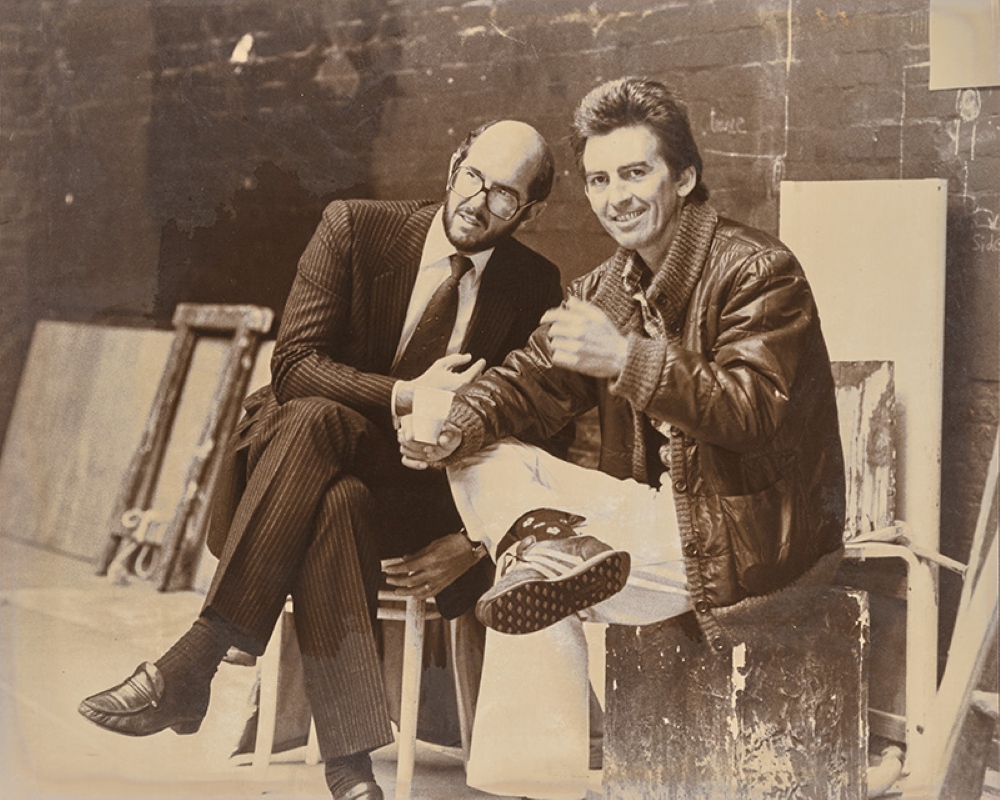
Most film buffs are familiar with the story of how ex-Beatle, George Harrison, stepped in to finance Monty Python’s Life of Brian, when the original studio, EMI Films, pulled out. This led to the creation of a company, Handmade Films, which pumped out more than twenty movies, many of them masterpieces, before the company crashed and burned, like so many British production companies of this era (Goldcrest, Palace). And Harrison deserves all the bouquets going to him for his role in Handmade – after all, the company was built on his fortune and friendships. But the driving force behind Handmade was actually Harrison’s partner/manager/Svengali/friend/Judas, the enigmatic Denis O’Brien.
Like so many key players in British film (Earl St John, Albert Broccoli), O’Brien was an American, a lawyer and banker who moved to London, where he became a manager, his clients including Peter Sellers. In the early 1970s, Sellers introduced O’Brien to George Harrison, who had suffered a series of financial blows, including debts from his Concert for Bangladesh, the plagiarism suit over ‘My Sweet Lord’, and the mess of the Beatles break up. O’Brien became Harrison’s manager, straightened up his financial situation, and the two men became very close, helped by the fact that they shared the same sense of humour, i.e. a taste for the absurd. And when Harrison’s friend, Eric Idle, told the musician about EMI pulling out of Life of Brian, and Harrison asked O’Brien how they could “help”, O’Brien suggested that they produce the film themselves with their own (well, Harrison’s) cash – and Harrison went for it.
This wasn’t as mad as it sounds, as rock stars had provided key finance for Monty Python and the Holy Grail, but it was still a gamble – a gamble that paid off brilliantly when Life of Brian (1979) became a massive hit. So, when Python Terry Gilliam approached them seeking finance for his solo film, Brazil… O’Brien turned it down because he didn’t like the script. But he did like Gilliam’s other idea, Time Bandits (1981), and Harrison and O’Brien backed that as well – and that was a huge hit too.
To make this hot streak even hotter, Handmade invested some funds in The Long Good Friday (1980), a gangster film originally envisioned as a television play then reconfigured as a film, then deemed too violent by Lew Grade’s ITC; it had a cinema release, did well, made a star of Bob Hoskins, became a classic.
So basically, Handmade Films’ first three bets were all successful. Is it any wonder that O’Brien and Harrison thought that they’d figured out how to beat the system?
O’Brien briefly took over managing Monty Python, but that didn’t last long – they were a hard group for anyone to manage, although it did result in them making Monty Python Live at the Hollywood Bowl (1982) for Handmade. O’Brien also got them started on writing their next film, but the budget for what became Monty Python’s Meaning of Life (1983) was too big for Handmade to handle, so a Hollywood major, Universal, took over – as it did for Brazil (1985).
If O’Brien couldn’t get Python as a group, he was keen to handle Python solo projects, which was actually a great idea – the involvement of John Cleese and especially Michael Palin in Time Bandits helped that film. Handmade backed two films starring Palin, The Missionary (1982) (written by Palin, directed by Richard Loncraine) and A Private Function (1984) (written by Alan Bennett). These were solid lowish-budget successes – not blockbusters, but entirely respectable, and good movies. Handmade had John Cleese star in Privates on Parade (1982), an adaptation of the stage hit. It started out backing Graham Chapman’s Yellowbeard, but filming halted, the company pulled out, Orion picked up the slack, and no one much liked the finished film when it came out in 1983.
Incidentally, Handmade’s involvement in Yellowbeard tends to be forgotten – as does its investment in other violent films that tried to repeat the success of Long Good Friday – Venom (1981), Tattoo (1981), The Burning (1981), A Sense of Freedom (1982). A more successful non-comic, violent Handmade film was Scrubbers (1982) from Mai Zetterling – tough, smartly budgeted, British… a credit to the studio and O’Brien and Harrison (and also musician Ray Cooper, who was head of production and basically acted as Harrison’s man on the spot).
Looking around for a new Python team, Handmade backed two efforts from the duo of Dick Clement and Ian Le Frenais: Bullshot (1983) and Water (1985). Neither of these did well, though they have their fans. Dick Clement later said that he “dealt much more with Denis O’Brien” than Harrison. “George did not emerge all the time, then occasionally he would come down from Olympus and enthuse. Denis also had a great enthusiasm which was very infectious, but other people had terrible battles with him and were very unhappy. Other directors have told me that they had quite a bit of trouble with him. I never had any trouble with him at all, actually — there was no interference and a lot of support, and George was part of that.”
Handmade then got its second (or was it third?) wind, with a series of delightful British movies: Mona Lisa (1986) from Neil Jordon with Bob Hoskins; Withnail and I (1987), the debut of Bruce Robinson which became a beloved cult movie and made a name of Richard E Grant (who described O’Brien in his diaries as “the incredibly tall, incredibly bald Big Noise from Handmade Films who is a Bilko identikit on a giant scale”); and The Lonely Passion of Judith Hearne (1987) from Jack Clayton with Maggie Smith. All different, unusual, thoughtful movies, all a credit to Handmade.
Then Handmade suffered the coldest of cold streaks – payback for the good luck it had enjoyed starting out, payback with interest.
Most notorious was the fiasco Shanghai Surprise (1986) with Madonna and Sean Penn, which somehow got made despite everyone absolving themselves from it – an attempt to make an old ‘30s style Hollywood movie: not a bad idea, just with inappropriate stars, director and script.
In later years, it became easy to point a finger at Shanghai Surprise and go “Handmade went wrong when it turned Hollywood” and certainly there’s something in that – but the company continued to back low budget British movies right up until its death, including follow up efforts from Richard Loncraine (Bellman and True), Bruce Robinson (How to Get Ahead in Advertising), and Bob Hoskins (The Raggedy Rawney), along with one from top auteur Nic Roeg (Track 29)… but all these films basically vanished. Handmade’s luck, so strong at the beginning of the decade, had turned.
It made a series of low budget American films: Five Corners (1988), Checking Out (1988), Powwow Highway (1989), Cold Dog Soup (1990). These efforts were ambitious, quirky and small, from not particularly well known directors (Tony Bill, David Leland, Jonathan Wacks, Alan Metter), and odd subjects (1960s friend drama, a comedy about ageing from king of comedy Joe Eszterhas, a Native American road movie, something with Randy Quaid). All films flopped. Most remain obscure except Powwow Highway, which has been a little rediscovered. Good on them and stuff, but… it was just so odd.
Handmade’s last film was its one “safe” effort from the late ‘80s – Nuns on the Run (1990), a high concept comedy (gangsters go undercover as nuns) with appropriate stars (Eric Idle, Robbie Coltrane). That did quite well at the box office, but it was too late to save the company, which wound up in 1991, a bunch of projects being cancelled. These included Breakfast of Champions, TVP (a proposed part-animated film with the Eurythmics), a Travelling Wilburys movie, Stretch, Big G, Catfish Tangle and Another World. In 1994, the company’s 23 titles were sold to a Canadian company for five million pounds. Things fractured between O’Brien and Harrison, with the latter claiming O’Brien cheated him out of 16 million pounds over a 12-year period. The court sided with Harrison and ordered O’Brien to pay damages of $11 million – half the amount of a debt for a soured deal over Cold Dog Soup. O’Brien declared bankruptcy and Harrison had to go back to the Beatles to get out of financial trouble (this prompted the release of those Anthology albums in the 1990s). All this stress likely contributed to Harrison’s death from lung cancer in 2001, though the smoking, drugs and being stabbed by a stalker didn’t help. O’Brien lived quietly in retirement, never giving interviews (at least, not that we’ve found), dying in 2021.
Few mogul’s reputations have suffered more than Denis O’Brien, commonly regarded as the shyster who ripped off the saintly George Harrison. And it’s definitely clear he was dodgy and had a real knack for annoying creatives, like Terry Gilliam, Eric Idle, Sean Penn, David Leland, Nic Roeg, Jack Clayton, and Alan Bennett – even kindly Michael Palin, who made several films with Handmade, was often exasperated about the American in his diaries.
But one senses that O’Brien might have been used as an all too convenient punching bag over the years. We’re not saying that he wasn’t a crook and/or didn’t do dumb/insensitive/illegal things. But there would have been no Handmade without him. And it just feels too easy for filmmakers to blame everything on him. Maybe everything was his fault. We would just like a bit more in depth scholarship on the subject – Robert Sellars’ book on Handmade is essential reading, but it’s time for a deeper dive. O’Brien’s papers have been deposited at the University of Texas – they may shed fresh light on what happened.
Could Handmade Films have lasted any longer than it did? Almost all production companies go to the wall eventually, even hugely successful ones (eg Hecht Hill Lancaster) – unless they get bought out by a parent company to give them protection (eg Working Title). Incidentally, the company still exists – it helped make Lock Stock and Two Smoking Barrels – but who cares about Handmade without George Harrison?
Having said that, it’s clear Handmade made mistakes – moving into direct competition with big budget Hollywood movies via Shanghai Surprise was a mistake as it always is for British companies (Rank, EMI Films), unless as part of a co-production with another major. It’s also bewildering why the company made so many of those quirky American films in the late ‘80s. It may as well have blown that money on British movies.
Still, what a marvellous legacy it left behind. Several stone cold classics (Life of Brian, Withnail and I, Time Bandits, The Long Good Friday), a slew of terrific films (Mona Lisa, The Missionary, The Lonely Passion of Judith Hearn, Bullshot, Scrubbers, Water, A Private Function), a legendary turkey (Shanghai Surprise), and a bunch of movies that we really mean to get around seeing one day. But Handmade’s movies will be around as long as the best Beatles tunes.
