



By Gill Pringle
Martin Scorsese’s epic western crime drama spotlights a shameful part of U.S. history, when members of Oklahoma’s Osage tribe were violently murdered during the oil boom of the 1920s…all in order to steal their new-found wealth. At the time, the Osage were among the richest people per capita in the world – worth more than US$30 million – but soon after inheriting their wealth, about 25 of them would mysteriously die in rapid succession. Their deaths were barely even investigated. Those lacking discernable wounds were simply ascribed to “indigestion,” “peculiar wasting illness,” or “causes unknown.”
Martin Scorsese was hooked on the story from the moment he read David Grann’s 2017 non-fiction account of the murders, Killers Of The Flower Moon: The Osage Murders And The Birth Of The FBI. “I was immediately intrigued,” Scorsese says. “Here was a terrible, large-scale tragedy – the systematic killings, over many years – that was all but unknown outside the Tribal Nations. It was a story of pure greed and exploitation that played out on an epic canvas, and at the heart of it was a deeply mysterious love story. I started to see the whole picture as I was reading the book. I was drawn to the people, to the world they inhabited, to the thin line between friendship and love on the one hand and extortion and murder on the other. And I was also drawn to the idea of making a picture on a grand Western canvas. And, most importantly of all, I thought… finally. Here was a perfect opportunity to address what I witnessed almost 50 years ago and to express my feelings about Native spirituality.”

Grann’s story outlined how the Osage’s lives were initially transformed by their wealth, riding in chauffeured luxury cars, building mansions, and sending their children to study in Europe. But, as the Osage began to be killed off, the family of an Osage woman, Mollie Kyle, became a prime target, with her sisters shot or poisoned. Many of those who dared to investigate the killings were themselves murdered. But as the death toll climbed to more than 24, J. Edgar Hoover’s newly-formed FBI took up the case in one of the organisation’s first major homicide investigations. Led by a former Texas Ranger named Tom White, who put together an undercover team, including one of the only Native American agents in the bureau. Together with the Osage, they began to expose one of the most chilling conspiracies in American history. The mastermind of the murder spree was one William K. Hale, self-proclaimed “King of the Osage Hills”. An affluent rancher with banking and business interests, he held political power and was active in Osage affairs. Kale encouraged his subservient nephew Ernest Burkhart to marry Mollie Kyle, a full-blood Osage woman…although he hadn’t counted on the two actually falling in love.
Gathering his oldest friend Robert De Niro – the star of Scorsese’s revered Raging Bull, Taxi Driver and Goodfellas, among many other collaborations – to portray Hale, the director enlisted another frequent collaborator, Leonardo DiCaprio, to play Ernest Burkhart. The role of Mollie was vital to get just right, with Scorsese landing on Lily Gladstone for the part. “It really was the Wild West back in those days,” the director tells FilmInk. “It’s a wide-open territory where a place, as beautiful as it is, can shift to being very sinister. And what I wanted to capture ultimately, was the very nature of the virus or the cancer that creates this sense of a kind of easygoing genocide. And that’s why we went with the story with Mollie and Ernest because that’s the basis of the love…and the love is the basis of the trust. So when there’s betrayal that way, that deep, then there’s our story.”

Having watched Lily Gladstone in Kelly Reichardt’s Certain Women, Scorsese was convinced that she was right for the part. “I was very, very impressed by her presence, the intelligence and the emotion that’s there in her face where you see it, but also you feel it. It’s all working, there’s something working behind the eyes, and you can see it happening. Also, there was her activism, which wasn’t overtaking the art. In other words, the art was in the activism in a sense, so the art takes over, in a way which we think would be more resonant later on…after you see the movie, and maybe thinking about it more, rather than a person preaching at you.”
Leonardo DiCaprio was equally impressed, “We had a Zoom meeting with Lily and immediately afterward, Marty was like, ‘She’s it. She has not only this incredible grace, but being Native American herself, Blackfeet, there was a lot of her perspective in the movie.” On Gladstone’s part, she certainly had early concerns. “My initial worry was that Mollie was going to be a tertiary character, and that kind of broke my heart, because you can’t tell this story without going into who the Osage people were, and how they were so exploited,” says the actress, who was relieved to learn that Mollie’s experiences, and her relationship with Ernest, would be central to the story. “Bless Leo for wanting to play the duality in one character,” she adds.
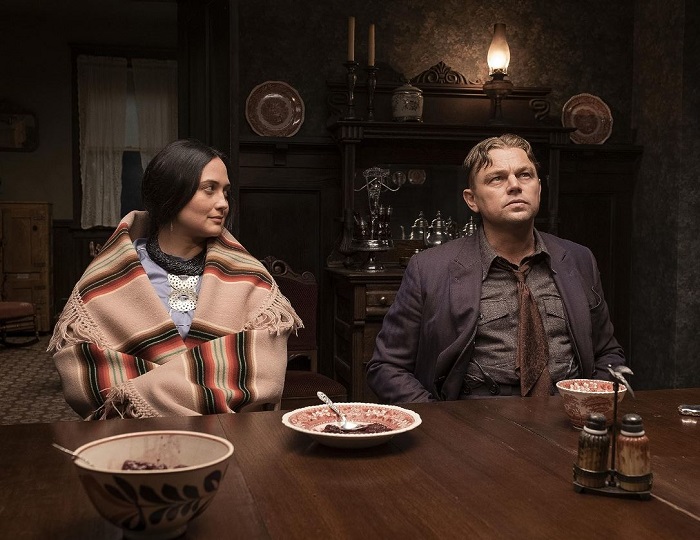
Looking back over the course of the filming process, Scorsese says, “I think the first big scene we did was one of my favourites where Mollie has dinner with Ernest alone. And she’s questioning him, a little bit of interrogation. What are you doing here? Are you afraid of him? What’s your religion? And then you begin to see the connection between the two. So that’s the way the script was ultimately created…by these moments. There’s one scene where Leo is driving her in the taxi, and he says something about ‘I want to see who’s going to be in this horse race?’ And she answers in Osage, and he goes ‘What d’ya say?’ And she says it in Osage again. And he says, ‘Well, I don’t know what that was, but it must be Indian for handsome devil.’ That’s an improv, and you see Lily laugh for real. So that’s the moment you see the actual relationship that’s happening between the two actors.”
“Lily brought so much depth and awareness to Mollie,” agrees DiCaprio. “She was such an incredibly open and courageous partner. Even though she’s not Osage, Lily immersed herself in that culture. We really looked to her as a beacon in the storytelling as well. She was definitely a muse to Marty and myself in making this movie,” says the actor, who joined De Niro in learning some rudimentary Osage himself. Killers Of The Flower Moon marks the sixth feature-film collaboration of DiCaprio and Scorsese, with the pair having previously made The Wolf Of Wall Street, Shutter Island, The Departed, The Aviator and Gangs Of New York.
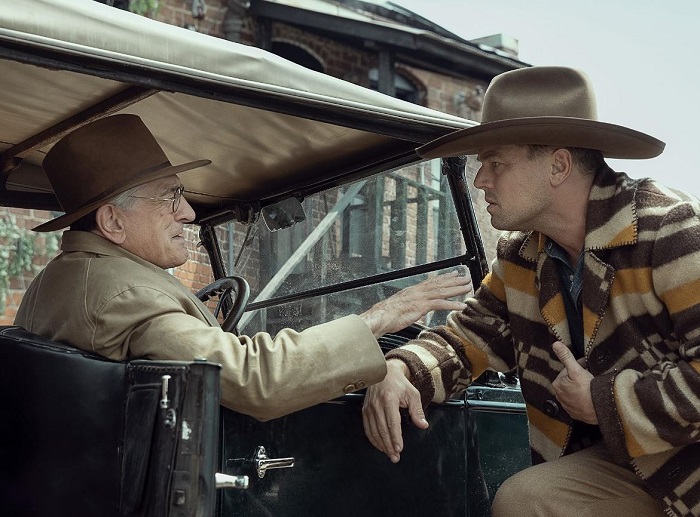
Discussing his long relationship with his other star, Robert De Niro, Scorsese smiles. “We were teenagers together, and he’s the only one who really knows where I comes from, the people I know…he knows them all. And I know his friends, his old friends. And we had a real testing ground in the 1970s where we tried everything, and we found that we trusted each other. It’s all about trust and love. And that’s a big deal. Because very often if an actor has a lot of power – and he had a lot of power at that time – an actor could take over your picture. The studio gets angry with you, and the actor comes in and takes it over; but with him, I never felt that. There was a freedom, and there was experimenting and also not being afraid of anything. He wasn’t afraid to do something…he just did it. And years later he told me that he’d worked with this kid, Leo DiCaprio, this little boy, in This Boy’s Life. He said, ‘You should work with this kid sometime’, but it was just casual. But with him, something like that, a recommendation at that time, is not casual. He says it casually but he rarely said that…he rarely gave recommendations. And so years go by and I’m presented with Leo for Gangs Of New York…he made Gangs Of New York possible actually. He loved the pictures I’d made and he wanted to explore the same territory. And then we developed more of a relationship when we did The Aviator, and that led to The Departed when we became much closer.”
Killers Of The Flower Moon is in cinemas now. Click here for our review.
