



By Rhiana Davies-Cotter and James Mottram
Viceroy – a ruler exercising authority over a colony in the name of the monarch of the territory.
Viceroy’s house – the ruler’s official dwelling.
Viceroy’s House explores the partition of India (i.e. the division of British India into two independent dominions, India and Pakistan), which took place in 1947. The film is directed by British-Indian director Gurinder Chadha and stars Hugh Bonneville, Gillian Anderson, Manish Dayal, Huma Qureshi, and Michael Gambon.
Like most of Gurinder’s film and television work, this film is drawn from the director’s personal experiences of being torn between two cultures and having to define herself despite the duality of her identity. “I have a foot in the British camp, I have a foot in the European camp, and I’m also Indian,” Gurinder says. “I think this gives me a perspective that is unique and different. It was an interesting puzzle for me to balance out British expectations and Indian expectations with this film.”
 Despite the film’s epic scale and historical setting, the story of India’s partition is very close to the director’s heart. “My ancestors are from the foothills of the Himalayas, which is an area of Punjab called Jhelum,” Gurinder explains. “In 1947, my grandfather and his older brother had gone over to Kenya to set up a business, while my grandmother stayed in Jhelum, in a big house my grandfather had built. One night, my grandmother was at home with my mother and her siblings, and all the trouble started. Violence broke out around them. Everyone was telling my grandmother she had to leave. But she refused to go until my grandfather came back. Then, one day,” Gurinder remarks, “An Indian army truck came and commanded my grandmother and her children to get in the truck. They spent three days on the road, during which my grandmother’s youngest child, my aunt, died of starvation. Not knowing where they were going or what was going to happen, my family became refugees. They were refugees for 18 months, until my grandfather, who’d been travelling all over the camps trying to find out where they were, eventually found them”.
Gurinder has never been able to see her ancestral home. “After partition,” she says, “Jhelum became part of Pakistan, so my family were never able to go back there. For me it was a very sad thing, because I’ll never get to see the home my grandfather built. In fact, I tried to get a visa recently to go to Pakistan, and I was denied because I’m of Indian origin.”
 Gurinder’s grandmother’s story could be a film in itself, but Gurinder felt that the wider story of India’s partition had to be told. “I wanted to make a film about the real reason partition happened,” Gurinder says. “When I was growing up I was always taught that partition was our fault – that Lord Mountbatten had come to India to hand it back to the people, but because we started fighting with each other, he had no choice but to divide the country. When I started investigating further, I realised that, actually, partition was a political act that had been orchestrated by the British behind the scenes. So, I felt that it was more important to tell the story of what happens to the ordinary people when history says one thing and then further research from a different perspective says something else.”
Viceroy’s House is based on two books, Freedom at Midnight and Shadow of the Great Game. “Originally,” Gurinder says, “we were just basing the film on Freedom at Midnight, which is the definitive book on partition. As we started working on it, though, I met Prince Charles at a charity function. He was very interested in what I was doing, and asked me if I’d read Shadow of the Great Game. I hadn’t read the book, so I went and researched it and then I met the author, Narendra Singh Sarila, who had worked with Lord Mountbatten as an Indian diplomat. Narendra had been in the British Library in 1997, writing a book on the Maharajas of India. In researching that book, he was going to the library every day for months, and then one day somebody came up to him, a librarian, and said, ‘Sir, you should see these papers.’ The librarian showed him two top secret documents [which revealed Britain’s anxiety about granting strategic territories to India and a map for partition that had been drawn up by the British government prior to 1947]. He immediately recognised how important this information was, ditched his book and wrote Shadow of the Great Game instead.”
Although the film is set in 1947, the subject matter feels relevant to the current political climate. “I think of the story as a microcosm of what’s going on in the world and what happens when politicians start to use and scapegoat one group against another in order to start dehumanising and criminalising them, and what that leads to is fear, destruction and eventually death.”
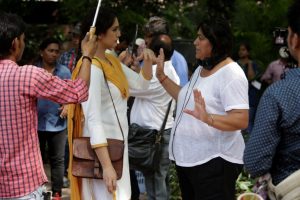 Despite the heavy subject matter, the film celebrates reconciliation and the struggle for freedom. While Gurinder could point fingers, she opts instead to show that the responsibility for the partition caused falls on all sides. “I wanted to make everybody human,” Gurinder says, “I think that when there are films about big human tragedies, it’s quite easy to make films about villains. For me, I wanted to show how geopolitics works in our time and how it affects ordinary people, so everybody acts like they’re doing it in their own interest. Everybody – the British, the Muslim League, the congress party – was acting for their own constituents, for their own people and for their own leaders, and everybody had their own agendas. In that, you ended up with a blundering mess of rules that lead to the partition of India, and ordinary people, like my grandmother, becoming a victim. So, I wanted to approach the story from that perspective and humanise everybody, but then make everybody accountable on a bigger level. I didn’t want to create division or dissension. I really just wanted to say ‘Everyone, let’s face up to the responsibilities of what happened at that time, and now let’s move on’.”
Viceroy’s House is in cinemas May 18, 2017.
