


by Stephen Vagg
 Hollywood made so many Westerns over the years that it made sense that studios would occasionally try to vary the formula (but not too much) via a location change. So, you had Westerns set in the snow (Northerns), the southern states (Southerns), Mexico during their revolution (Pancho Villa Westerns) or the French invasion (Emperor Maximilian Westerns)… and, every now and then, Australia.
Yep, Hollywood made Westerns about Australia, which, you won’t be surprised to know, varied widely in terms of authenticity, some even being shot here. There was The Bushranger (1928) with Tim McCoy, A Final Reckoning (1929) with Buffalo Bill Jr, Stingaree (1934) with Richard Dix, The Kangaroo Kid (1950) with Jock Mahoney, Quigley Down Under (1990)… and in 1939 there was Captain Fury.
This was a medium-budget effort produced by Hal Roach, best known for his comedy shorts, notably Laurel and Hardy, Harold Lloyd, and the Our Gang series, but who made all sorts of movies. In the mid-1930s, Roach diversified into features, mostly for United Artists. It was a second-tier operation, but no disgrace: Roach discovered Victor Mature and movies made at his studio included Topper (1937), Of Mice and Men (1939), and One Million Years BC (1940).
We’re not sure what got Hal Roach thinking about Australia, but we guess it was along the lines of “I want to make a Western with a twist, where else did they have horses and guns, hmmm… there’s enough Canadian movies, South Africa might be too tricky, hmm what about Australia?” Maybe, he also heard about Rangle River (1936), who knows.
Apparently, Roach originally wanted to make a film version of the classic bushranging novel Robbery Under Arms. This was announced in the press, but Roach soon backtracked, most likely due to the fact that the movie rights were held by Ken G. Hall and Cinesound. Hall hoped to make a film version of it for two decades, but could never find the money, in part because of concern about the ban against bushranging films in New South Wales (eventually, film rights went to the Rank Organisation who made a 1957 version with Peter Finch).
Anyway, back to Roach. He was still keen to do something in Australia and decided to come up with his own original story, Captain Midnight “a rugged, romantic saga of Australian colonisation showing the metamorphosis of New South Wales from a penal colony – a sort of Devil’s Island – into a land of determined British pioneers.”
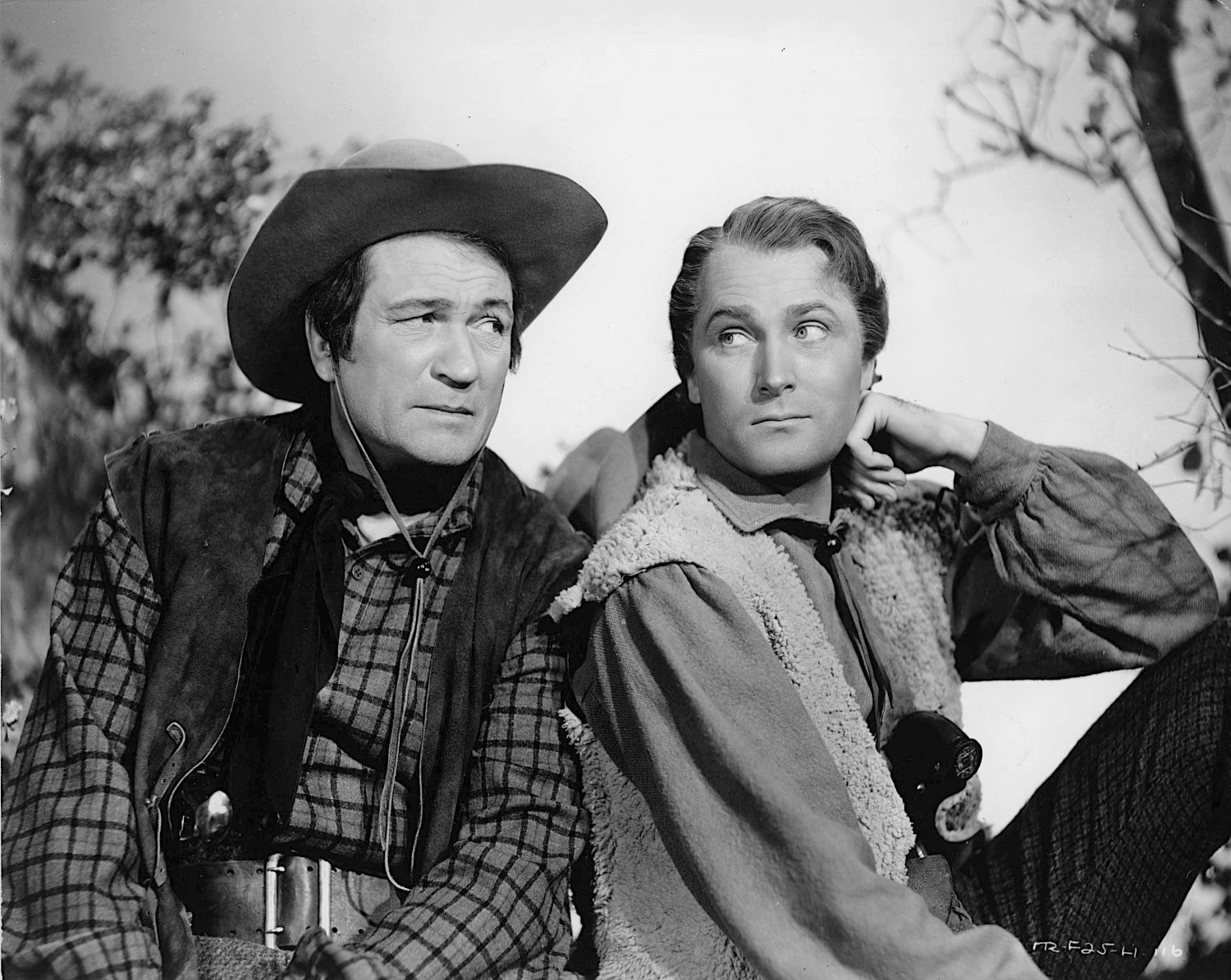
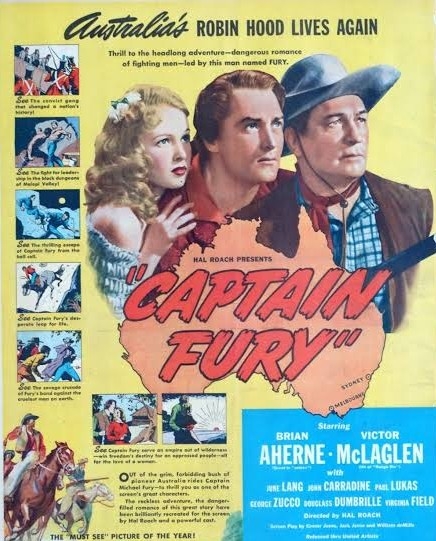
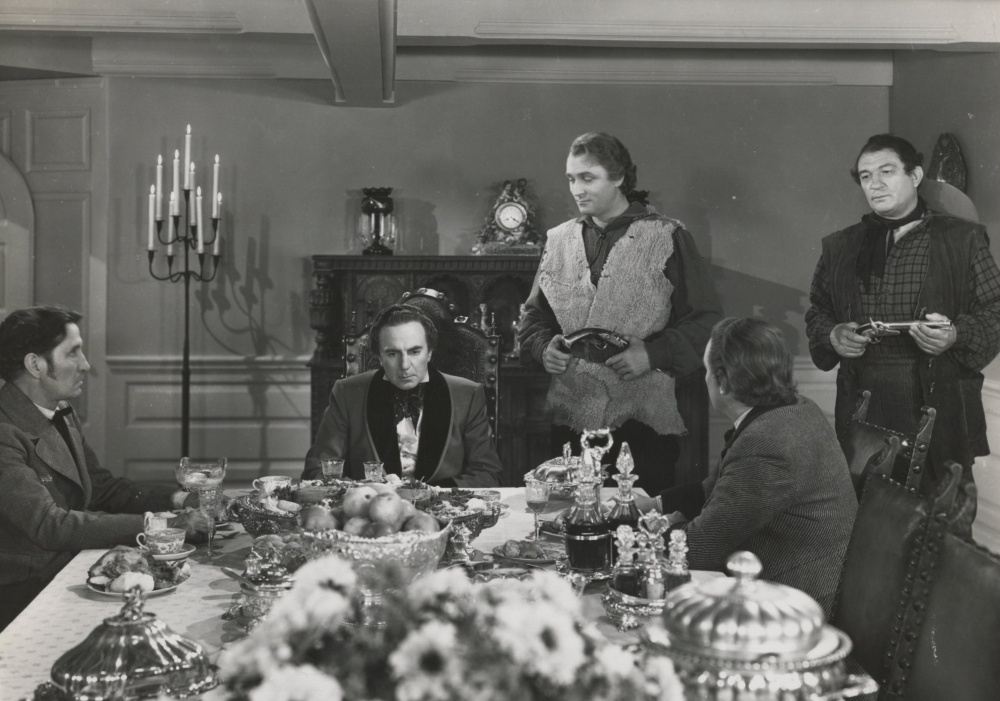
Eventually, the title became Captain Fury and the movie was shot in late 1938. The story has Fury (played by second-tier star Brian Aherne, a sort of poor man’s Ronald Colman of his day), an Irishman sent to Australia as a convict. He’s farmed out to a cruel land baron (George Zucco) and his evil overseer (Douglas Dumbrille). Fury/Aherne escapes with his mates (Victor McLaglen, John Carradine) and helps local settlers rise up against Zucco, including the cute daughter (June Lang) of a Mammonite farmer (Paul Lukas). Fury does some fairly low level thieving, of Zucco and co, and the settlers win. Apparently, the bushranging aspect was removed out of fear of offending Australia.
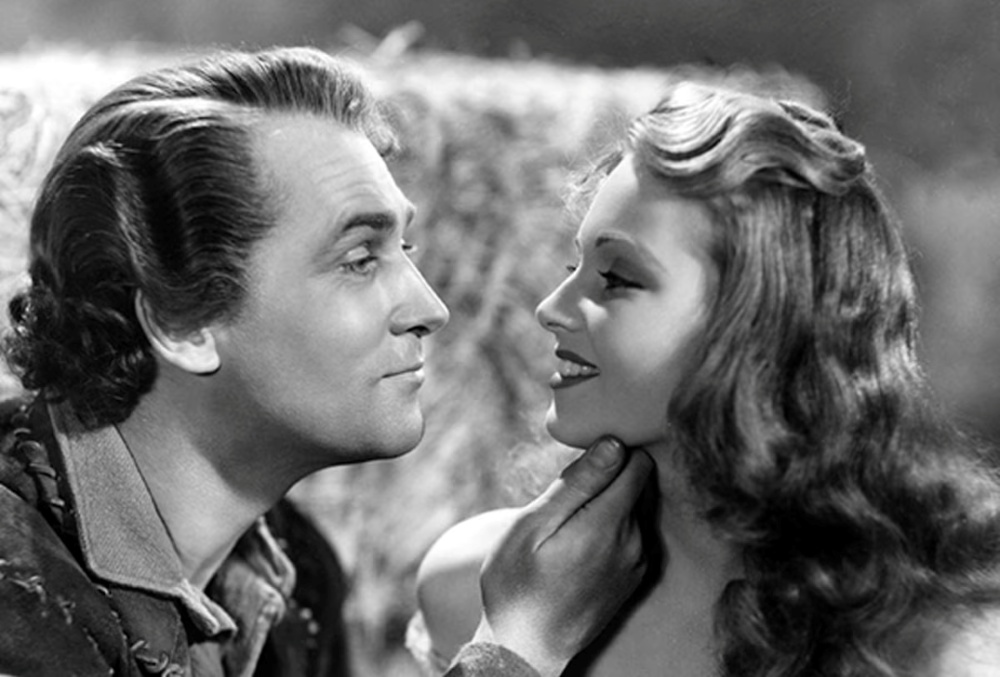
A bunch of writers worked on the script; three are credited and Brian Aherne wrote in his memoirs that the movie was heavily improvised. This certainly seems like the case. Captain Fury starts well, with convict lashings and escapes, but gets bogged down around the middle with a random collection of scenes – a bit of action, some romance. It doesn’t really build.
Roach grabs tropes from everywhere. There’s plenty of Western-type sequences – homesteaders being plucky, a funeral, shoot-outs over rocks, galloping horses. Another key influence was Robin Hood, with Fury robbing from the rich and giving to the poor, and a symbol of authority (in this case the governor) arriving to solve all the problems. Brian Aherne claims in his memoir that Roach wanted to adapt For the Term of His Natural Life; possibly the actor got this mixed up with Robbery Under Arms, or maybe Roach tried to get the rights to Term as well – there is some convict stuff in there.
It’s all silly but something is always happening and the film isn’t without historical interest. There were land-hungry barons who kicked people off the land in Australian history, the squattocracy, and there was convict exploitation going on. Also, the film gets points for making it clear Aherne/Fury was an Irish political prisoner, fighting for a more democratic future.
Frank Baker, brother of Australian sports star turned movie actor Snowy, worked on the film as technical adviser and some Aussies were in the cast like Billy Bevan.
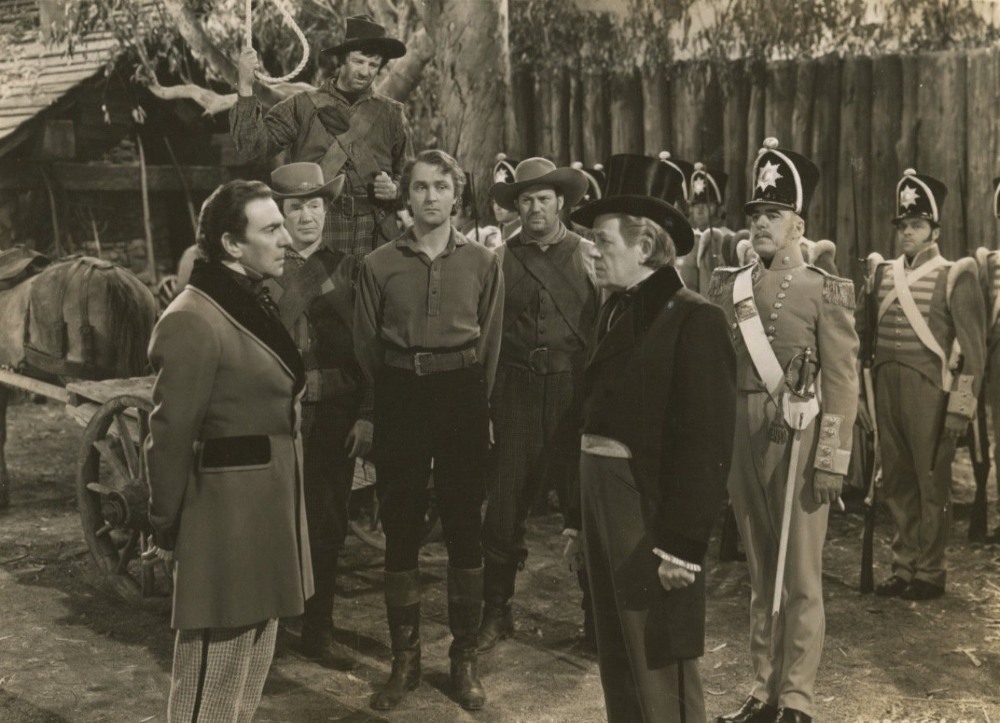
The movie looks terrific – there are wonderful recreations of colonial Sydney as well as villages and forts; the art design deservedly earned an Oscar nomination. And the cast is fantastic. Aherne is quite winning, and the line-up of support players is equal to any “A” picture: Zucco, Carradine, McLaglen, Lukas, Douglas Dumbrille. That is super impressive.
Captain Fury did reasonably well at the box office – not a huge hit but it had “legs”; Aherne wrote in his memoirs that people all around the world were always mentioning that they’d seen it. Australian critics were bemused, but far less harsh on the film than they would be on local movies.
