




by Stephen Vagg
During the Golden Era of Hollywood, RKO had possibly the most unstable management of all the major studios – which was part of the reason that it ultimately collapsed in a heap in the late 1950s. RKO tried numerous studio heads over the years, some quite famous (David O. Selznick, Howard Hughes, Jerry Wald and Norman Krasna, Dore Schary, Merian C. Cooper), but none lasted very long. Charles Koerner was in the hot seat for only a few years (1942-46), and is best remembered among film buffs for one thing – firing Orson Welles. In recent years, he also featured as a character in the Aaron Sorkin movie Being the Ricardos (2021), sacking Lucille Ball from RKO. These dismissals (one of which didn’t really happen) have tended to obscure the fact that Charles Koerner was perhaps the greatest RKO mogul of them all, the man who brought the studio out of a financial mess, was responsible for some of its best movies, and who might have, had he not died of leukaemia in 1946, ultimately saved RKO from destruction.
Koerner was born in 1896, in New Orleans. He started working in theatres in 1914 and stayed in exhibition for the next twenty-five years, with some time out for army service during World War One. He eventually became president of RKO’s theatre division – this involved not just screening movies but also arranging vaudeville shows.
RKO was a funny sort of studio. Formed in the late 1920s, it was technically one of the “big five” studios (the others were MGM, Paramount, Warner Bros and 20th Century-Fox), because it had its own cinema chain, but it was the smallest of the quintet and suffered from chronic financial instability. Part of this was due to the fact that, as mentioned, RKO changed heads of production every few years. In the 1930s for instance, David O. Selznick had a go, then Merian C. Cooper, Sam Briskin, and Pandro S. Berman.
In 1939, RKO installed a guy called George Schaefer as president. Typically, a film studio’s president left making movies to the head of production but not always. Schaefer was a “not always” case, and his interfering/micro-managing eventually prompted Pandro Berman – a genuinely talented executive with a decent record – to quit RKO. The heads of production became Harry Edington and then Joseph Breen (the Hollywood censor trying a career change) but until early 1942, it was basically Schaefer who was the key decider over what got made at RKO.
Throughout his three-year regime, Schaefer tried to “upscale” the studio’s product and went on a big arty kick, purchasing the film rights for numerous prestige novels and plays. Most famously, he granted Orson Welles an unprecedented deal which would ultimately result in Citizen Kane, The Magnificent Ambersons, Journey into Fear and It’s All True. Less famously, he also signed producers like Jed Harris, William Dieterle, Max Gordon & Harry Goetz, Gabriel Pascal, Gene Towne & C. Graham Baker, and documentarian Pare Lorentz. He arranged a deal for RKO to distribute Sam Goldwyn films that was so weighted in Goldwyn’s favour it would lose RKO money, even when the films were hits.
Schaefer’s presidency was financially disastrous for RKO. The studio lost money on Carole Lombard dramas (Vigil in the Night, They Knew What They Wanted), dud sequels to earlier hits (Anne of Windy Poplars, Little Men), Maureen O’Hara films (Dance Girl Dance, A Bill of Divorcement, They Meet in Argentina), prestige adaptations (Swiss Family Robinson, Abe Lincoln in Illinois) and Anne Shirley vehicles (Unexpected Uncle, Four Jacks and a Jill). The studio was kept competitive by its Bs (eg The Saint series), the movies of Ginger Rogers (Bachelor Mother, Kitty Foyle), comedies (Irene, My Favorite Wife, The Devil and Miss Jones, Look Who’s Laughing) and a couple of Hitchcocks (Mr and Mrs Smith, Suspicion).
As the losses piled up, Koerner was brought into the studio in early 1942, ostensibly to “help” Breen while the latter was on leave. Breen soon left for good, as did Schaefer (replaced by Peter Rathvon). Koerner became RKO’s new green light guy, officially from May 1942.
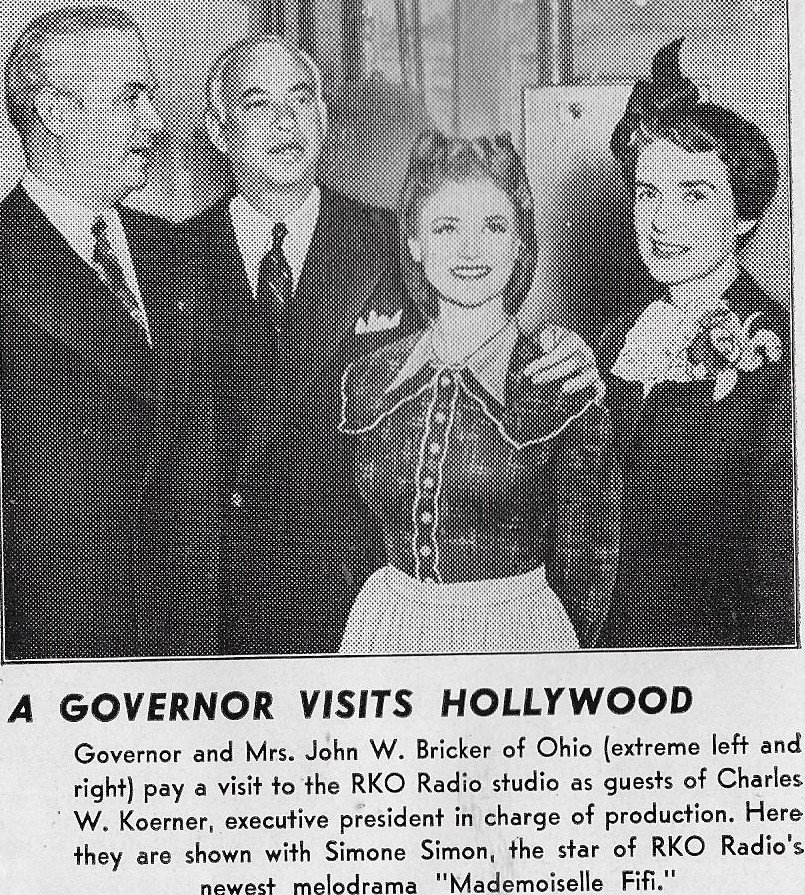
He did not stuff around, getting rid of many of the studio’s high-priced contracts, including Jed Harris and Lorentz, but most famously Welles. This caused the filmmaker to quip “We have just turned a bad Koerner” to which Koerner supposedly replied, “All’s well that ends Welles”. We have no idea if either is true, but they were reported as such in the press.
By the end of 1942, RKO showed a profit for the first time in five years. The studio went on to enjoy record-breaking box-office in 1943, 1944, 1945 and 1946 (based on a programme arranged by Koerner before his death). It was RKO’s best-ever hot streak.
It’s often tricky to determine who did what when it comes to studio heads, though it’s a little easier in Koerner’s case because so much excellent scholarship has been done on RKO, notably by Richard Jewell, and on the career of Orson Welles.
Why was Charles Koerner so successful?
* First of all, he was lucky in taking over RKO just after the USA entered the war. This was a hugely successful time for Hollywood – the loss of markets in Europe and Asia was offset by the fact that people didn’t have much else to do, and the introduction of television was delayed, so they went to the movies a lot. Increased taxes were compensated for by controlled wages. Still, RKO’s record was particularly good under Koerner.
* Assigned Val Lewton to make those amazing horror films – Cat People, I Walked with a Zombie, The Seventh Victim, The Leopard Man, The Ghost Ship, The Curse of the Cat People, Isle of the Dead, The Body Snatcher, Bedlam – plus the two non-horror movies no one remembers. This was perhaps Koerner’s greatest artistic legacy. Lewton was never as effective under any other studio chief; if Koerner had lived, imagine what other masterpieces Lewton might have made (we would have loved to have seen his Blackbeard film with Boris Karloff, for instance).
* He fired Orson Welles. Yes, this was a shame. Yes, The Magnificent Ambersons and Journey into Fear were mauled and It’s All True was thrown away. But the fact is that Orson Welles was simply not, and never would be, a commercially orientated filmmaker. Yes, Citizen Kane copped it from the Hearst press… but we’re not sure how much of a blockbuster it would have been otherwise. Yes, The Magnificent Ambersons was poorly recut – but does anyone think it would have been a hit in its original form? Or It’s All True? Orson Welles wasn’t interested in hits. Yes, RKO’s belligerence to Welles under Koerner was unfortunate, and it would have been cheaper for the studio just to release Welles’ version of the above movies – but honestly, ask anyone who loaned money to Orson Welles and see how they went on. It is not inconsistent to call Welles a spoilt baby and a genius.
And here’s the thing about Charles Koerner and Orson Welles – the studio head later signed a deal between RKO and International Pictures, which made two films with Welles: Tomorrow Is Forever and The Stranger (Welles directed the latter). Both were commercial and did well and were interesting. Welles might have thrived under Koerner the way Val Lewton did: artistic freedom in exchange for a low budget and commercial genre. Welles could have done The Smiler with a Knife, The Life of Christ and Heart of Darkness for RKO, for instance. But feelings were probably too hot for this ever to have worked.
* Promoted young directors. The following came up under Koerner’s regime: Jacques Tourneur, Mark Robson, Robert Wise, Gordon Douglas, Edward Dmytryk, Anthony Mann. That is a very solid track record, better than that of any other studio head at RKO.
* Backed Dmytryk. The journeyman director deserves his own entry because he really thrived under Koerner and gave the studio exec his biggest hits at RKO: Hitler’s Children, Behind the Rising Sun, Tender Comrades, Murder My Sweet, Back to Bataan, Cornered, Till the End of Time. Koerner was Dmytryk’s favourite executive; certainly, the director never thrived as well under anyone else.
* Skilfully used second-tier stars who’d become names at other studios. These included:
– Pat O’Brien, best known for being overshadowed by James Cagney in movies at Warner Bros; Koerner put him in in a series of mid-budget pictures that were surprisingly popular: The Navy Comes Through, Bombardier, The Iron Major, Marine Raiders, Having Wonderful Crime, Crack-Up.
– George Raft, who had imploded his career after managing to turn down The Maltese Falcon, High Sierra and Double Indemnity; Koerner used him in some hugely popular noirs: Johnny Angel and Nocturne.
– Laraine Day, who was no one’s first choice at MGM; RKO put her in a string of hits (Mr Lucky, Bride by Mistake, Those Endearing Young Charms, The Locket).
– John Wayne, then not a big name, was in popular RKO films like The Lady Takes a Chance, Tall in the Saddle, and Back to Bataan. (Day and Wayne appeared together in a big RKO flop, Tycoon, but it was not made until after Koerner died).
– The most notable of these was Dick Powell, who was an ageing singer until Koerner personally cast him as Philip Marlowe in Murder My Sweet. From all accounts, this decision was Koerner’s rather than the actual producer and director of that film; it probably came about due to wanting to use a star for cheap, but it completely altered the trajectory of Powell’s career.
* Leaned into radio. RKO’s background was in radio and Koerner took full advantage of this, relying heavily on radio IP. This resulted in some huge hits like Seven Days’ Leave. To be fair, RKO had done this a lot before Koerner came along.
* Started a Dick Tracy B series.
* Did a deal with International Pictures, which resulted in a string of hits: Casanova Brown, Belle of the Yukon, It’s a Pleasure, Along Came Jones, The Woman in the Window, as well as the aforementioned Tomorrow Is Forever, and The Stranger.
* Developed new stars. Robert Mitchum played his first leads under Koerner (Nevada). So did Frank Sinatra (Higher and Higher, Step Lively) and Robert Ryan (Tender Comrade). When George Sanders no longer wanted to play The Falcon in a series of B pictures, Koerner replaced him with Sanders’ real-life brother Tom Conway, who proved just as popular and a useful support actor in other films (eg Cat People), though never a star on his own (Two O’Clock Courage). RKO had Lawrence Tierney under contract though it was Monogram who made him a star via Dillinger. In the debit column, Koerner tried to turn Philip Terry into a star, along with the team of Carney and Brown, and missed the chance to sign Gregory Peck to a long-term contract. He also didn’t have much luck with new female stars (Barbara Hale, Jane Greer).
* Shared Lucille Ball’s contract with MGM. Contrary to what Aaron Sorkin said, Koerner didn’t fire her from the studio (though the experience was clearly traumatic for Ball who had been at RKO for years). Sending Lucille Ball to MGM was actually a promotion. It should be noted that even MGM couldn’t turn her into a movie star. We’re not sure Lucille Ball was movie star material. Anyway, she found her mediums (radio, television) and got her revenge, buying the RKO backlot in the late 1950s.
* Arranged a deal with David O. Selznick that resulted in some big hits (Notorious, The Spiral Staircase).
* Worked with Jean Renoir who made This Land Is Mine at RKO. The Frenchman adored Koerner and said he would have stayed in Hollywood longer had he been able to work under the studio chief more.
* Gave Frank Capra the story that became It’s a Wonderful Life. To be fair, it was probably just a piece of IP lying around – “hey Frank why not film this?” – but Koerner did it. Also, the film did lose money at the box office.
* Kept up a steady stream of war movies – some were pro-Russian (The North Star, Days of Glory).
* Brought in Leo McCarey who gave the studio Once Upon a Honeymoon and the monster hit The Bells of St Mary’s.
* Bought the rights to the Tarzan films, which had been put on the back burner by MGM. These proved to be solid earners for RKO.
* Produced a string of well-cast big-budget vehicles with “A”-list stars – Mr Lucky (Cary Grant), The Sky’s the Limit (Fred Astaire), Tender Comrades (Ginger Rogers), The Spanish Main (Paul Henreid & Maureen O’Hara), The Enchanted Cottage (Dorothy McGuire), Government Girl (Olivia de Havilland), The Lady Takes a Chance (Jean Arthur), Show Business (Eddie Cantor).
* Made some prestige-y movies like None But the Lonely Heart (a passion project of Cary Grant and Clifford Odets) and Days of Glory.
One day, Koerner felt a twinge in one of his feet which he thought might be gout. Then some glands on his neck began to swell as if he was getting mumps. Koerner did tests and doctors discovered he had leukaemia. His wife and doctors decided not to tell him. He died on February 2, 1946.
Koerner was replaced as RKO’s head of production by Peter Rathvon, who stayed in the job until the end of 1946, after which he went back to being president and Dore Schary took over as head of production. Schary oversaw some terrific films at RKO (Crossfire, Out of the Past) but many duds. During the years 1947-1948, RKO lost a lot of money, with notable flops including Sister Kenny, Honeymoon, Magic Town, So Well Remembered, Tycoon, Mourning Becomes Electra, I Remember Mama, and Night Song. Schary’s regime was given a halo of martyrdom because Howard Hughes bought the studio in 1948 and Schary resigned on a point of principle. Hollywood got a better sense of Schary’s ability as an executive when he ran MGM (to sum up, Schary was a good producer of a certain kind of movie, but a poor studio head).
(Sidebar: Dore Schary claimed Koerner originally rejected Crossfire, which turned out to be RKO’s big success of 1947. We’re not sure how true this was – the film came from the team of Edward Dmytryk, John Paxton and Adrian Scott, which had given Koerner some huge hits (Murder My Sweet, Cornered). We know Scott pitched the project to Koerner and RKO bought the rights to the original novel in March 1946, just after Koerner died. Maybe Schary was telling the truth. Or Schary was told Koerner rejected the project as a ruse to get Schary to green light it, so it could be seen as a Schary success. End of sidebar.)
Charles Koerner wasn’t a perfect studio head at RKO – he was an early champion of projects that turned out to be big flops like Sister Kenny and I Remember Mama. His plans to push into Mexico and England turned out to be not-so-great ideas. He missed the chance of getting Gregory Peck under contract and failed to develop notable female stars. It is unfortunate that he felt the need to make Welles pay – allowing time to finish Magnificent Ambersons, Journey into Fear and It’s All True probably would have saved the studio money in the long run, not to mention resulting in better movies.
But he knew how to manage costs and cast films properly: maybe Sister Kenny and I Remember Mama would have made a profit if made under Koerner’s supervision. He ran a diversified, broad-appeal slate. He did back artists provided they operated within tight budgetary confines (Val Lewton, Jean Renoir, Clifford Odets). He took calculated risks (eg Dick Powell in Murder My Sweet) and developed the studio’s new directors and stars so there was talent coming through. Most of all, even allowing for wartime conditions, he did seem to have a knack of what the public wanted to see – predominantly escapist movies, but also artier stuff if made for a price.
A big “what if” of RKO history: what if Koerner had lived at least a few more years? Could the studio have survived?
It was RKO’s losses in 1947-48 (thanks to the Rathvon/Schary films) that prompted one of the studio’s major shareholders, Floyd Odlum, to sell his interest to Howard Hughes. And it was Hughes who killed RKO. Maybe another year or two of Koerner success would have stopped Odlum selling out. And if Hughes could have been kept at bay, RKO might have lived.
Even if not, there is every chance that Koerner would have been poached by another studio, as Schary was. If Koerner had gone to MGM, like Schary, Koerner might have put that studio on a more stable footing and possibly saved it from going under in the 1970s. Such are the hinges of fate.
Charles Koerner. Should be better known.
