



by Stephen Vagg
Like many Australians, David Stratton has been an omnipresent fixture of my cinephilia as long as I can remember: not just via the SBS Movie Show and the ABC’s At the Movies, but also his introductions on SBS’s Cinema Classics and Movie of the Week, his reviews for Variety and The Australian, and his authoritative texts on the history of the Australian film industry, The Last New Wave: The Australian Film Revival (covering the 1970s) and The Avocado Plantation: Boom and Bust in the Australian Film Industry (1980s). Throw in his long directorship of the Sydney Film Festival and association with the University of Sydney’s Centre for Continuing Education, and he has good claim to be the most influential Australian film critic in history.
Indeed, who else matches him? Kenneth Slessor brought style to the craft, Bill Collins was a magnificent populariser and educator, Adrian Martin and Paul Harris were iconic enough to appear in Love and Other Catastrophes, Sandra Hall penned some respected texts, Melbournians loved Ivan Hutchinson and Jim Murphy, Marc Fennell provided a badly-needed younger voice to a boomer-clogged field, Josephine O’Neill and Colin Bennett were… there, John Flaus and John Hinde became legendary, Margaret Pomeranz was a great Ginger Rogers to David’s Fred Astaire (he gave her class, she gave him sex appeal, etc etc)… but I don’t think anyone came close to Strats.
No one was as good at presenting and reviewing and interviewing and judging and educating and serious scholarship. And yes, sure, David Stratton had a job where he got to fly around the world and watch lots of movies and probably owed his big early career break (appointed director of the Sydney Film Festival when not even thirty) in part to his English accent in forelock-tugging culturally cringing Australia of 1966. But no critic in Australia – few in the world – approached Stratton’s combination of intellectualism, enthusiasm, internationalism, accessibility, political advocacy and scholarship.
Stratton completely bucked the stereotype of the whingeing Pommy migrant – he adored his new country, and its movies, and did much to promote it and them, immensely enriching Australia’s cultural landscape in the process. It helped that in addition to his life-long love for cinema, Stratton had a very strong work ethic (he was a migrant, plus his dad was a greengrocer – you can’t be one of those and bludge), and an autodidact’s passion for education (he never finished high school). He was probably on some sort of spectrum but neurodivergence is useful, if not essential, for a true film buff. Furthermore, Stratton escaped the two key afflictions that curse and inhibit many an Australian movie critic – namely, the desire to make films themselves and/or to live overseas in a “world capital” where they’re “appreciated”. Stratton just wanted to watch, write and talk about movies in Australia. His life was a crowning example of what happens when a nerd finds a way to make money out of his passion. He loved what he did, and he wanted to share that love, and audiences responded in kind. I know I did.
David Stratton impacted my life in numerous ways. I’ve read and re-read The Last New Wave and The Avocado Plantation more times than I care to count – they are still hugely useful, readable accounts of those eras. The Avocado Plantation led to utterly unfair threats of defamation by two whiny filmmakers (I know who the parties are but I’m not going to say their names because they’re still alive) which scared him off doing subsequent volumes on the ‘90s and ‘00s, which was a great loss. Also invaluable from a scholarship point of view were his introductions to movies that screened on SBS. Bill Collins will always be my first love as a movie critic (he was my first and you never forget your first), but David Stratton was a close second, opening up the world of European, Asian, and older Australian cinema – not the least of which was showing people how surnames needed to be pronounced.
Stratton’s impact and skill is perhaps best demonstrated by the fact that he had so few successful successors in his various fields. Numerous attempts to find the “new David and Margaret” have not worked out. No one else was as good at introducing foreign films. No other critic seemed/seem willing to attempt a solid, useful general history of the Australian movie industry of the ‘90s, ‘00s or ‘10s (Why is that, by the way? Too hard? Too many words?). Even subsequent directors of the Sydney Film Festival seem to have not had the same impact of David Stratton, who made a lot of noise fighting censorship in the late ‘60s and ‘70s.
I didn’t know Stratton personally. I met him in passing twice, one at the Brisbane International Film Festival, and once at Cannes. I sent him a copy of my biography on Rod Taylor – who Stratton met, incidentally, at the 1968 Sydney Film Festival, when Rod was in town pushing The High Commissioner – and he wrote an enthusiastic letter of appreciation. He and Margaret gave a very sweet review to my first feature All My Friends Are Leaving Brisbane on At the Movies, which helped immeasurably in promoting the film. Unfortunately, they weren’t able to repeat this on my second feature, Jucy, because the week that hit cinemas someone was doing a big tribute to him and Margaret – which was good for them but not so good for us: Jucy kind of got a little lost in the shuffle, though he had nice words for the movie in what turned out to be his last book, Australia at the Movies.
I have tipped my hat to David Stratton a few times in my own career. My script for the TV series Darby and Joan (Season 2 Ep 5, still available on ABC iview!) had a plot where Bryan Brown and Greta Scacchi visit a small town movie cinema run by Chris Haywood who I described on the page as a “David Stratton type” – and whose love of cinema makes him a suspect for the ensuing crime (poison by way of Viagra, if you’re interested). It was very cute that an iconic British-turned-Aussie actor like Haywood played an iconic-British-turned-Aussie film critic such as Stratton.
When I was script producing Neighbours years ago, we did a story about Susan Kennedy (Jackie Woodburne) and her husband Dr Karl doing up their celebrity sex lists, i.e. celebs they were allowed to hook up with (for a G-rated show, Neighbs often had a dirty mind). Susan’s list included David Stratton, a suggestion of the very talented writer Holly Alexander, and Jackie made a point of saying how much she loved that line, because it was so very Susan Kennedy. After all, Stratton was the thinking woman’s piece of crumpet – a cultured gent to have a glass of white wine and discuss Antonioni with at some exotic film festival on the Mediterranean. Swoon.
I say I didn’t know David Stratton personally, but of course when you watch and read someone for over forty years you become familiar with him to some degree. I, like all his fans, knew the Stratton peccadillos: his distaste for hand-held camera technique and Americanised Australian stories, for instance, or his love for classic cinema and pretty blondes (Gosia Dobrowolska got a lot of appreciative mentions in The Avocado Plantation). Once, at the Brisbane Film Festival, my wife and I met a blonde actress, star of a new Australian feature, who was on her way to a dinner where David Stratton was a guest; we jokingly advised her that if she wanted a good review on At the Movies she should flirt with him a bit; she didn’t laugh, just nodded, went “good tip” and headed off to dinner with a determined look. She got a good review. (She was a good actress and deserved it, incidentally – so was/is Gosia Dobrowolska – I’m just reporting what I saw!)
He could be a little prissy. You sensed his private life might’ve been more rock’n’roll than the staid public image allowed, especially in the seventies. He always seemed up for a cameo poking fun of himself. He once had wine thrown at him by Geoffrey Wright. He fought the good fight on censorship. He gave some spare change to Michael Hutchence at Cannes, thinking the latter was a beggar – that’s the sort of thing a nice person does.
My life was richer for David Stratton being in it and I am going to miss him a lot.
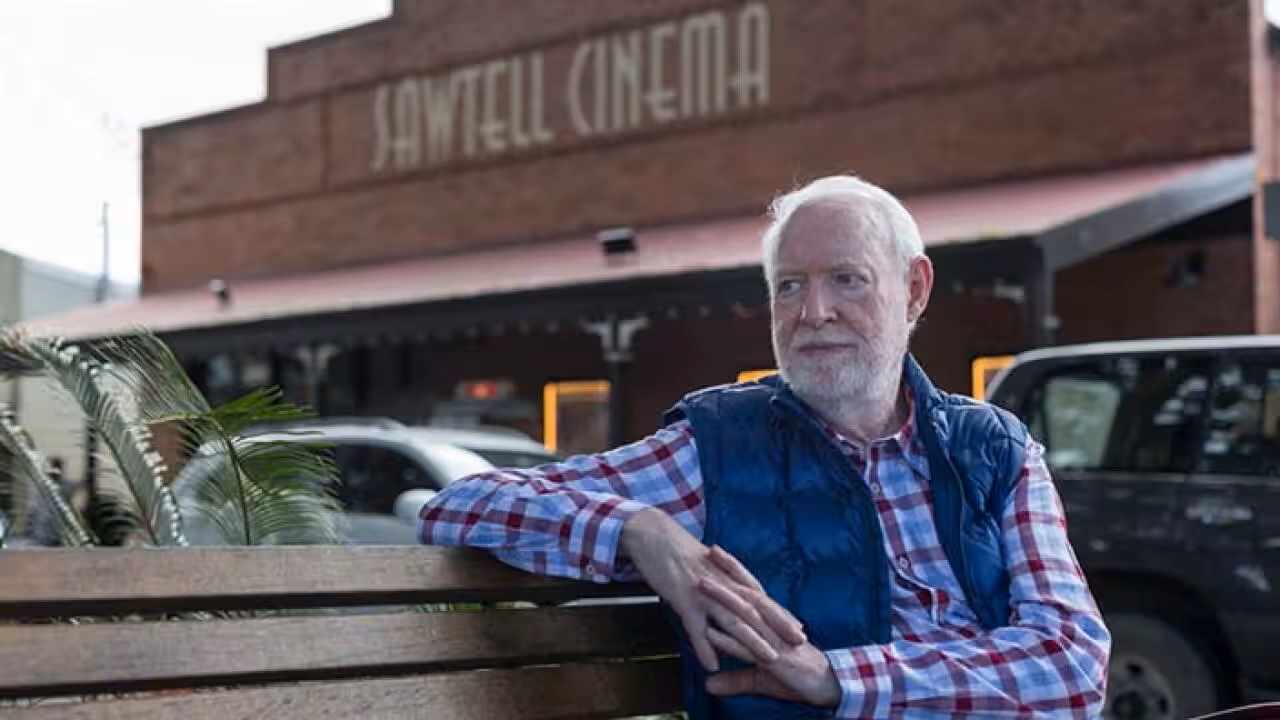
Image: David Stratton: A Cinematic Life
