



by Stephen Vagg
A 1939 comedy musical
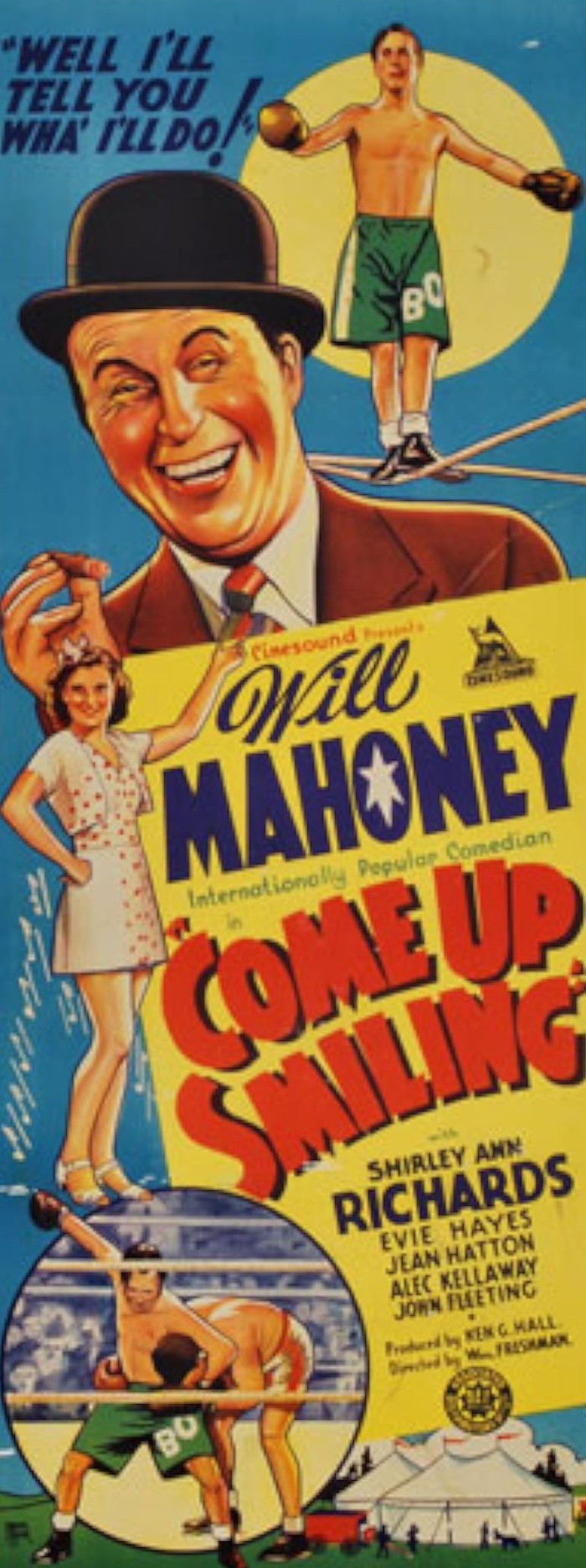 By 1939, Ken G Hall knew that the most sure-fire genre of Australian cinema was a popular comedian in a star vehicle. With Come Up Smiling, he tried to vary the formula a little – first of all, it would star an internationally famous foreign comedian rather than someone local: American Will Mahoney, who had made a few visits to Australia, most recently in 1938. Secondly, it would be the first Cinesound feature not directed by Hall – instead, the company imported Australian-born William Freshman, who had spent most of his career in England as an actor and director. This would, in theory, free up Hall’s schedule to enable him to prepare some bigger-budgeted movies, notably the long-announced Robbery Under Arms and Overland Telegraph (spoiler number one: this didn’t happen because of World War Two).
Will Mahoney was a sprightly, engaging vaudevillian, who could sing, dance, act and play instruments. He was a global star, having enjoyed success in America and England – the fact that Hall wanted to build a vehicle around him was indicative of Cinesound’s ambition. Stars of his earlier comedies were not known outside Australia or New Zealand – but a Will Mahoney movie might, in theory, have a chance of making inroads overseas (spoiler number two: this didn’t really happen, but it was worth a shot).
The script for Come Up Smiling was credited to Freshman, but it was from an original story by “John Addison Chandler”, a nom de plume for Hall. Possibly some uncredited work was done on the script by Freshman’s British wife Lydia, a screenwriter of some note who accompanied him to Australia; Cinesound’s team of gag writers might also have done a pass.
Mahoney plays Barney O’Hara, a performer in a touring carnival who runs a show with a pompous actor (Sydney Wheeler) and the latter’s singing daughter Pat (Jean Hatton, who’d been in Mr Chedworth Steps Out) (NB: some accounts of this film say Hatton plays Mahoney’s daughter – which would make sense – but on screen, she clearly calls Wheeler’s character “daddy”).
Pat is invited to sing at a party held by Colonel Cameron (Guy Hastings) and his daughter Eve (Shirley Ann Richards), but her voice conks out mid-performance. To raise money for an operation to fix Pat, Barney has to fight ‘Killer’, a top boxer (Alec Kellaway), and enlists the help of dancer Kitty (Mahoney’s real life partner Evie Hayes). Gangsters inevitably get involved (headed by Cinesound’s regular assistant director and villain-depicter, Ron Whelan).
The story is, not surprisingly, a justification for various comedy sketches and songs that showcase the ability of its stars. It mostly works and Come Up Smiling has plenty of nice moments, particularly a warm feeling of family. There are some flaws, the most notable of which is the love story(s) – the film hints that Mahoney is in love with Shirley Ann Richards, but she’s dating some dude played by John Fleeting, from Gone to the Dogs. This story goes nowhere without any conflict; indeed, Richards and Fleeting could be cut out of the film entirely without any impact on the story. The relationship between Barney/Mahoney and Kitty/Hayes has huge potential but is under-serviced. One senses that Frank Harvey, Cinesound’s regular screenwriter, would have found a way to connect all these threads – turn Richards into Hatton’s sister, say, and have her fall in love with Fleeting over the course of the movie, and do a proper romance between Mahoney and Hayes. But he appears to have been busy writing a script for Overland Telegraph.
In fairness, we’ve only seen a 70-minute version of this movie, called Ants in His Pants and perhaps there is a longer cut out there which does not have the aforementioned flaws.
The film was released as Come Up Smiling in Tasmania in November 1939, but Hall was dissatisfied with the response, had the movie withdrawn, re-cut and re-released after Christmas in other states as Ants in His Pants.
 We’re not sure what was changed – maybe they were significant; possibly it was also a flex by Hall to show Freshman who was boss (maybe that’s unfair, but we have known a lot of bosses who sincerely declare “I just need to take some time off and let someone else take over”, but once it starts happening, are unable to do so and wind up taking control again).
Incidentally, after Cinesound announced that it would no longer be making films, Freshman and his wife returned to England in early 1940, dodging Nazi boats on the way; after war service, he made the film Tehran (1947) then moved into television.
Ants in His Pants/Come Up Smiling is a bright, energetic movie, full of excellent performances. Mahoney is a lively star, Hatton very sweet, Wheeler fun as always, Richards as lovely as ever (even if wasted in her nothing part), Evie Hayes has a splendid musical number, and Alec Kellaway wonderful as a Shirley Temple-loving boxer. The movie is stolen, however, by a freckle faced gawky kid (we’re not sure of the actor’s name) who sneaks ants into Mahoney’s pants. There is a very unfortunate musical number where Mahoney performs in blackface singing to a lamb calling it ‘Lammy’ and later looks at his reflection and uses the “N” word to describe himself (a reflection of the black and white minstrel shows that were huge in Australia at the time).
 The technical quality of the movie is very high. Apparently, Chips Rafferty and Charles Tingwell are among the extras, but we couldn’t spot them. In all honesty, it probably wasn’t worth importing William Freshman to work on this, Cinesound would have been better off promoting someone from its own ranks, but the English CV of Freshman would have given the studio confidence.
Mahoney and Evie Hayes toured Australia extensively during the war, proving popular with American and Australian servicemen. He went back to America but decided to settle in Australia permanently and died here. Come Up Smiling/Ants in His Pants is a worthy showcase of his abilities.
The author would like to thank Graham Shirley and the National Film and Sound Archive for its assistance with this piece. Unless specified, all opinions are those of the author’s.
