



by Stephen Vagg
Note: This piece contains direct quotes from the movie, which uses racist terminology.
Westerns are one of those genres where you can tell all sorts of stories within its framework – a comedy, thriller, romance, action film, allegory on contemporary society, etc. So it’s not that surprising that from time to time they are used to spread the Gospel. Yep, there are such things called Christian Westerns, and what’s more, one was made in Australia: Shadow of the Boomerang (1960).
The film had its origins in a 1959 tour of Australia and New Zealand by American evangelist Billy Graham. Nowadays, evangelists have a, shall we say, mixed reputation, invoking images of charlatans, sex scandals, Hillsong, Scott Morrison, Tammy Faye Bakker, and so on. And to be fair, the profession has always been treated with some trepidation in popular culture – you only have to consider films like Miracle Woman (1931), Elmer Gantry (1960), and Angel Baby (1961). However, Billy Graham was definitely a more respected evangelist, probably the most respected of them all.
He was a preacher from North Carolina who started holding “crusades” in the late 1940s, preaching the gospel of Jesus and anti-Communism to crowds that grew from thousands to tens of thousands. He was a brilliant communicator and soon became internationally famous, packing out venues Taylor Swift-style throughout the USA, then other countries, including the British Commonwealth. Graham was close to presidents, disliked gays and being alone with women who weren’t his wife, was slightly progressive on race, and remained remarkably untouched by scandal and controversy for someone who toiled so long in a field full of grifters.
Graham had a strong entrepreneurial streak, with fingers in all sorts of pies – books, radio, television, merch, etc. His company, the Billy Graham Evangelistic Association, had a film subsidiary, World Wide Pictures (WWP), established under documentary filmmaker Dick Ross. WWP would produce and distribute films; some of its better-known efforts over the years included The Restless Ones (1965) with Kim Darby, Two a Penny (1965) with post-born-again Cliff Richard, and The Hiding Place (1975) with Julie Harris.
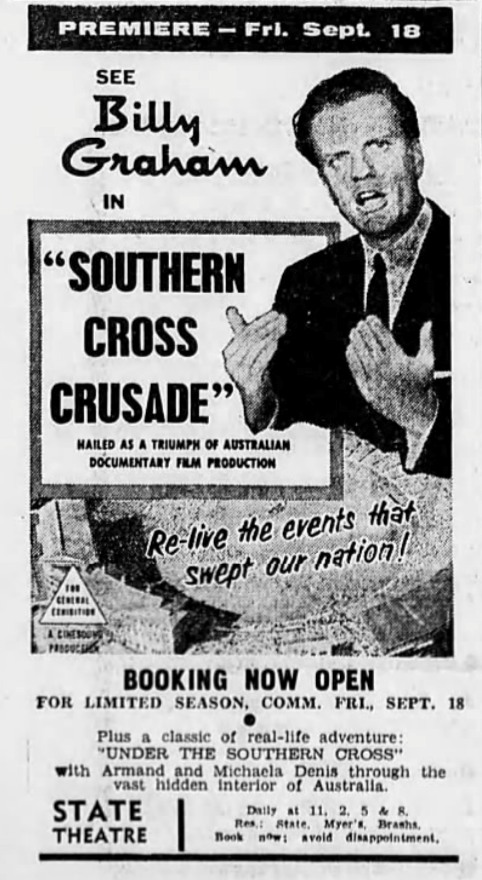 Graham’s 1959 Australia/New Zealand crusade had been a huge success, with Billy seen by over three million Australians, including 143,000 who packed out the MCG. According to records published at the time, £40,000 was raised during the 1959 crusade to contribute to both a documentary and feature film that would refer to the crusade. WWP had done something similar during Graham’s 1954 London Crusade – the resulting film was called Souls in Conflict (1954). The documentary of his antipodean crusade came out in late 1959; called The Southern Cross Crusade, it was made by the team at Cinesound. The feature film was shot in late 1959 and was called Shadow of a Boomerang. Its reported budget was less than £100,000.
Incidentally, there had been a long tradition of religious organisations involved in Australian moviemaking – the Salvation Army for instance had its own filmmaking unit which made Soldiers of the Cross, while the Christian Television Association regularly produced programs such as the early serial drama The House on the Corner (1957). But WWP was primarily an American organisation.
Dick Ross arrived in Sydney in October 1959 accompanied by the film’s two American stars, Dickie Jones and Georgia Lee. Both were vice-presidents of the Hollywood Christian Group. Jones was a former child star, who had voiced the title character in Disney’s 1940 version of Pinocchio, and was starring in Buffalo Bill Jr on TV. Lee was the wife of actor-turned-minister Ralph Hobbs; she had been in the WWP film The Heart is a Rebel. Dick Ross told the Australian press, “We like to choose our actors from people who have had similar Christian experiences to those we portray in the films and we also like them to have good domestic backgrounds.”
Filming on the Australian leg of Shadow of the Boomerang started in November 1959 and took place at Cinesound Sydney studios and on location at Camden (where Ken G Hall used to direct many Cinesound features back in the 1930s). We say “Australian leg” because we are pretty sure the opening sequences were shot in the US as they are full of American actors. However, the bulk of the movie was filmed in Australia and used Australian talent, notably singer Jimmy Little, radio actor Marcia Hathaway, and vaguely familiar faces like Keith Buckley and Vaughan Tracey. There was a religious connection for some of these performers – Hathaway in particular had turned to Christ after the 1959 Crusade, while Ken Fraser had appeared in the 1958 religious television play The Way Back.
The script for Shadow of the Boomerang was written by Ross in association with an Australian, John Ford, a journalist who had recently received acclaim for his television play The Big Day; he later worked for Gough Whitlam. The script is actually solid and the language feels authentically Australian.
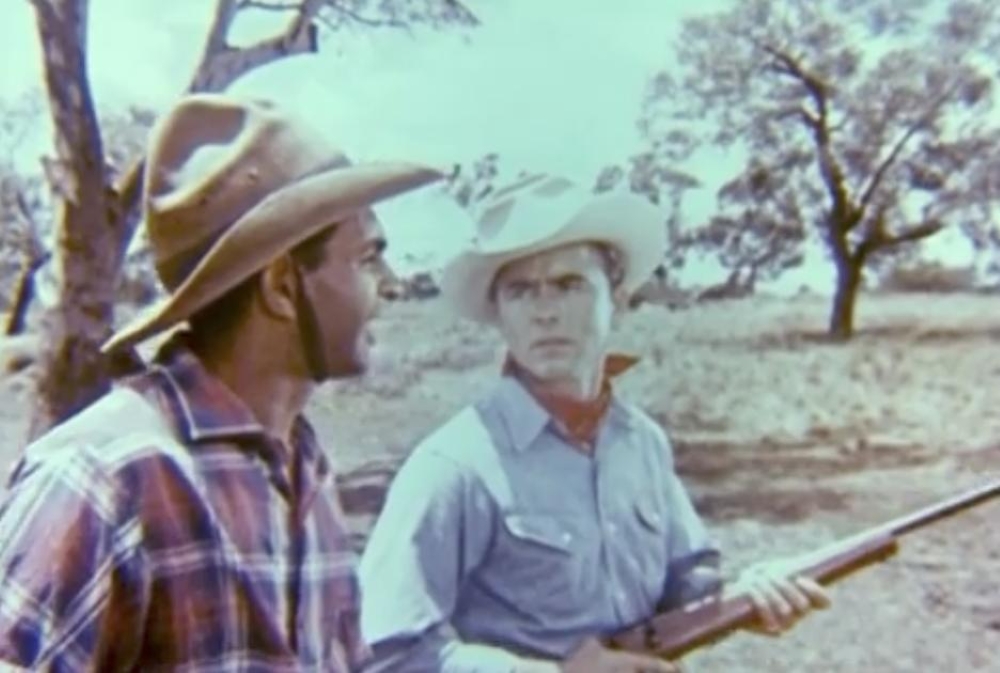
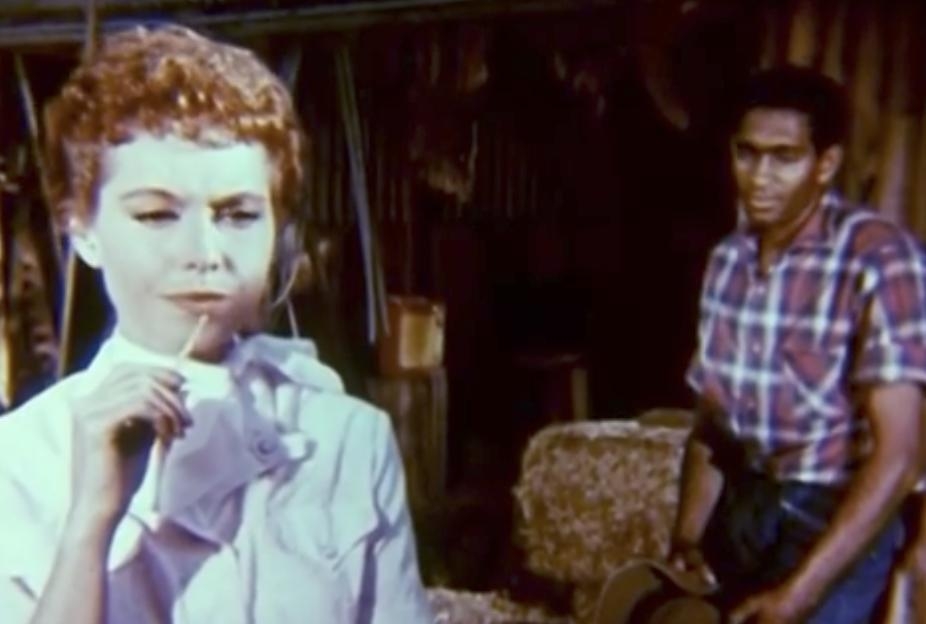
The plot of the movie focuses on nepo baby brat Bob Prince (Jones) whose frustrated father sends him out to run a ranch in Australia, where hopefully his son will become a man. Bob is accompanied by his sister Kathy (Georgia Lee), who is keen on adventure and escaping an unseen man who is “getting too serious”. Bob and Kathy head out to the ranch where Kathy makes friends but Bob sets about annoying everyone. In particular, he wants his employees, many of them black, to work on weekends and refuses to let them attend Billy Graham’s 1959 crusade of Australia. The siblings both find kind-of romance, Bob with a nurse (Marcia Hathaway), and Kathy being pursued by two stockmen (Keith Buckley, Ken Fraser); she also seems very flirtatious with Aboriginal stockman Johnny (Jimmy Little) and a doctor (Vaughan Tracy). Bob won’t let Johnny go to church and instead takes him hunting for a troublesome boar. [SPOILERS] Jimmy is mortally wounded while saving Bob’s life from the boar, in the best “noble savage” tradition, but dies happily knowing that Bob is going to church to listen to Billy Graham on the radio. Bob gives himself to Christ. “The end of this film is really the beginning of the Christian life for the son,” said Ross.
Shadow of the Boomerang reminded us a lot of the 1950 meat pie Western The Kangaroo Kid – both were lowish-budgeted American films made in Australia with foreign talent and money, which made a genuine attempt to reflect local culture (not perfect but appreciated). Both movies were guilty of fauna exoticism (look – a kangaroo!) and not fantastically acted but were unpretentious, solidly constructed genre pieces that knew exactly what they wanted to do and did it. Both achieved their aims far more than bigger budgeted movies shot here around this time such as Kangaroo (1952), The Siege of Pinchgut (1959) or Summer of the Seventeenth Doll (1959).
We will admit that it was a shame that the budget only extended to filming a ranch in Camden as opposed to the outback (sorry, Camden, but you know what we mean). Also, from time to time, the storyline dragged, and we had to spice things up mentally by imagining that Kathy was secretly sleeping with all the men on the ranch (you can totally do that interpretation of the film, Georgia Lee flirts with everyone on screen).
Nonetheless, there is plenty of cultural value in Shadow of the Boomerang. The film is quite strong on racism – Bob uses the “N” word a lot, which has power; a stockman tells him that we don’t say that word in Australia, no sir, the correct words are “abo”, “native” or “even black fella” (thanks, stockman). Jimmy Little has charisma to burn and gets to play one of the most three-dimensional Aboriginal characters to date in film history (a very low bar to jump over, admittedly) – he’s contemporary, respected, handsome, sings, heroic, has a rich spiritual life. And the movie does stress the importance of religion to many Aboriginal people raised on missions, however problematic the origin of that importance may be. There is a lot of documentary footage of Billy Graham preaching and he is an electric performer. And the core of the story – the conversion of the siblings to Christ – is very well done.
Shadow of the Boomerang had its world premiere at Madison Square Garden in October 1960. It wasn’t released in Australia until nearly a year later – we’re not sure why it took so long, possibly they couldn’t get a decent deal, maybe there was distributor apprehension about religious and/or Australian movies, but who knows. Shadow of the Boomerang was issued in Melbourne on a double bill with the 1960 car racing film The Green Helmet (based on a script and novel by Australian Jon Cleary).
Dick Ross made movies for Graham for a few more years, then went his own way. His later efforts include The Cross and the Switchblade (1970) with Pat Boone as a teacher who forces himself into Erik Estrada’s bedroom at 3am when Estrada is just wearing white underpants.
Cast member Marcia Hathaway later appeared in the television play Harlequinade. She was swimming in shallow water at Sugarloaf Bay in Middle Harbour, Sydney, on 28 January 1963 when she was attacked by a bull shark. Her fiancee Frederick Knight fought off the shark with his hands and feet but by then Hathaway’s leg had been torn to shreds and she died within 20 minutes. Her faith was a great comfort to her as she was dying, and to her family and friends grieving her loss.
Georgia Lee’s daughter, Robbie Lee, would go on to be the iconic star of 1970s exploitation masterpieces Big Bad Mama (1974) and Switchblade Sisters (1975), in which her mother played small roles. We’re not sure how Georgia reconciled that with her other work, but no doubt God was forgiving.
Shadow of the Boomerang is an odd footnote in the history of Australian cinema, but not an insignificant one and Australian admirers of Billy Graham especially are commended to see it.
