



by Shahran Morshed
Worth: $20.00
FilmInk rates movies out of $20 — the score indicates the amount we believe a ticket to the movie to be worth
Cast:
Eylul Guven, Amy Zimmer, Ádám Tompa
Intro:
… an exceptional debut, and a film whose images are difficult to leave behind.
Sophy Romvari’s Blue Heron feels like looking through an old family photograph whose details become more complicated the longer we stare at it. There is an unusual tenderness in the way the film observes people, places and fragments of a life that cannot be entirely recovered. Its images carry the warmth of childhood, but beneath that warmth lies an uneasiness that gradually reveals itself. With this remarkable feature debut, Romvari has created a deeply personal work that finds an extraordinary cinematic language for memory, family and the limits of understanding another person.
Set in the late 1990s, the film follows eight-year-old Sasha and her Hungarian immigrant family as they relocate to a new home on Vancouver Island. Their fresh beginning is gradually overshadowed by the increasingly dangerous and unpredictable behaviour of Jeremy, the eldest child. His parents struggle to understand him, seeking professional help while trying to keep the family together. Sasha, meanwhile, watches the tensions unfold without fully comprehending their consequences.
Romvari captures this childhood perspective with remarkable sensitivity. Sasha does not possess the language to understand everything happening around her, but she absorbs the silences, anxieties and changing relationships within the household. Jeremy’s hand-drawn maps become particularly fascinating in this context. While others attempt to understand him from the outside, his maps offer glimpses of an inner world that remains largely inaccessible. They quietly suggest how little we can ever know about another person’s experience.
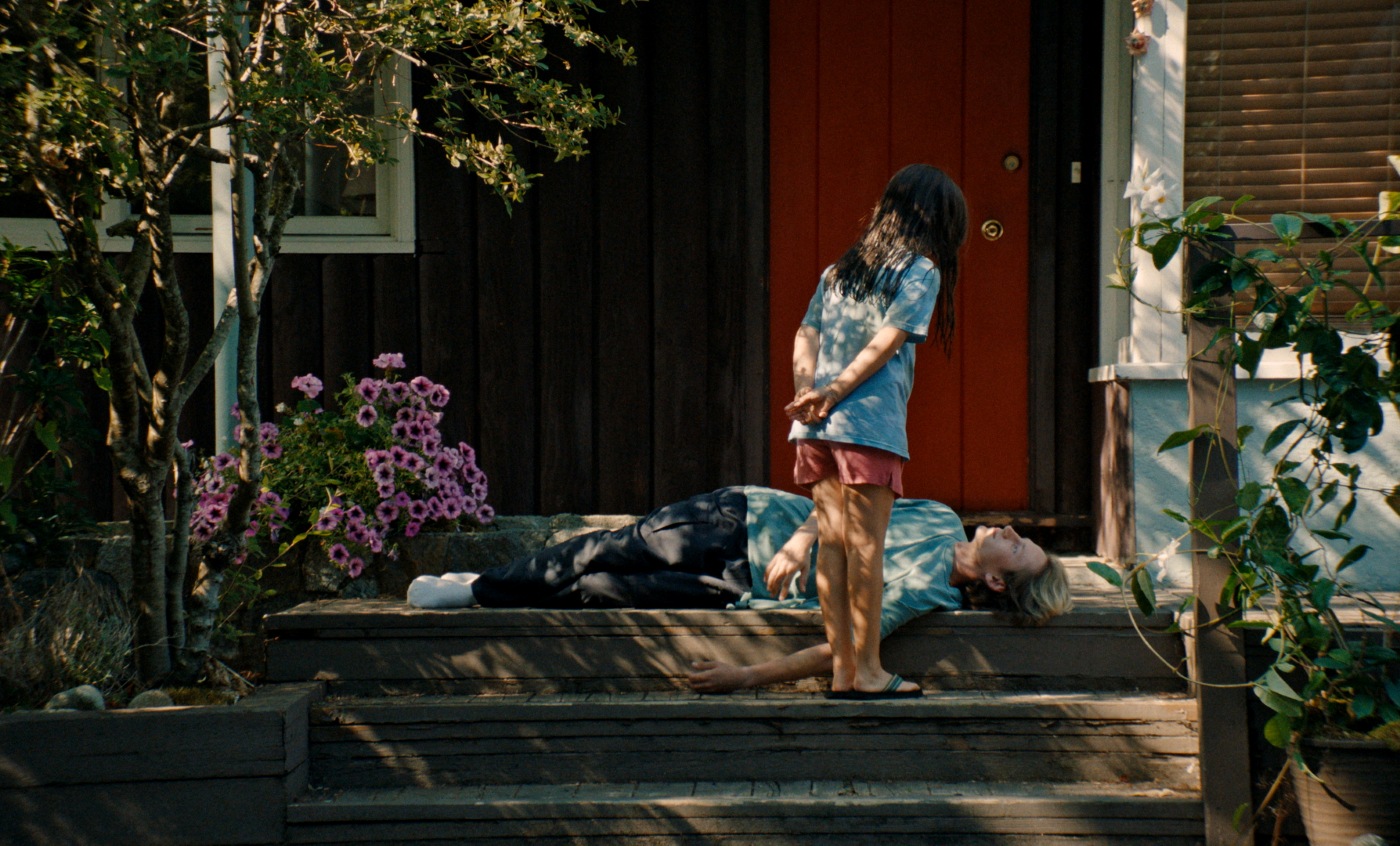
Blue Heron’s visual language is extraordinary. Maya Bankovic’s cinematography gives the family home and its surroundings an almost painterly quality. The natural light, green landscapes, domestic spaces and seemingly ordinary encounters are captured with an eye for beauty that never feels ornamental. Almost every frame could stand as a painting, yet the images remain intimately connected to the lives unfolding within them. The period details are equally convincing, while the performances bring remarkable naturalness to the family dynamics. Eylul Guven is particularly affecting as young Sasha, and Edik Beddoes gives Jeremy an intriguing presence, balancing vulnerability and unpredictability without reducing him to a familiar character type.
As the film progresses, its relationship with the past becomes more complicated. An adult Sasha, played by Amy Zimmer, returns to her childhood experiences, turning the act of remembering into a personal investigation. Moving between fiction, recorded images and documentary-like observations, Romvari questions how much of our past can actually be recovered. Her interest in documentation is deeply personal, influenced in part by her father, who was always photographing the family. Yet Blue Heron understands that preserving an image is not the same as preserving an experience. Photographs and videos may retain fragments of a moment, but they cannot contain everything that happened beyond the frame. One of the film’s most moving moments comes through a letter near the end, based on a real message Romvari received. It allows Sasha to encounter her brother through someone else’s experience of him. After spending much of the film trying to understand Jeremy, she finally sees another dimension of his personality. The letter does not resolve everything, but it changes the way we understand him. It is a beautiful reminder that the people closest to us can still have parts of their lives that remain beyond our knowledge.
What makes Romvari’s achievement so impressive is the confidence with which she brings these different forms together. Her personal history provides the foundation, but she never confines the film to autobiography. Instead, memory becomes something fluid, incomplete and constantly changing. She trusts her images, her performers and the silences between them, never forcing an explanation where uncertainty feels more honest. With Blue Heron, she has sculpted a remarkably distinctive cinematic voice. Its visual compositions, performances, sound and narrative structure come together with an extraordinary sense of purpose. It is beautiful in almost every aspect, not merely for its visual splendour but for the intelligence and tenderness of its filmmaking.
Some memories remain with us without ever becoming entirely clear. Blue Heron understands that beautifully. It is an exceptional debut, and a film whose images are difficult to leave behind.
