


by Flynn Shan Benson
Worth: $18.00
FilmInk rates movies out of $20 — the score indicates the amount we believe a ticket to the movie to be worth
Sydney Film Festival
Cast:
Sebastian Stan, Renate Reinsve, Lisa Loven Kongsli, Ellen Dorrit Petersen, Vanessa Ceban, Jonathan Ciprian Breazu
Intro:
… a film made with precision and daring, anchored by brilliant performances, that represents an uncompromised artistic vision.
Fjords, bodies of water shadowed by towering mountains, are emblematic of the Scandinavian landscape, of a certain Romantic sublime — or of a fantasy of Christian Europe untouched by modernity. In Cristian Mungiu’s Fjord, winner of the Palme d’Or at this year’s Cannes, this geography, like the film itself, is both divine and pitilessly unanswering.
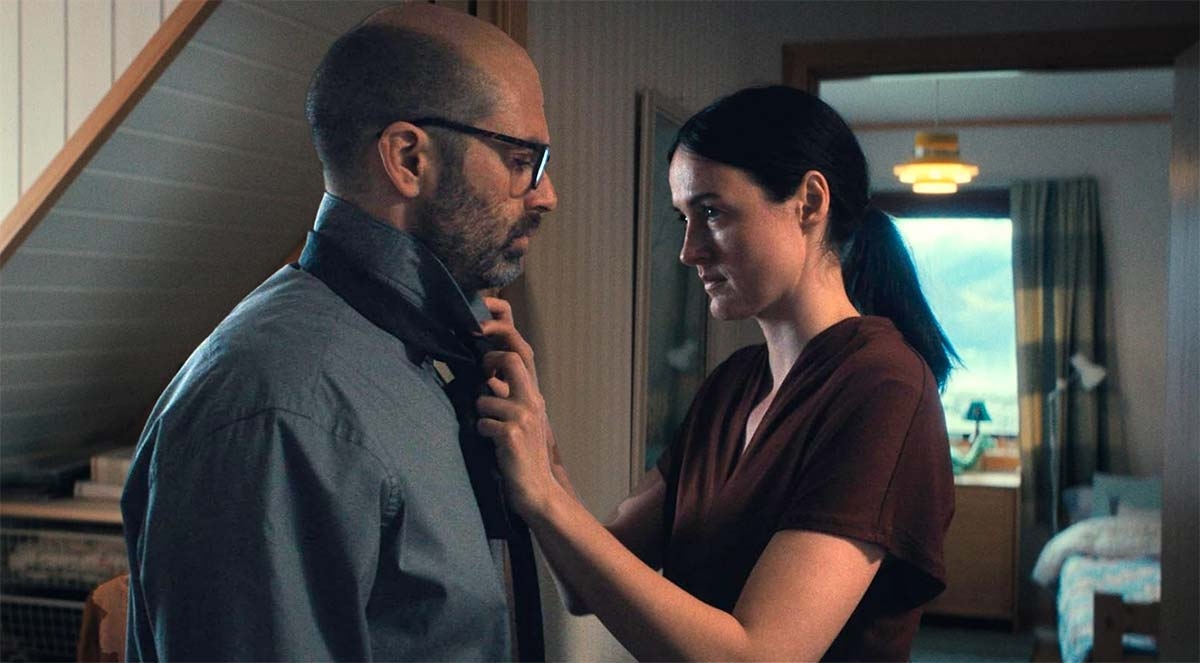
In any case, for the patriarch of a Romanian family, Mihai (Sebastian Stan, using a comical amount of prosthetics to make himself look like a generic middle-aged man), who has moved from his native country to a remote Norwegian town with his Norwegian-born wife Lisbet (Renate Reinsve, hiding her charisma in the observant gaze of a devout housewife) and their five children, it represents an alien landscape.
Even before the central dramatic episode of the film, Mungiu asks the audience to look at his precisely composed, Haneke-esque tableaus, and consider what they are seeing. Does Mihai, trained as an aeronautical engineer and now employed in comparatively menial IT work in the local school, feel frustrated and demeaned, or does he have a genuine sense of community service? Is he, in his devotion that seems fervent to a secular audience, merely a man of deep faith, or a reactionary Christian nationalist? Is he a product of the Romania that gave a home to Andrew Tate, or the one that prosecuted him? In the same vein, is Lisbet a diligent nurse who attends to the bodies of the deceased and consoles the bereaved, or is a Christian zealot who lures the vulnerable into her church?
The film is careful to tease its audience with these uneasy and ambiguous scenarios during its early sections: the father plays Amazing Grace on a school piano, before being gently reprimanded by the principal. The younger daughter says that lesbians will go to hell, shocking her teacher. An adolescent Norwegian girl shows intense affection for her new classmates, speaking English with them and inviting them to her birthday party; she also shows destructive tendencies that could reflect lax parenting, or just the potential of Instagram to warp young minds. A recurring image is of a child jumping out of a window and landing offscreen, so that we can only assume they are unhurt.
The inciting incident for Fjord comes when the two older children line up for the morning school bus with bruises on their face, which they claim were caused by a fall. We have seen that the parents will ground the children and enforce their prayers, but we have also seen closeness and affection in their screen-free household. Importantly, the bruises were made during one of the film’s discordant ellipses, so we never entirely escape the suspicion that this smiling family could hide unspeakable violence.
The school officials then follow official procedures, albeit with a certain eagerness, and arrange for child protective services to intervene and determine whether Mihai and Lisbet are fit parents. Even when the children apparently give answers and testify that their father ‘slaps’ them, the fact that they are communicating in a second language, that this is only reported second-hand, that corporal punishment has gone from normal to illegal in a lifetime, means that the ambiguities only grow.
What follows is an extended courtroom drama that effectively pits the Norwegian state against the Romanian family, as both sides let the case become a proxy for the tensions between liberalism and religious freedom.
Fjord, like last year’s Palme-winner It was Just an Accident, then becomes less about solving the mystery at the film’s centre than about what is revealed by those claiming vindication on either side.
Moreover, even while the film tips its sympathy to Mihai and his claims of religious persecution — the audience may laugh when the Norwegian child protection authorities made their case — it never loses the dark irony that only a liberal society would let itself be challenged in this way: perhaps, in Mihai’s ideal vision of a conservative Christian society, there would only be dogma; perhaps, if he were Australian, he would endorse Pauline Hanson’s vision of a ‘monocultural society’. Or, this ingeniously unsettling film suggests, perhaps this scenario is a variation of a situation that is far more common, and far less likely to find sympathy with an Anglo audience: when families from Pakistan, Senegal, China, Syria, or any number of other countries, move to a Western country and find that, despite working to assimilate and be ‘model migrants’, their relatively conservative mores and religious beliefs leave them at odds with their surroundings.
That Mungiu is able to place these paradoxes of modern life into his drama and still create something riveting is a testament to his ability as a filmmaker. It is not a technically flawless film — Mungiu indulges in obvious symbolism and unsubtle declarations — but it is a film made with precision and daring, anchored by brilliant performances, that represents an uncompromised artistic vision. It is exhilaratingly original because it is willing to look at the world at this particular moment and try to unearth its contradictions, without pretending to resolve them.
In the end, behind all these dilemmas of parenting is the unspoken fact that the film’s children — none of whom were born when the first iPhone came on the market — will be more radically disconnected from their parents and society than any previous generation; they will be the first generation of humanity that has no need to rely on tradition, no need for media from older generations, able to form themselves entirely in a dark room with a bright screen.
The last line of the film is a warning, ‘Be careful’: it is for us as well as them.
