


by Sam Addams
Casinos are built on the belief that a card turning over or a roulette wheel stopping is purely a matter of chance. But cinema has always loved pushing that boundary, imagining gamblers who don’t just ride their luck, but master it, characters who can read cards facedown, calculate chaotic probabilities in an instant, or glimpse the future before the dealer even lays down the flop.
The casino may look different today. Instead of every gamble happening across a felt table under neon lights, much of the experience has moved online, with online pokies in Australia now part of the broader digital entertainment conversation. But cinema’s favourite gambling fantasy, the player who somehow knows what everyone else cannot, has never really disappeared.
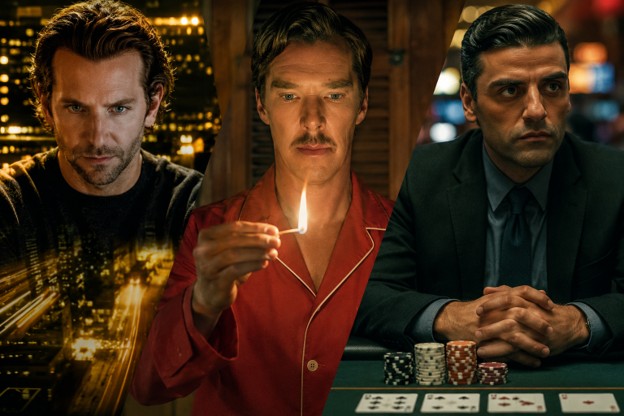
Stanley Kubrick was unusually open to that possibility, once expressing hope that ESP and related psychic phenomena might eventually find scientific proof. Cinema has explored the idea from several directions: The Wonderful Story of Henry Sugar imagines extraordinary perception, Limitless turns cognition into a chemically enhanced superpower, while The Card Counter finds an almost superhuman edge in extreme discipline and mathematical control.
Limitless: What If Your Brain Had No Ceiling?
In Neil Burger’s Limitless (2011), Eddie Morra, played by Bradley Cooper, discovers NZT-48, a fictional drug that appears to remove the limits of human cognition. Based on Alan Glynn’s novel The Dark Fields, the film turns an ordinary writer into someone capable of recalling almost anything, recognising patterns almost instantly, and processing vast amounts of information at extraordinary speed. With Robert De Niro’s Carl Van Loon watching his rise, Eddie’s transformation eventually reaches the casino, where probability, memory, and rapid calculation become another expression of his seemingly limitless mind.
He appears to process the information around him so quickly that uncertainty itself starts to look manageable. It is a cinematic version of the ultimate advantage play: perfect recall, accelerated calculation, and an ability to recognise patterns before everyone else has even noticed them.
But stripping away the cinematic flair leaves a compelling, grounded question: Is any of this actually scientifically possible? While a single pill that unlocks 100% of human cognitive capacity remains rooted in the myth of unused brainpower, modern neuroscience and neuropharmacology are actively probing the limits of human processing speed, working memory, and pattern recognition. Can real-world smart drugs, targeted neurostimulation, or hyper-specialised training allow a mind to approach that level of predictive calculation, or are we strictly constrained by the biological limits of neural architecture? It raises the ultimate question of whether such extraordinary mental clarity can ever be triggered chemically, or if it remains the exclusive domain of those rare ancient yogis who spent lifetimes cultivating total mastery over the mind.
Henry Sugar and the Fantasy of Seeing Through the Game
If Limitless imagines a brain operating beyond its normal limits, Wes Anderson’s The Wonderful Story of Henry Sugar asks an even stranger question: what if you could see what your eyes were never supposed to see?
Adapted from Roald Dahl’s 1977 short story, Anderson’s 2023 film follows Henry Sugar, played by Benedict Cumberbatch, after he encounters the extraordinary story of Imhrat Khan, portrayed by Ben Kingsley. Through Dr. Chatterjee’s account, Henry learns of Khan’s claimed ability to see without using his eyes and becomes determined to master the technique for himself.
The film’s meditation scenes draw on kasina meditation, an ancient Buddhist concentration practice in which the practitioner focuses intensely on a physical object to develop deep mental absorption. In fire kasina, that object is typically a flame: the practitioner stares at a candle, closes their eyes, and uses the resulting afterimage as a point of concentration. That is essentially the discipline Henry undertakes in his pursuit of extraordinary perception.
There is even an intriguing linguistic coincidence at the heart of the story. The Pali word kasiṇa refers to the meditation “totality” or object of concentration, and its sound is strikingly close to the English word casino.
Eventually, Henry appears to develop dermo-optical perception, or “sight without eyes,” allowing him to see through the backs of playing cards. Henry’s real transformation comes afterwards. He initially wants the ability to make a fortune at the tables, only to discover that extraordinary perception brings a different kind of responsibility. The story ultimately becomes less about beating the house and more about what a person chooses to do after acquiring an extraordinary advantage.
The Card Counter: When the Superpower Is Discipline
If Henry Sugar sees through the cards, William Tell sees through the system.
Played by Oscar Isaac in Paul Schrader’s The Card Counter (2021), William is almost the opposite of Henry. There is no mystical vision and no miracle drug. His extraordinary ability has been forged through years of rigid routine, including the psychological scars left by his time in solitary confinement. He keeps his world deliberately small, records every detail, and approaches gambling with an almost mechanical calm.
His edge comes from concentration, memory, probability, and repetition. Card counting does not predict the next card; it changes the mathematics of certain games by keeping track of the balance of cards that have already appeared. Combined with disciplined betting and emotional control, this can create an advantage under the right circumstances. It is a far cry from seeing through a deck, but it is perhaps more unsettling because it has a basis in reality.
The idea belongs to the broader world of advantage play, famously explored by mathematician Edward O. Thorp and later demonstrated on a much larger scale by the MIT Blackjack Team. Casinos responded with surveillance, countermeasures, and restrictions designed to identify players who appeared to be gaining an unusual mathematical edge.
Schrader turns that familiar battle into something darker. With La Linda, played by Tiffany Haddish, and Cirk, played by Tye Sheridan, pulling William toward a confrontation involving Willem Dafoe’s Major Gordo, gambling becomes another expression of the character’s attempt to maintain control over a life shaped by chaos.
When Cinema Turns Luck Into a Superpower
One of cinema’s greatest tricks is giving us abilities we could never possess ourselves. For a few minutes, the screen lets us see through walls, glimpse tomorrow, read what is hidden, and bend the rules of reality without asking whether any of it should be possible. That is the magic of the superpower: not proving that humans can do the impossible, but making us feel what it might be like if they could.
In Next, Nicolas Cage’s Cris Johnson can see roughly two minutes into the future, turning time itself into something he can briefly look through. X: The Man with the X-Ray Eyes gives Ray Milland’s Dr. James Xavier the ability to see through physical objects, creating a darker version of the same fantasy later explored by Henry Sugar. In Intacto, the idea becomes stranger still: luck appears to be a force that can be transferred, harvested, and possessed. Meanwhile, All for the Winner and the God of Gamblers films turn ESP, telekinesis, and impossible card manipulation into an exuberant Hong Kong spectacle.
What makes these powers so captivating is their visual language. A candle flame becomes a doorway to another form of perception. A pair of eyes becomes an instrument capable of looking beyond physical reality. A moment of silence can represent someone calculating what others cannot. Cinema can take an invisible idea, intuition, precognition, memory, luck, or consciousness, and give it a face, a gesture, and an image.
Perhaps that is why these films remain fascinating even when their powers have no established place in science. We already know what it feels like to be unable to see the other side of a card or know what will happen next. Cinema simply reverses that limitation. For a little while, we become the person who knows, sees, and perceives what everyone else cannot, and the impossible feels less like fantasy and more like a possibility waiting just beyond the edge of the frame.
Concluding Thoughts
In the end, these films aren’t really about beating casinos. They’re about beating the limits of perception. Limitless asks what happens when the mind accelerates, The Card Counter finds extraordinary power in discipline, and Henry Sugar dares us to imagine that perception itself might have hidden dimensions. Cinema cannot give us those abilities in real life, but for a couple of hours, it can make us believe that perhaps we have been looking at the world the wrong way all along.
