


by Flynn Shan Benson
Worth: $10.50
FilmInk rates movies out of $20 — the score indicates the amount we believe a ticket to the movie to be worth
Cast:
Salman Rushdie
Intro:
... a narrow perspective ...
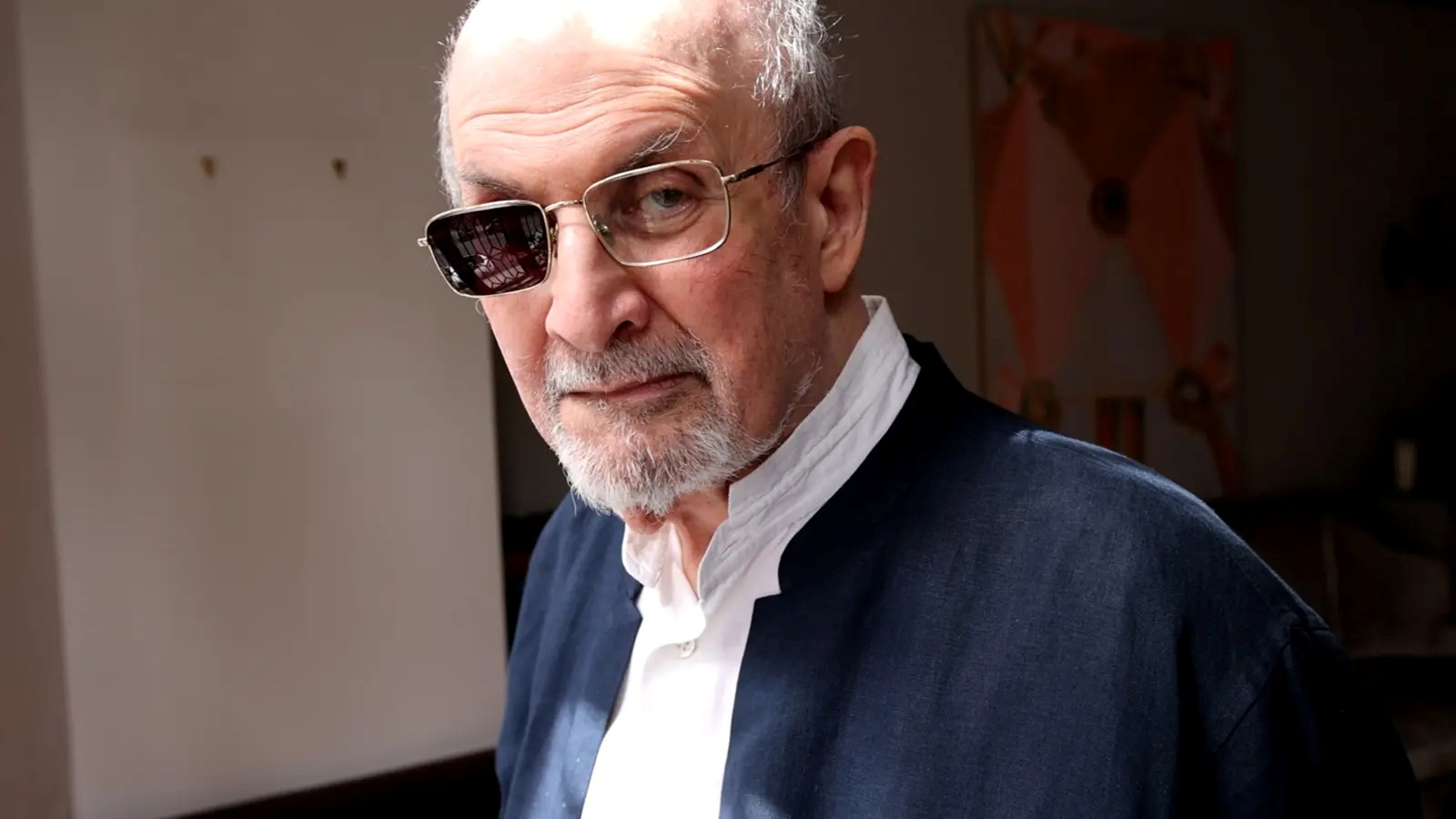
In 1989, Salman Rushdie stopped being a mere writer and became a historic figure: the Iranian government decreed that his novel The Satanic Verses was sufficiently blasphemous to Islam as to warrant the author’s death. After a decade in hiding, foiled assassination attempts, diplomatic negotiations and free speech debates, the author re-emerged into public life, cameoed in Bridget Jones’s Diary, wrote novels that had no impact on global politics, and lived an affluent New York life — until, in 2022, like some fictional contrivance, he was about to give an address on safe havens for writers when a man rushed the stage and stabbed Rushdie ten times. Oscar-winning documentarian Alex Gibney’s new film Knife offers an account, from the author’s own perspective, of the attack, Rushdie’s recovery, and the broader significance of this act of violence.
Gibney’s film is billed as ‘based on’ Rushdie’s memoir Knife, though it becomes clear that it is less a straight adaptation of the text than a documentary project sanctioned by the author.
After a lurid re-enactment of the near-fatal stabbing, the film offers a concise biography of Rushdie: We see the scion of an upper-class Indian Muslim family find himself a lesser entity in the elite sphere of British education. He then spends years in London working on advertising copy — including an Aero commercial he was particularly proud of — before his novel Midnight’s Children wins the 1981 Booker Prize, establishing him as a writer.
Gibney is adept at providing footage to encapsulate this strange flashpoint of literature and religion, including Rushdie’s own prose, interviews, footage of British protests demanding Rushdie’s death, and even clips from International Guerillas, the 1990 Pakistani action film which depicted Rushdie as a Satanic Zionist mastermind who is ultimately obliterated by Qurans.
Interspersed with this account are recordings of Rushdie recovering in hospital made by his wife (and the film’s executive producer and cinematographer), the writer Rachel Eliza Griffiths.
Rushdie deserves commendation for his willingness to bare the suffering wrought upon him — the stitches holding together his stomach and neck, his mutilated eye rendered entirely sightless. Yet at the same time, these sections place a sickly emphasis on the personal and sentimental — as when we see Rushdie telling Wes Anderson in a phone call that ‘there will be cuddles’, or announces to his future viewers that this is a story of love overcoming hate.
Such a narrow perspective obscures the more pertinent questions around the attack – why a man who wasn’t born when the fatwa was issued, who only knew about Rushdie from Youtube videos, would try and nearly succeeded in ending this man’s life. The closest the film comes is an awkward sequence in which footage of Rushdie and his assailant is superimposed on footage from Kurosawa’s High and Low, so that Rushdie can construct a fictional dialogue with the young man. But the film does not climax with any moment of clarity, but rather with the exploitative footage of the stabbing which was used to market the film. To see, from multiple angles, a man violently attacked with a knife does not illuminate anything about free speech, or the status of a writer in society — the violence only gives the illusion of meaning, like a cheap thriller or the commercial news.
Alas, there’s no exploration of Rushdie’s contradictions, a man who is inclined to pose and posture while also having claim to being a genuine secular saint; a man who speaks in the staid vowels of the British elite but writes with exuberant inventiveness about the folly of empire; a man who is as giddy and unabashed as a schoolboy about his fifth wife. There is also no investigation of the alienated young man who tried to kill Rushdie – were his actions the latest front in the war on free speech, or rather another symptom of the violence and threats to public figures that increasingly define American political life; if he had more in common with Luigi Mangione than Ayatollah Khomeini. But none of that is the story Rushdie wants to tell.
