


by Damien Spiccia
Worth: $16.00
FilmInk rates movies out of $20 — the score indicates the amount we believe a ticket to the movie to be worth
Cast:
William S. Burroughs, Howard Brookner, Allen Ginsberg, Jackie Curtis, Patti Smith, Frank Zappa, Ed Sanders, Anne Waldman, Laurie Anderson, Philip Glass, Timothy Leary, Brion Gysin
Intro:
By expanding its scope beyond the convention stage, Nova ‘78 becomes more than a record of a perfect storm of creative voices – what writer now could draw this kind of talent? Through rough and sombre 16mm footage, Brookner and Areias preserve a culture caught between idealism and exhaustion, as beat culture clashes with punk’s fuck-off nihilism.
In late 1978, Manhattan’s Entermedia Theater (now the Village East cinema) hosted the Nova Convention, a sold-out, three-day gathering of artists, poets, musicians, and theorists to celebrate the ideas and legacy of William S. Burroughs, recently returned to New York after twenty-five years of self-imposed exile in Latin America, North Africa, and Europe. NYU film student Howard Brookner, with help from classmates Jim Jarmusch and Tom DiCillo, filmed the event in its entirety, though outside of brief excerpts in Brookner’s 1983 documentary Burroughs, the unedited footage was thought lost. Recovered in 2012 and restored through the Howard Brookner Legacy Project, that footage forms the basis of Nova ‘78, directed by Brookner’s nephew Aaron Brookner and Rodrigo Areias, which also serves as a companion piece to Aaron Brookner’s Uncle Howard (2016).
What Allen Ginsberg called “the Burroughs occasion” brought together an eclectic line-up of some of the twentieth century’s most influential countercultural figures. Burroughs kicks things off in a hilarious pre-filmed segment as Dr. Benway, performing gruesome surgery alongside a gormless nurse (Warhol superstar Jackie Curtis). Filling in for the absent Keith Richards, Patti Smith takes the stage fishing for cash in her coat and offering to personally reimburse anyone disappointed by Richards’ no-show. Ginsberg sings a sea-shanty-like take of William Blake’s “The Tyger”. Other artists pay tribute to Burroughs more directly. Frank Zappa recites the “talking asshole” bit from Naked Lunch, and Ed Sanders performs “Uranium Willy” with electrodes on his fingers that distort the words.
Premonitions of the future and systems of control are a recurring concern: Anne Waldman evokes nuclear annihilation with a polemic against “mega, mega, mega, mega, mega death” from “the devil’s work, plutonium”, while Laurie Anderson ends her voice-modulated “Language of the Future” with a warning: “This is the language of the on again, off again future, and it is digital.” Burroughs delivers a blistering response to Proposition 6, which sought to ban gay and lesbian teachers from the classroom and was overwhelmingly rejected by voters.
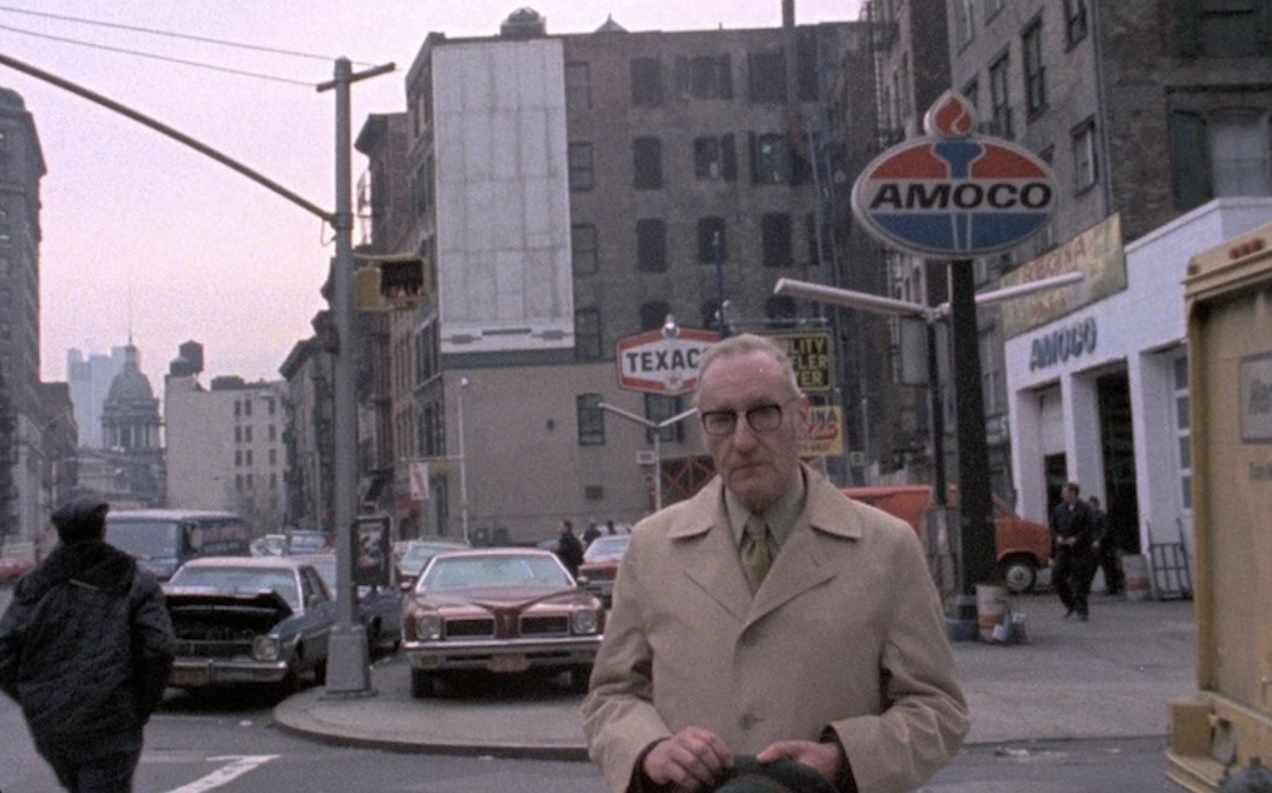
While focusing primarily on the convention, Brookner and co-editor Tomás Baltazar also include observational diversions that echo Burroughs’ cut-up methods of creating meaning through juxtaposition, as when they intercut Philip Glass’s solo synthesiser performance with Brookner’s footage of decaying Manhattan streetlife, like a dingy proto-Koyaanisqatsi. But most diversions centre on Burroughs himself, showing Brookner the proper way to throw a knife, for example, or sharing his joy at loading and shooting rifles, which makes for uncomfortable viewing given Burroughs’ own infamous ‘William Tell’ killing of his wife Joan Vollmer. In these moments, Brookner and Burroughs share a friendly rapport – Brookner would even cast Burroughs as a butler in Bloodhounds of Broadway (1989) – but around the convention, Burroughs seems alternately inscrutable and eerily prescient. When Brookner asks him for his thoughts on the event, he doesn’t answer. Later, when asked, “How nice was it, this thing?”, he just walks away. Yet in a backstage discussion about the recent Iranian Revolution, he warns that “we may live to regret it, literally, when we’re suddenly in need of oil.” Elsewhere, he rails against “mediocre elites” and a culture increasingly governed by bureaucracy, conformity, and greed. His warning is simple: “Time is a resource, and time is running out.”
By expanding its scope beyond the convention stage, Nova ‘78 becomes more than a record of a perfect storm of creative voices – what writer now could draw this kind of talent? Through rough and sombre 16mm footage, Brookner and Areias preserve a culture caught between idealism and exhaustion, as beat culture clashes with punk’s fuck-off nihilism. In an onstage discussion on political futurology featuring Timothy Leary, Brion Gysin invokes the Sex Pistols’ “no future”, which, fifty years on, sounds less like provocation than diagnosis.
