



by Enzo Callas
Stoner comedies have long occupied a particular niche in popular culture – a blend of absurdity, subtle satire, and a laid-back charm that keeps viewers coming back. Beginning with the iconic Up in Smoke, the genre established its blueprint: two hapless companions navigating surreal misadventures, often under the influence, in plots that balance ridicule and affection. Up in Smoke debuted in 1978 and, despite modest expectations, grossed over USD 104 million – a staggering return that turned it into a cult classic and codified the stoner comedy formula (Box Office Mojo).
From Counterculture Roots to Pop-Culture Mainstay
The genesis of stoner comedy can be traced back to Cheech & Chong’s counterculture routines. Their pioneering style – two laid-back misfits on a drug-fuelled quest – set a template echoed in countless successors.
Their 1978 debut film, Up in Smoke, directed by Lou Adler, was a low-budget gamble that became an unexpected box office sensation. Made for roughly USD 2 million, it went on to earn more than USD 104 million worldwide, cementing its status as a cultural phenomenon. The plot, thin but effective, follows Cheech and Chong’s hapless journey in a van made entirely of marijuana – a premise that distilled the essence of stoner humour: surreal situations, improvised banter, and irreverent defiance of authority.
Critics were split at the time, with some dismissing it as aimless, yet it found a devoted audience that connected with its free-spirited energy and anti-establishment charm. Over time, Up in Smoke has been recognised not just as a cult classic but as the film that codified the stoner comedy’s DNA – a loose, episodic structure driven more by chemistry between leads than conventional plot. Its success proved there was a market for cannabis-centric storytelling, paving the way for everything from Half Baked to Pineapple Express.
Anatomy of the Laugh
A stoner comedy thrives on a few core ingredients: the buddy-duo dynamic, surreal sequences, irreverent dialogue, and the munchies – comic relief wrapped in the mundanity of snacks and paranoia. The genre succeeds by leaning into the absurd while honouring the humanity of its characters.
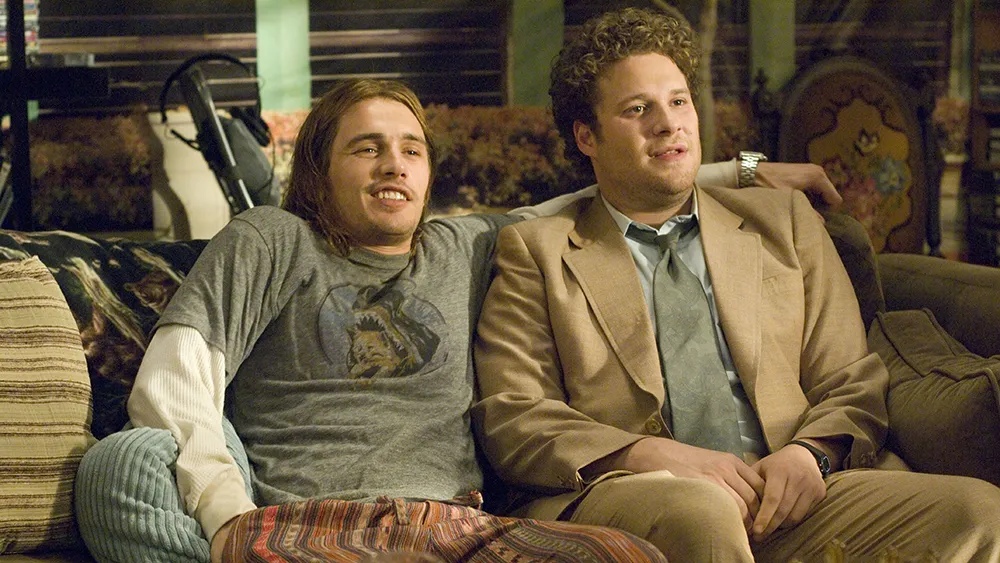
One of the clearest examples is Pineapple Express, the 2008 action-comedy directed by David Gordon Green and produced by Judd Apatow. Starring Seth Rogen and James Franco, it fused traditional stoner antics with fast-paced action sequences, creating a hybrid that appealed to both comedy and genre-film audiences. The film follows a process server and his laid-back dealer who go on the run after witnessing a murder, turning a haze-filled day into a chaotic survival mission.
The film’s title has since crossed over into cannabis culture itself – inspiring, among others, a popular strain known as Pineapple Express from Barney’s Farm, celebrated for its tropical aroma and uplifting effects.
Upon release, Pineapple Express grossed over USD 102 million worldwide against a USD 26 million budget, making it one of the most commercially successful stoner films ever made, according to Box Office Mojo. Critics praised its blend of absurd humour and legitimate suspense, with The Guardian noting how it “took the stoner movie into blockbuster territory” while still indulging in goofy weed-centric set pieces. Its influence can still be seen in modern comedies that mix cannabis culture with other cinematic genres, proving the formula is more adaptable than its laid-back reputation suggests.
The Enduring Appeal
There is a peculiar comfort in stoner comedies. In times of stress, audiences return to predictable laughter – knowing that chaos will resolve in smiles. Even viewers unacquainted with cannabis culture find the humour universal. Nostalgia also plays a significant role: films like Friday, which celebrated its 30th anniversary this year, remain touchstones of community and memory.
For those exploring the genre, certain titles have become essential viewing. Up in Smoke (1978) remains the foundation – Cheech & Chong’s counterculture classic that set the template for everything that followed. Dave Chappelle’s Half Baked (1998) offers a cult-favourite take on friendship and mischief, while Harold & Kumar Go to White Castle (2004) redefined modern stoner buddy comedy with an epic munchie quest. Pineapple Express (2008) blends cannabis humour with action-film chaos, and The Big Lebowski (1998) elevates the form into offbeat noir-comedy, with Jeff Bridges’ “The Dude” becoming a cannabis culture icon.
The Australian Take
Australian cinema has dipped a toe into the genre. The 2009 Australian film Stone Bros. (also known as Stoned Bros.) brings local flavour to the stoner narrative, depicting a comedic odyssey across the outback, as noted in Wikipedia. Meanwhile, the 2004 comedy The Crop imagines a nightclub owner turning to cannabis cultivation in the early 1980s to save his business – an irreverent reflection of Australian entrepreneurial spirit.
Evolution and Cultural Resonance
Stoner comedies continue to evolve. The legendary Cheech & Chong have expressed admiration for modern talents like Seth Rogen, whose work carries the tradition into new creative territories. Rogen himself has matured in both style and substance, steering his craft toward more thoughtful satire and diverse storytelling.
Why the Genre Still Hits
Stoner comedies endure because they are at once absurd and tender, escapist yet grounded. Whether revisiting classics like Up in Smoke or enjoying modern blends like Pineapple Express, the genre invites audiences to laugh at misadventure, embrace eccentricity, and find light in the haze. Perhaps that is why, time and again, viewers settle in for just “one more hit.”
