



by FilmInk Staff
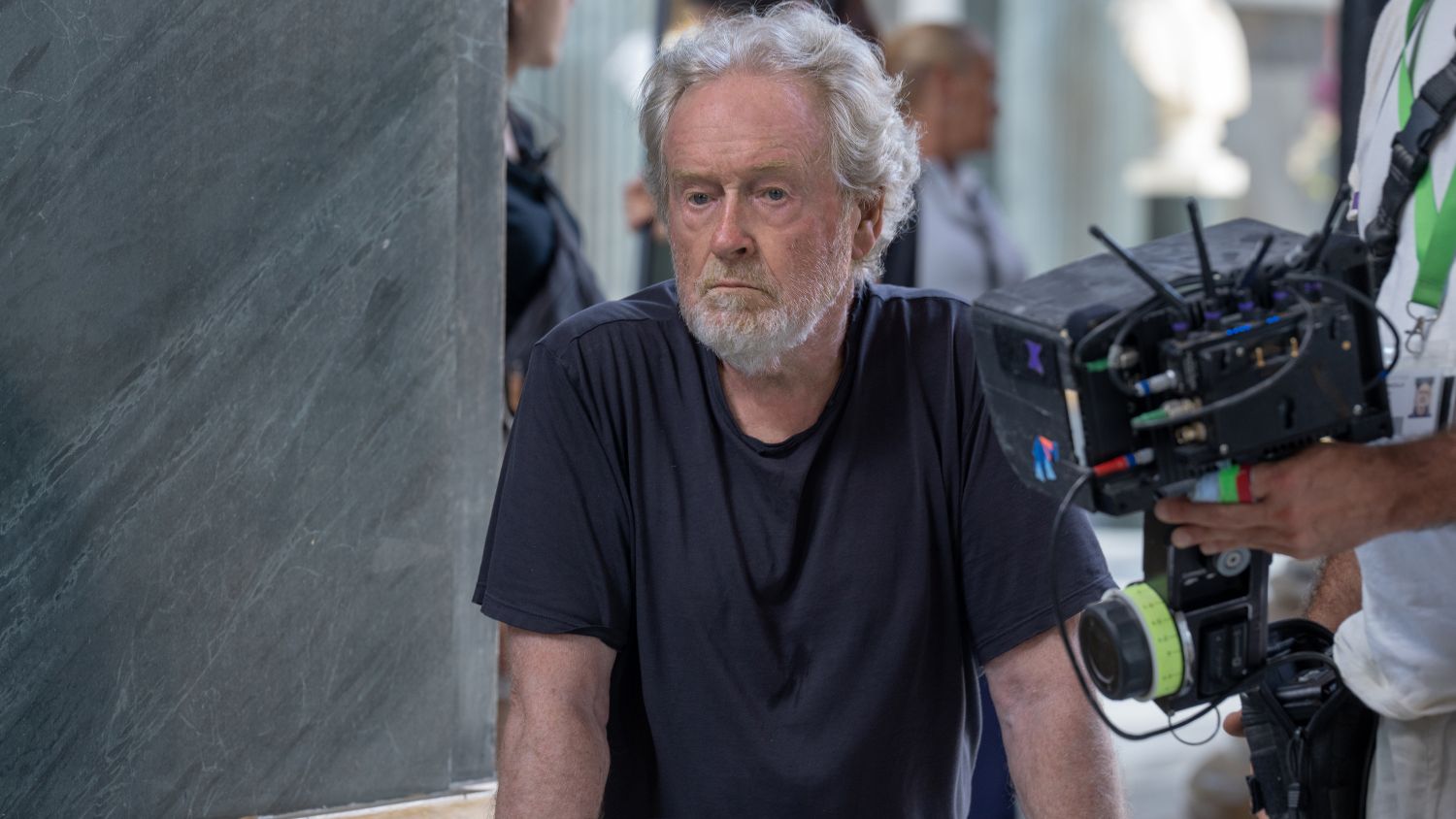
What were the biggest challenges of making a sequel to Gladiator?
“One of the problems is producing a film that delivers on the expectation of a film that was initially so successful. The way we found to do that was to continue the spiritual thread that ran through the first movie, and that now continues in this one. Despite all the action, we pulled that spiritual thread through into this movie – and I think it’s very powerful.”
You mention how beloved the original is. Was there a part of you that was concerned by the pressure of following it up?
“No. I embrace stress. Don’t do my job if you can’t take stress. It keeps the tubes flowing, so I embrace it. It definitely was a challenge, but it’s challenges like that that make my job interesting! I wasn’t going to be scared by it. I was going to go military on it. And I knew that the original film was still very much alive. That’s the funny thing with the bloody TV. I can flick on and catch what I did 20 or 30 years ago. And the rest. So, this had ticked away in my head. ‘What happened next?’ It’s how it happens for me. I lie in bed at night and an idea will pop into my head, and I have to get up and write it down. I can’t help it.”
You’ve said you regretted not directing the sequels to Alien and Blade Runner. Did you feel it had to be you, and you alone, who made this sequel?
“I guess I did feel quite proprietary on this. I worked hard on it at the script stage, did a lot of the footprint with the writer. The footprint becomes really important, because after that, you’re fleshing out that footprint with the characters and dialogue. You have to have that skeleton first – and it has to be right! So, I tend to work with various people on the skeleton first. What I do still is good old-fashioned shit. We shot this in 51 days because I’m boarding as I’m talking. I’m drawing a very sophisticated comic strip. I’m filming on paper: shots, locations, violence. Then I take those boards to the relevant parties. By doing that, it helps the writer to look at them and go, ‘Oh, I see you, Ridley’.”
To be clear, you shot this movie in just 51 days? That’s crazy…
“You’ve just got to know where to put it [the camera]. If you don’t, don’t try it. By doing the boards, I’ve already got in my head where all the cameras are going to go. When you walk in in the morning, with 900 personnel needing to know what you need them to do, you better know what you’re going to do. You can’t stand there and say, ‘Let’s chat about this…’ You just can’t do that. That’s why I’m usually shooting the first shot by 9am, not lunchtime. When that happens on film sets, there’s been too much talking.”
Where does this film, and the original, sit on your filmography, do you think?
“When it comes to the actual day to day of doing of it, this is the biggest movie I’ve ever done. I think it might be the culmination of all my experience. In terms of what I’m doing, but also in terms of the audience reaction. Gladiator has had a longevity. And I think that’s because of its emotional weight, added to the violence and the themes of mortality, or immortality. On the first Gladiator, that was my tack: immortality. I got to shoot Heaven, which became one of the most important tasks I’ve ever had. I shot it in Tuscany. Tuscany was Heaven, which is about right.”
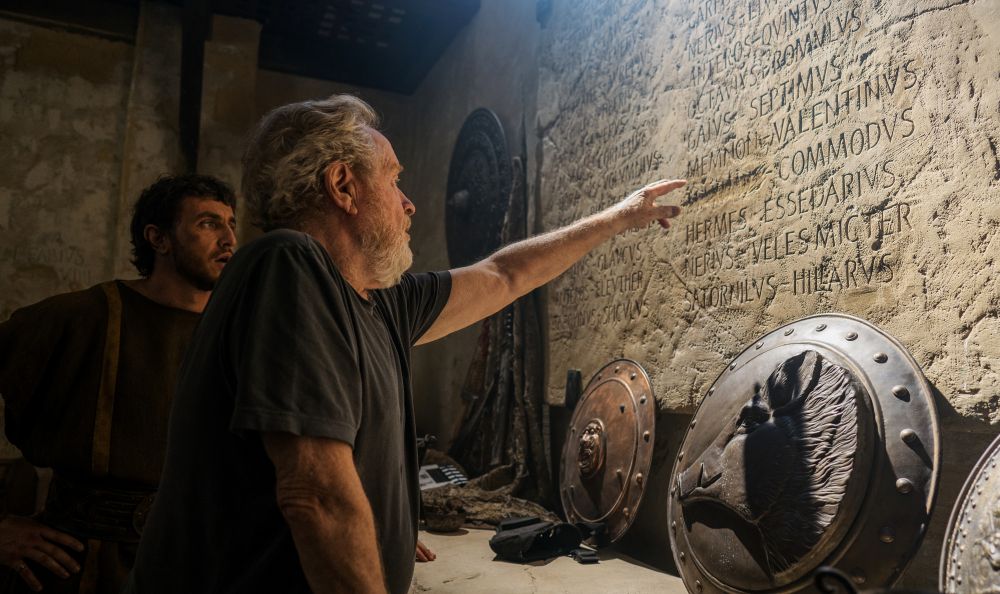
Tuscany was Heaven in the first movie but is it right that Iceland became your purgatory on this one?
“Yes, when I visited Iceland, that’s when I saw what purgatory could look like [for the sequence in Gladiator II, on the River Styx]. It just felt like purgatory, the sea and sky were iron-grey, the beach all black pebble. That image stuck in my mind and became the first image I had for this movie. In the film, it’s the sequence when Lucius realises that he’s lost his woman, lost his wife. That’s why we meet them early on. There’s not much said. They’re in the garden [in Numidia]. She says, ‘Be gentle’. They kiss. Then there are warning trumpets as the Roman fleet arrives to raid North Africa. They are introduced taking a territory, just for the sake of it. Why take it? It’s what the Romans did. They took places just to take them, to take prisoners, which would then comprise slaves and fighters. So, we have, really, three minutes to bond these two, for the audience to feel something, so that when he wakes up [in his dreams] at the River Styx he is agonised, because he’s lost her. The River Styx is where it all started.”
The opening siege on Numidia is the first of many extraordinary sequences in Gladiator II. Which was the most challenging?
“It was that opening sequence. The sea siege on Numidia was very challenging because we shot it in the middle of the desert! All that sea was sand. I built three full-scale boats with guys rowing inside. A hundred feet long and three stories high, troops on the deck, all designed exactly like the Roman ships were. Then, through ILM, who did a fantastic job, you make it 50 ships. Then they apply all their magic and apply many more ships and people – and, of course, the water. I love that sequence. It looks like a painting. Making this film was one of those moments when you realise that filmmaking is the best train set a boy could ever have.”
A key sequence in Gladiator II also puts actual sharks in the Colosseum. Where did that concept come from?
“In development, you go through the shopping list of what occurred, historically, in the Colosseum. And there are a lot of things to choose from. I knew they did used to flood the arena and had sea battles in there, and I knew they used to put eels in there, so if you fell in, a moray eel would probably go for you. Think about what they achieved. If you can build the fucking Colosseum, you can put sea creatures into it too. And, by the way, we built our Colosseum full-scale, about 60 percent of it. Full-scale!”
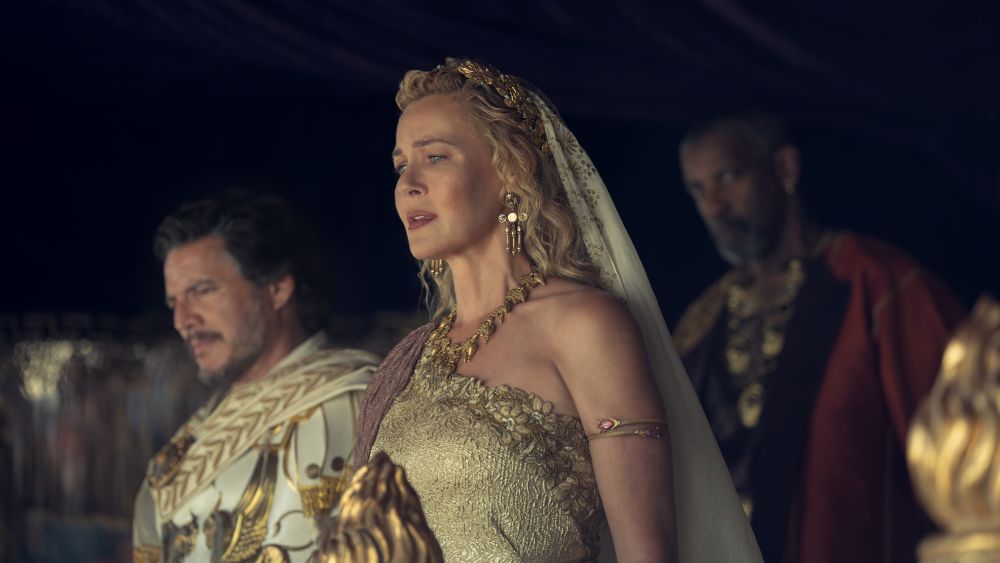
Connie Nielsen has said she felt very emotional, being back in the Colosseum for this movie. Did you?
“Emotional? Probably not. But excited? Hell, yes! Having Connie back was lovely because it was great to have a survivor from the first movie, 14 or so years on. It works out perfectly. And for me, to be back in there with all the guys and all the gear and all the leather and all that shit was great! Eleven cameras, we had. Eleven! You have to be so fast and proficient. I’d be lying if I said it wasn’t a thrill.”
You’ve said Paul Mescal reminded you of a young Richard Harris, which is handy, given his character’s lineage in the movie, right? [Mescal’s Lucius is the grandson of Marcus Aurelius’, played by Harris in the original Gladiator.]
“Yes, he absolutely reminded me of a young Richard Harris. He’s got his profile, he really has. And he reminded me of a young Albert Finney. There’s a boyish thing that Finney had, in films like [1960’s] Saturday Night and Sunday Morning. A freshness and a mischievous quality. Finney had it, Paul has it. He also has a theatrical background, which helps. When you’re acting in the arena, just being in something of that scale, the power of voice that you must deliver is one that very much comes from theatre.”
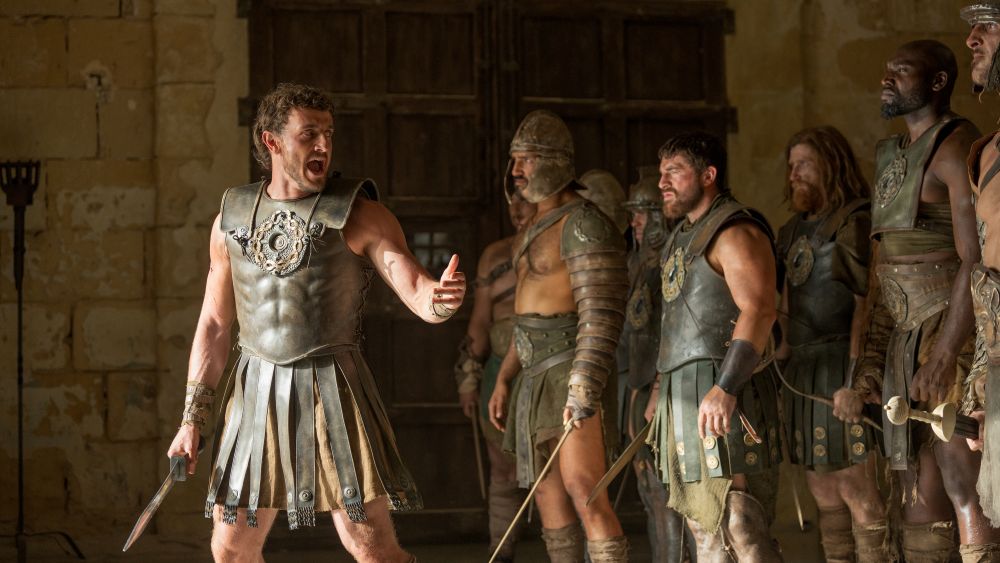
How would you describe Paul’s performance in Gladiator II? How does it compare to Russell Crowe’s in the original?
“They’re both top class. It’s that simple. If you think of actors on a scale of, say, 20 points, very few have all 20 points. Some have 10, some eight, some nine. Some even have 15. And I will say that Russell and Paul both hit 20 points on everything they can do, including violence. They’re both naturally talented, physical actors, as well as great voice actors. They both have a very unusual talent.”
Paul says you cast him after only a very brief Zoom meeting. Is that right?
“Yes. That’s what I’m like as a director, and it’s why being an agent for me is impossible. Because I’ve got no plan [when it comes to casting my movies]. I’m a bit like a child in a playpen saying I like that red ball, or that green toy. I will go for what immediately appeals to me. It’s how I work. I think I tend to get attracted to an actor before I even watch one of their videos. I’ll have him or her in mind already because I watch everything. I’ve always watched a lot of stuff because I always need a bedtime story. I’ll go to bed and come across something that normally I wouldn’t have watched. In Paul’s case, it was called Normal People [the 2020 mini-series in which Mescal starred opposite Daisy Edgar-Jones]. Not normally my cup of tea. But I saw this guy, then binged the whole series. And this was when I didn’t know who Lucius would be. So, Paul was always at the forefront, having seen what he could do. There really never was another Lucius. That role is a very complex one. So complex that there really aren’t many people with the range to navigate its many nuances. Paul can.”
Another magnificent performance in Gladiator II is Denzel Washington’s, as Macrinus. Where did that character come from?
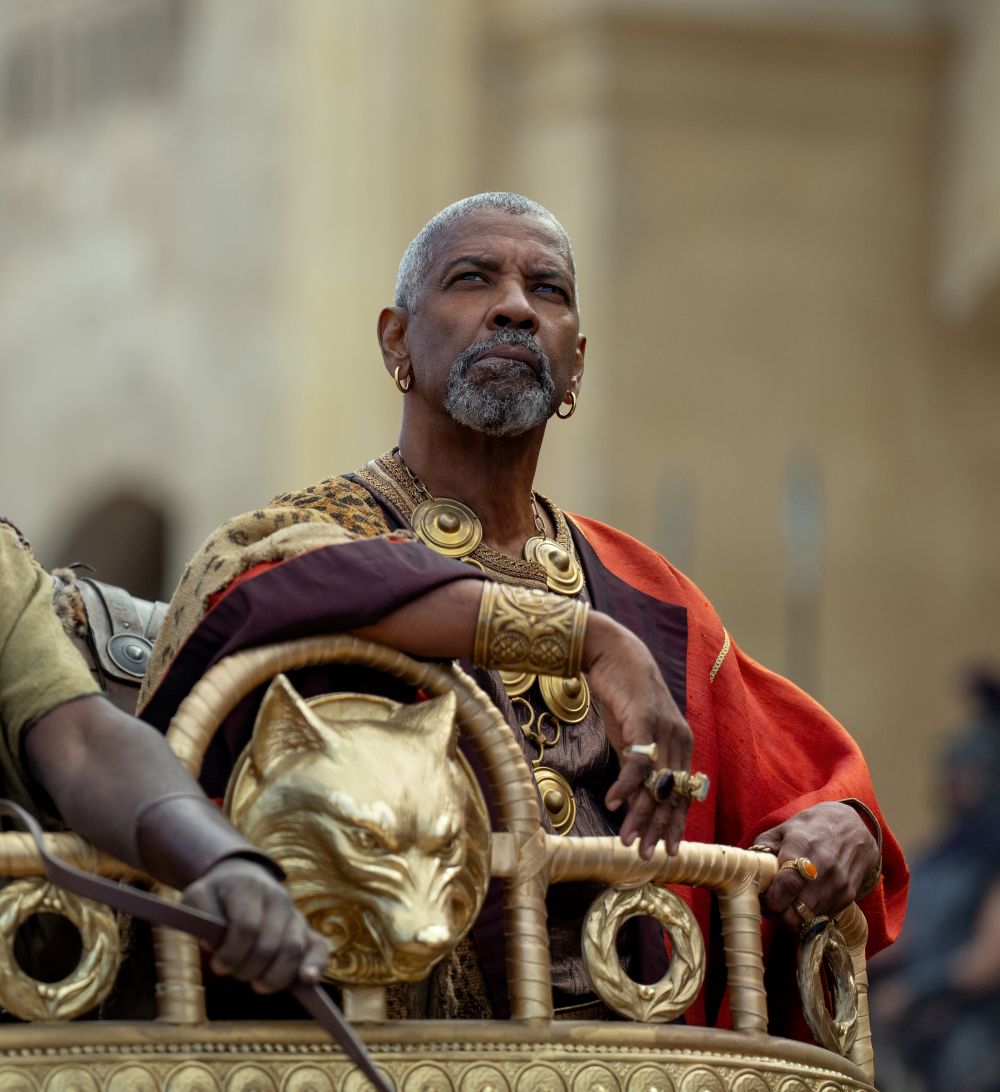
“My idea with the Denzel character was to base him on the paintings by [the French painter and sculptor] Jean-Leon Gerome, which had beautiful oil-on-canvas colours and costumes. That was what informed him.”
What did Denzel say when you showed him those paintings?
“He didn’t love the beards. But he loved all the silver, the whole nine yards. The rule with Macrinus was to make him a very wealthy, but dangerous-looking artisan. Sitting with Denzel, we discovered he had probably been a prisoner of war – out of Africa somewhere. And he had earned his right to be a free man in the arena. So, he’s tough. And then, through that, he gets into the life and eventually starts supplying things for the Roman armies: food, olives, bread, wine, and foundry weapons. Suddenly, this guy’s an arms dealer. And now that he’s rich, he’s thinking, ‘Why can’t I have a seat in the room with all these wankers? They don’t know what the fuck they’re doing! I can take all this over’.”
What has to inspire you to make a movie? Why make this one?
“I’m very fortunate to be my age and still be functioning as well as I am. It’s partly because I’ve looked after myself – although I’ve ruined my knees with too much tennis – and partly because I love doing what I do. I think Gladiator II is one of the best things I’ve ever made. Maybe the best.”
Gladiator II is new to Buy or Rent on Digital from December 27
