



by Gill Pringle
Max Schreck’s performance as the vampire Count Orlok in 1922 movie Nosferatu has haunted Robert Eggers since childhood, prompting the fledgling filmmaker to direct a version of the film while still in high school.
“I did a play of Nosferatu that I directed with my close friend Ashley Kelly Tata, that was black and white on stage, black and white makeup, black and white sets,” recalls Eggers, 41.
“And this gentleman, who owned a cool local theater in New Hampshire – the theater that was doing John Webster and Sam Shepard and not Rodgers and Hammerstein – saw this play of ours and asked us to do a more professional version of it in his theater. And this totally changed my life. It cemented that I wanted to be a director and, even if I never had made Nosferatu, Nosferatu is still a large part of my identity as someone who is making creative work because of that experience,” says the filmmaker whose early fascination with the supernatural would lead him on a path to make gothic horror films The Northman, The Witch and The Lighthouse.

“Max Schreck’s performance and his makeup really struck me and was so compelling, as well as the haunting atmosphere and the way that director F.W. Murnau and his screenwriter Henrik Galeen turned the Stoker story into a very simple and enigmatic fairy tale.
“In many ways, my adaptation of Nosferatu is my most personal film. A story, not engendered by me, but one that I have lived with, within, and dreamed about since childhood. I often felt that I had the same un-jaded creative spark of a first time filmmaker when finally making the film because of the years of thought I have put into it. And I feel more fortunate than ever to have had the chance to make it with my trusted team of long-time collaborators,” he says of his creative team which, of course, includes Willem Dafoe in the role of controversial scientist Professor Albin Eberhart Von Franz, an expert in the occult and mysticism.
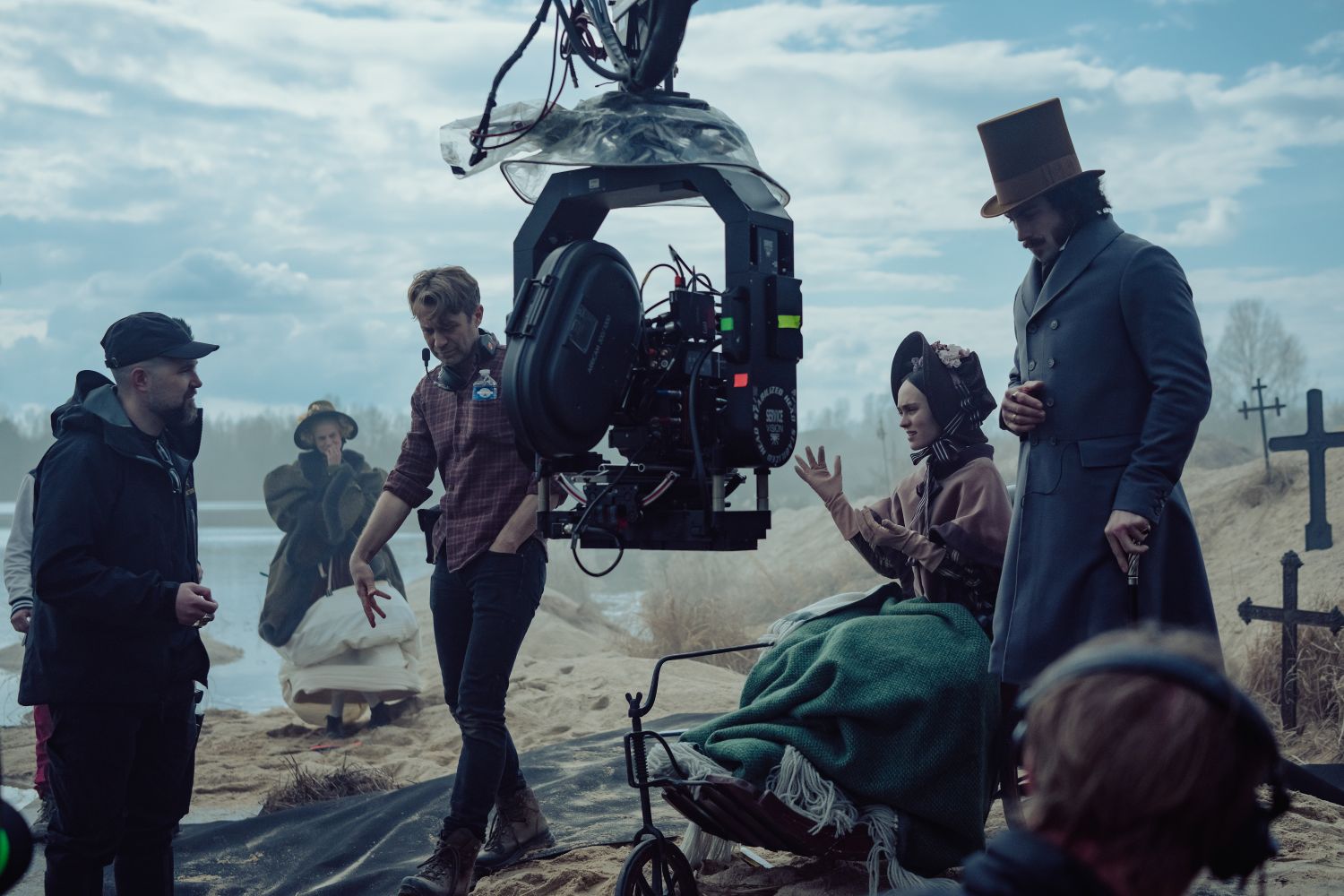
Having worked with Anya Taylor-Joy in The Witch and The Northman, with Nosferatu he finds a new muse in Lily-Rose Depp, casting her in the pivotal role of Ellen, the new bride of Nicholas Hoult’s Thomas Hutter.
“It’s crazy, because Ellen is in pretty much every version, whether she’s the long lost love or whether she just has a beautiful throat, as Max Schrek says. But, in the Murnau film, he’s going there for Ellen and it merges into Ellen’s story by the end of the film.
“So, I thought: ‘what if it’s her story from the very beginning?’ One of the things that immediately got me thinking was that Ellen is described as a somnambulist in the film, and we see her sleepwalk. But someone who sleepwalks today doesn’t mean much. It means, trying to get treatment to sleep.
“But in this period, it was thought that people who were somnambulists were able to tune into another realm; the spirit realm, the dark realm, and different astral planes. That was really exciting, because then I got to explore her ‘hysteria’ and her melancholy, and the ways in which she’s this isolated figure who doesn’t fit into 19th century society and no one understands her.
“And she has a very loving relationship with her husband, but he can’t see this other side of her, and the one person that she does find a connection with – who can understand this other side of her – is, unfortunately, a demon, a vampire. I think that it makes for a very tragic and, hopefully, interesting love triangle,” says Eggers, who directed Bill Skarsgard into his own creepy version of Count Orlok.

If Orlok sends the townsfolk into a frenzy, then Dafoe’s Professor Von Franz is alone in making the connection between Ellen and Orlok. “He is the only character who truly understands the strange psychic connection between them. It is embedded with many of my own memories and personal experiences amplified and transposed to 1830s Baltic Germany. It took time to get there, to understand the fascination. Of course, it was the image and performance of Max Schreck that haunted me as a kid. There was something essential about the mysterious vampire and the simple fairytale of Nosferatu,” says the director.
 Depp, 25, was thrilled when Eggers outlined his story to her, explaining how she would not merely be a damsel in distress. “Something that I think is really beautiful about Rob’s decision to tell the story from her perspective, is that it feels like the intention isn’t just to give a new twist to the story, or modernise it just for the sake of doing that, but it actually serves the purpose of really deepening the story, because when you see it from her perspective, there are so many more layers to it,” says the daughter of Johnny Depp and Vanessa Paradis.
“And it offers so many more layers to all of the characters, because it’s not just this demonic force that’s hell bent on killing everyone in sight. There’s a carnal, lustful, complex and quite human desire there from the vampire side and then also, from this young girl’s side, you see this yearning, which I think makes it much more scary and complicated, and speaks to so many larger themes.”
She hopes that audiences will make their own interpretations. “Rob has said that he doesn’t make movies with messages necessarily attached to them, which I think is very cool because it allows space for everyone – be it, the people making it, or the people watching it – to attach their own meanings to it.
“Something I was thinking about a lot when I was constructing the character emotionally, is that she’s dealing with an internal war in a lot of ways, like dealing with accepting aspects of herself that, the society she’s living in, has no room for; that the people around her can’t understand, that she feels a lot of shame about, and that isolates her a lot.
“I think in a lot of ways, for her, it’s the battle within as well as the battle externally, coming to terms with a darkness within herself that I think has always been there, and that she’s desperately trying to suppress in a way. In the end, something that’s beautiful about Ellen’s relationship with Von Franz is that he gives her the opportunity to do a good deed with this part of her that I think she’s always felt. I think it speaks to the larger question of human beings just accepting things within yourself, that are hard to accept, or that you don’t want,” she says.
If the Nosferatu legend is typically all doom and gloom, then Eggers adds improbable laughs courtesy of Dafoe’s Von Franz and Aaron Taylor-Johnson’s Friedrich Harding. “Von Franz enjoys his work, so there’s a delight in it, which helps with the humour. But both Willem and Aaron, who contribute 97% of the comedy in the film, play it straight. It doesn’t work if you try to play it for humour in this context. But I like super depressing art house movies that make you want to not leave your house for two weeks and I’d like to make another one like that, but this was intended for a broad audience, and so you need to sometimes let the steam out of the tension with a little bit of humour,” says Eggers.

Already a fan of Eggers’ work, Dafoe is only happy to do his bidding. “I’m there to make manifest what he sees. That’s my job and that’s what I want to do. And I have an interest in the things that he’s interested in. He gives me wonderful things to do, and feeds me all this research that turns me on and makes me learn things, and it opens me up and opens the door for applying myself to the pretending. And he makes a beautiful complete world that really tells you what to do. That’s a wonderful place to be for an actor, and every time that I’ve worked with him, he always does that. So when he calls, I come running,” Dafoe says.
Nosferatu is in cinemas 1 January 2025
