



by Lewis Khan
For decades the job of a film producer was clear.
Find a script. Raise the money. Get the film made.
That was the finish line.
If the film worked, everyone celebrated. If it didn’t, the industry moved on and the producer started again.
But something uncomfortable has happened over the past decade.
Getting the film made is no longer the hard part. The hard part is making the film matter once it exists.
Look at the independent film landscape right now. More films are being completed than ever before. Funding pathways still exist. Production pipelines still function.
Every year, talented producers assemble the pieces and deliver finished work. And yet, a huge number of those films arrive quietly and disappear just as quickly.
Not because the filmmaking is weak. Because nothing structural exists around the film to help it survive.
The industry still talks about “getting films up.” That language belongs to another era, a time when theatrical release windows were longer, attention was less fragmented, and the simple act of making something created its own gravity.
That world is gone. Today, a film enters an environment saturated with content, shrinking cinema screens, algorithm-driven discovery and audiences overwhelmed by choice.
Attention has become the scarcest resource in the film industry. And attention rarely gathers around a single film anymore; it gathers around worlds, characters and ideas that people can return to.
In that landscape, a completed film is not an asset by default.
It’s a starting point.
Which means the role of the producer is quietly evolving.
Across Australia, producers are realising that getting a film made is only half the job. The more difficult task is designing the conditions that allow the film to live once it’s released.
The most effective producers aren’t simply delivering projects anymore. They’re designing the structure that allows those projects to endure.
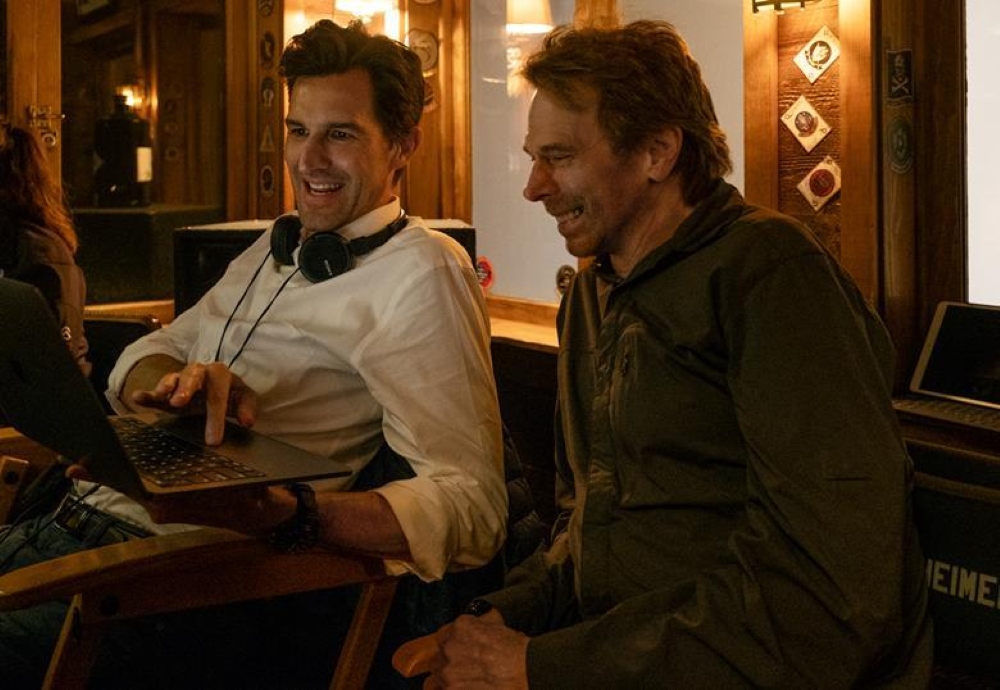
In other words, they’re thinking like architects [pictured – architecture graduate Joseph Kosinski, now a producer and directing Top Gun Maverick and F1 with uber producer Jerry Bruckheimer].
Architecture isn’t just about constructing a building. It’s about designing something that people move through, return to and build upon over time.
Producing is moving in that direction. The film is no longer the entire project.
It’s the foundation.
What matters increasingly is what surrounds it.
Audience.
Story world.
Community.
Cultural identity.
Future instalments.
These used to sit in the marketing column. Increasingly, they are part of the producing strategy itself.
The reason is simple: a single film, standing alone, is a fragile asset.
Investors know it. Distributors know it too. One release window, one marketing cycle, one opportunity to capture audience attention.
But when a film exists inside a larger structure, a recognisable character, a cultural conversation, a world audiences want to return to, the risk profile changes. The project develops a longer life and a wider set of possibilities.
Horror producers recognised this earlier than most.
They have long recognised that a film can function as an entry point into something larger. A character becomes a cultural figure. A mythology expands across sequels. Fans participate in the story long after the credits roll.
You can see it in the afterlife of The Babadook. Jennifer Kent’s 2014 film was never designed as a franchise machine, yet the character escaped the film and entered culture in unexpected ways. The Babadook became a meme, a symbol and an unlikely icon online. Suddenly, a small Australian horror film had a cultural footprint far larger than its production scale suggested.
That wasn’t traditional marketing.
It was cultural momentum.
The opportunity for producers today is recognising that momentum and building around it when it appears.
Because the uncomfortable truth is this: the old definition of producing is no longer enough.
Getting the film made still matters.
But it’s only half the job.
The producers shaping the future of the industry are doing something slightly different. They are building the audience alongside the project. They are thinking about the long tail of the idea before the cameras roll. They are treating each film as the foundation of something that might continue.
That requires a different mindset.
Less project management.
More structural thinking.
Less focus on the single release moment.
More attention to what the story becomes over time.
In that sense, the producer is no longer just a facilitator of production.
They are the designer of the ecosystem around it.
That might sound like a subtle shift.
But it changes almost everything about how films are conceived, financed and released.
The producer hasn’t disappeared. The role has simply grown into something larger.
The producer is becoming the architect.
Lewis Khan is a producer based in Sydney
