


John Noonan
British producer Neil Edwards has been in the TV game for over 20 years, working on numerous series including Born To Kill?, a true crime show on which he also directs. Sympathy for the Devil is his first feature length documentary and recounts the history and impact of The Process Church of the Final Judgement, a splinter group of Scientology, who became big in the ‘60s and beyond.
When did you first hear about the Process? “I make a serial killing documentary series over here [Born to Kill?] that goes around the world. As part of that, I was interviewing a true crime writer who had had contact with the Manson family. They’d wanted him to write their story on their terms. And I said, ‘weren’t you frightened by them?’ I mean, for all the hype around the Manson family, they still did some pretty scary shit. And he said, ‘No, I was never scared of them. But I tell you what really freaked me out. It was The Process. With their dark robes and German shepherds, they scared the shit out of me.’ I thought, ‘Bloody hell! Who are these people?’
“I’d been interested in the ‘60s since I was a teenager and knew quite lot about all the commune movements, the Morning Star Ranch, and all that. [The Process had] just not been on my radar. Maybe because they’d become so secretive. So when I started digging, I found what I thought was an amazing story.”
When you approached members of The Process, were they hesitant? Did they think you were looking to sensationalise them? “Absolutely. I think that was their number one concern. It took some coaxing. Essentially once you’ve convinced one who’s got a friend, then they kind of vouch for you and it was passed along like that. But yes, it did take a lot of nurturing. And I’m not really surprised. I think they just thought, ‘Here comes a guy who is going to do exactly the same as what everyone else has done.’
“One of the kind of characteristics they had was that they felt they could intuit what people were doing, and were telepathic. And I think they very quickly decided that I was a decent enough chap. Also, these are the kind of people who take great leaps, as they did back then. Once they decided I was okay, they were like, ‘Let’s go for it.’ And I didn’t find any of them shifty or hesitant once they committed.”
You were really trying to focus on them as people rather than a collective? “Yeah, I think what’s kind of special about them is although they were a cult – and I don’t think any of them would deny that – they were all very strong individuals. I think they are very charismatic and bright people. Perhaps not the people you would associate with a cult. Although they obviously had very powerful leaders that they looked up to, I think they were also very strong in their own right. Which is why I think they kept going for so long.”

And back then, they would have been seen as just a phase, an antithesis to the flower power of the ‘60s… “Yeah, I think a lot of them still hold those ideals close; some of the theories they learnt early on. I don’t know whether it’s good or bad, but they certainly still believe in some of that stuff. I did shove all the ‘outsider view’ right up early [in the film] because that’s the starting point for lots of people. That was certainly the starting point for me. Who are these people? Who are these bizarre illuminati? And then the film plays out as a very human story.
“Imagine being in London in ‘67. Imagine how cool that would be and what people were up to. I mean, people were up to some very interesting things and The Process were one of those groups that were pushing the boundaries. I think that period, ‘67-68, is probably their legacy. The publications they were putting out at that time, the really provocative stuff, that came back to bite them. By the early ‘70s, [The Process] was a much more churchlike community. They still had this unity of Christ and Satan thing going on, but the publications were far less provocative by then.
“However, some of the stuff, like the sex magazine, which came out in ‘68, was quoted from in all those conspiracy theory books because it is a very strong read. Much of those magazines are slightly taken out of context though. They’d have the viewpoint of Satan, the viewpoint of Lucifer, the viewpoint of Jehovah and, of course, the only bits people want to quote from is the viewpoint of Satan.”
What do you think was so enticing about The Process? You touched upon the fact that everyone was doing something against the norm. So, was it because they were so provocative? “I think it’s a combination of things. The way they dressed, the way they presented themselves, the magazines, was almost like a pop group. A spiritual pop group. I think that was incredibly enticing. There were profiles, just like you would get with The Beatles. He’s the quiet one, he’s the intelligent one. He’s the satanic one, he’s the Luciferian one. Combined with the uniforms, which were de riguer for pop groups in the ‘60s, I think that, which might seem trivial, was seductive to people.
“Another thing that’s seductive is the rituals. I’ve read accounts by former members, who didn’t want to be in the film, of their initiations into the group, which are really fun. (Laughs) They’re so atmospheric with the candle lit rooms, the robes and all that. It must have felt amazing
“And we all want to feel special don’t we? We all like to feel different. Just as I was once a Mod and other people were Punks, I think there’s an element of setting yourself apart from the crowd. And these people felt extra special, because they felt they were actually God’s chosen people and were the ones that were going to survive the apocalypse. Who wouldn’t want to feel like that? How amazing would that be to sit on the bus and think, ‘you know what? All these other people are going to burn and I’m safe, because God has chosen me.’”
Do you think anything like The Process could happen now? Right now people are talking about how social media has influenced things like the election in America? Could The Process rise again on Twitter? “I think some people are trying to do that. There is a kind of online Process. I don’t think you could call it The Process at all because you can’t run something like that remotely from a computer. It kind of goes against what it’s about.
“In the wider picture of cults, and intense beliefs, and total zealousness, we’re seeing it now. We’re seeing it with groups like ISIS. And I’m in no way comparing The Process to ISIS, like some people have in terms of how far these things can go. But I think with social media… Something I’ve had personal experience with in my family is the cult of Anorexia and how the socialisation element, the peer pressure element that is very, very important in cults, has come into play with the rise of more and more anorexic people. I think so many of the social and psychological triggers are universal for joining groups like this and getting deeper and deeper into them. And that’s not to suggest [Anorexia] is not an illness. It absolutely is!”
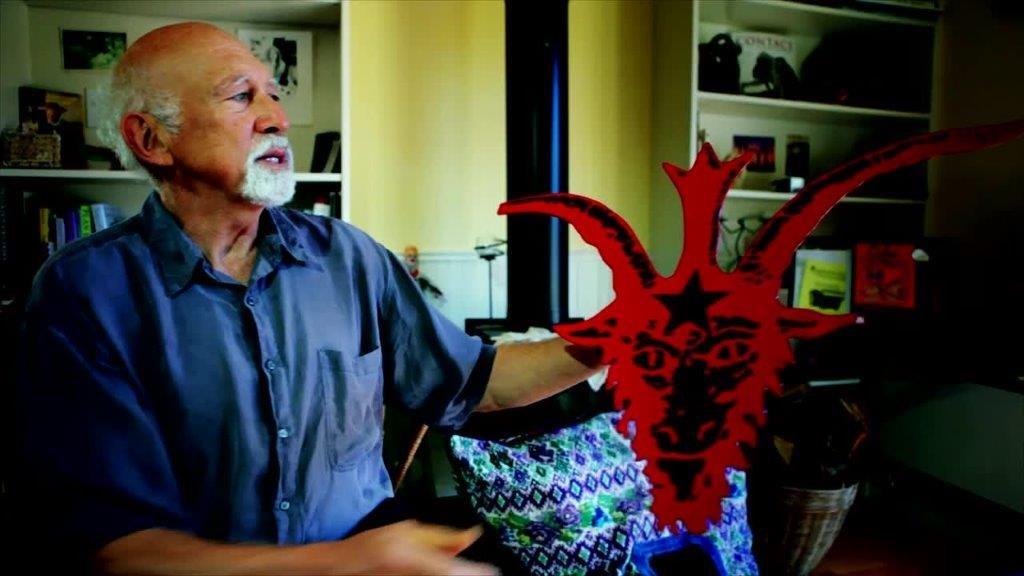
You directed, wrote, produced and edited the film, as well as wrote original music for it. It’s obviously a very personal project. “Yeah, you’re absolutely right. When I originally started off, I just wanted to tell the story and meet the people. Then the deeper I got into it, the more I wanted to protect it. That desire to not sensationalise the story in a certain way, and to keep the costs down, all played into that (pauses) megalomania element. (Laughs)”
Do you have any other stories on the horizon? “I will do something else. Although I’ve been in television for 20 years, this was the first feature doc I’ve done. I’ve absolutely had a ball screening it, and meeting people, and I’m really happy I did it. So I’ll definitely be doing something else.”
And at the end of the day, what has been the reaction to the film from members of The Process? “All the people that are in it have seen it and are really complimentary. I’ve had people turn up at various screenings, and they come over at the end and say… Well, one comment was ‘Thank you for not being an arsehole.’ (laughs) So, they’ve gone in fearful and come out very complimentary. I mean, it’s a sensational story, but not a sensationalised story. Those members of The Process who have seen it give it the thumbs up. Those who haven’t are probably still sceptical.”
