

by Gill Pringle
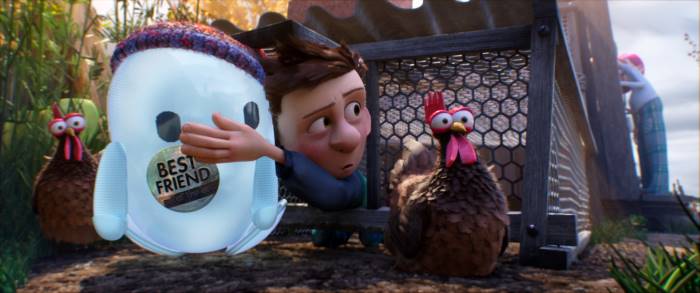
The last in his class to obtain this hot new device, unfortunately Barney’s new “Best Friend” malfunctions making him more of an outsider than ever.

In a world dominated by online relationships, Locksmith hopes that this poignant but funny story strikes a chord with children and adults alike as it addresses the fundamentals of friendship and how being an authentic version of yourself is more valuable than having the latest cool device.
“This film has an important message that both parents and children will understand,” says producer Julie Lockhart. “The amount of time a kid spends on screen and the worry that it causes parents, and the family as a whole, is something everyone can appreciate and, of course, it just looks beautiful on the big screen.”
Adds co-director/co-writer/executive producer Sarah Smith: “People today are living through chat, posts and likes/dislikes, but the dorky, contrarian, hilarious friendship of Barney and Ron – built through shared experience – is a powerful reminder of the best things about growing up.
“Children have had their fill of screens because almost all their relationships have been reduced to onscreen. I think the appeal of a one-on-one, face-to-face human friendship is really strong right now, especially for children. They want to get outside and play in the woods and play with their friends in the way you see Barney and Ron doing. The sitting at home with your screen is kind of counterbalanced, so hopefully that gives it an extra relevance,” says Smith.
Directed by Smith and Jean-Philippe Vine, Ron’s Gone Wrong features an eclectic ensemble voice cast including Zach Galifianakis (Ron), Jack Dylan Grazer (Barney), Ed Helms and Olivia Colman.
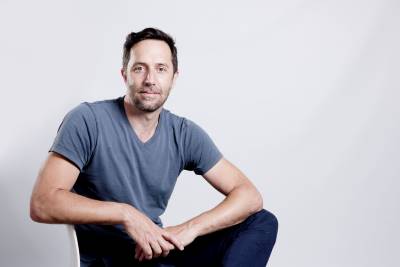
FilmInk talks tech with Ron’s Gone Wrong co-director Jean-Philippe Vine.
What is message that children can learn from Ron’s Gone Wrong?
“As filmmakers, it was really important to us that the audience understand that everyone has insecurities. We talked about the whole technology thing, which comes with a number of issues all on its own, and loneliness, or how we are tribal with technology… But the thing that hits me the most is the sense that Barney is all wound-up about being a kid on the sidelines, and by the end of the film he is totally comfortable with who he is. We’re all parents who made this movie and we’re all blundering our ways through parenthood and it’s really hard to set boundaries for our children. But what we were trying to do was tell a story that could resonate with kids and with parents and to do that it has to have this universal emotional hook to it which – in this case – is the feeling of being an outsider. And Barney really is an outsider in his head. He doesn’t know that he’s an awesome kid and it’s gotten really worse in our movie because every kid now has this incredible device and he’s the one kid in town that doesn’t have one. And then when his dreams finally come true, of course he gets a completely dysfunctional broken robot. So really, the heart of our story is the relationship that they build together and, through the process, Ron challenges Barney about what friendship is and it becomes this relationship of equals.
“I hope the audience take away is to embrace friendship in a way that is about the messiness of who we are. It’s about the things that we hide as much as the things that we share and it’s about having mutual trust and affection for one another.”
 What are your personal feelings about today’s technologically driven world?
“The world today is fully saturated in technology and it has become a necessity in our lives, so our film really takes a look at what that means for the world of friendship. Ron and Barney are an unlikely pair of buddies, completely different, but through the course of the movie that build a powerful bond that becomes incredibly fulfilling for each of them. The film is a celebration of friendship, especially the messy ones!”
You previously worked on Pixar films Cars 3, Inside Out and The Good Dinosaur. Do you think Ron’s Gone Wrong has the potential to become a classic?
“Yes, I just thought it was a really powerful and simple story that kind of got to the heart of what it’s like to be a kid and also a parent in this particular technological age. It just felt like it had the makings of a classic.”
Ron’s Gone Wrong addresses how social media today effects increasingly younger kids, making a negative impact. The film’s release coincides with the recent shocking whistleblower revelations from former Facebook product manager Frances Haugen. Were you pleased by this happy coincidence?
“Yeah, I can’t help being secretly pleased. A lot of what we’re trying to do in this film is talk about what’s behind the tech and social media that we use every day and what’s our relationship to it and especially, how does it impact young people who are immersed in that universe now. It was really important to tell a story that was kind of an adjustment and points to healthy ways to look at friendship and how we see ourselves.”
How did you decide upon the look and feel of the animation and the characters?
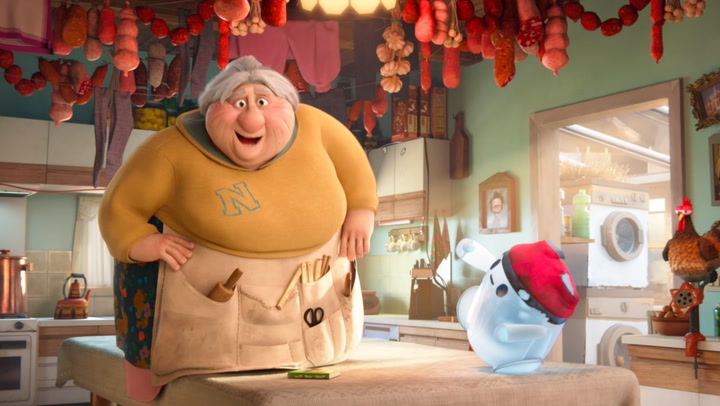
“One of the big things was we wanted this world to feel gently stylised, but actually really plausible because we’re trying to tell a story that communicates to kids figuring real lives out. It’s a coming of age story in the era of social media, so our design and animation style is definitely heightened, there’s all that comedy rhythm and timing that we love. But at the same time, our characters are designed in a way that supports who they are and their emotional arc. And Donka [voiced by Olivia Colman] is like a force of nature and full of love, and you just want to hug her. So, we designed her with that kind of lovely strength. Good design has got to be character and story driven.”
Talk about the creative process behind the design of Ron, the robot?
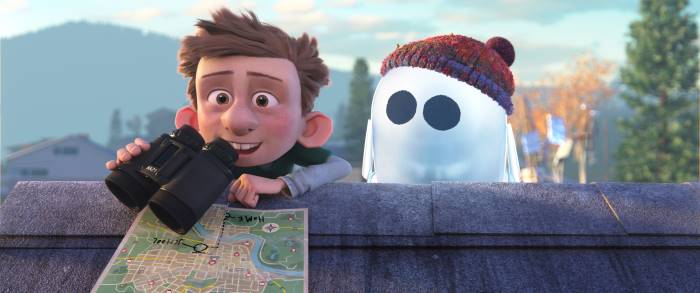
“From the get go, we wanted for Ron to be super simple and appealing and almost as if we stole the best designers from Apple to make this thing. But it had to do so many things. It had to kind of move around on wheels and be able to go up and down stairs, which I don’t think any robot has figured out yet. But it also had this 360 screen, like a walking, talking iPad, and that was really cool because with that screen, we could design each Bot to have a different persona. So, it has all kinds of tribes in our movie, whatever you’re into, Death Metal or Daft Punk or gaming, you’d have a really cool robot kind of persona, but it almost killed our rigging crew because they had to rig all these extra characters to actually create so many different kinds of robots.”
What is your future predictions for technology? Are the robots going to take over like in Terminator or I, Robot?!
“I’m just a cartoonist! But what’s really interesting is that I personally use Alexa as a personal assistant all the time and I appreciate how seamless the process is and how easy it makes my life, but there’s a definite sense that the reason it is so seamless is that it knows quite a lot about me and a lot of the information that I’m willingly yielding about my life is very useful to big tech so, in terms of predictions, I think it’s going to become more and more human-like and our job will then be to define, ‘OK, what does it really mean to be human and feel human?’ And perhaps we actually take care of ourselves a bit more and potentially learn how to separate ourselves from it.”
You have a wonderful voice cast. How did you get Oscar-winning actress Olivia Colman on board in the role of Donka?
“We had her in mind but we felt like we were playing a long shot because we’re a start-up company in London (Locksmith) so we had to convince her that we had animation story-telling chops. But, thankfully, she really resonated with the story. She also comes from an amazing comedy background so, even though she’d literally just won an Oscar the weekend before she came to record with us for the first time, she was so willing to just bring this warmth and energy to Donka and just go for it.”
What did Olivia enjoy about playing Donka?
“I think she liked that Donka is a rebel essentially, and fixes everything for her family. She is feisty and fierce and will make a sausage out of all the livestock in the backyard. Olivia is a family person at heart, so she loved that. She’s also not so keen on being out in the public eye so much and, similar to Donka, Olivia is irreverent and does her own thing.”
The music really helps drive the narrative?
“Yeah, it’s a massive storytelling device that just carries the ideas even deeper, and Henry Jackman was utterly incredible to work with, a total genius. And you know, Sarah [Smith, co-director] gave him the note that this was going to be like a contemporary John Hughes. And that’s really what you feel in this soundtrack. We couldn’t be more chuffed.”
What were the particular challenges of directing a movie during lockdown?
“It sometimes felt like we were making the world’s biggest and most expensive home movie. Suddenly, over 250 crew members were working from home with production protocols that were a logistical nightmare at first. We had sound engineers, digital modelers, riggers, animators, lighting crew and more, all working from makeshift locations: basements, guest rooms, laundry rooms, and potting sheds. It’s a massive credit to our systems and production teams, the way they kept our show running in full crunch mode. It showed how amazingly creative people can be in overcoming such obstacles.”
Ron’s Gone Wrong is in cinemas now.
